Ved Prakash, MPMI Assistant Feature Editor
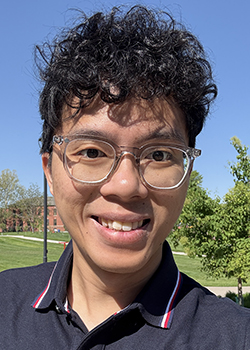
Chi Hzeng Wong is a plant virologist currently investigating viral synergistic interactions in wheat as a doctoral student at the University of Nebraska. His research journey began during his undergraduate studies in the Department of Plant Pathology at the National Chung Hsing University in Taiwan, where he developed a foundation in plant disease management. During his master’s degree program at the Graduate Institute of Biotechnology, he focused on plant virus-host interactions of Bamboo mosaic virus, identifying host proteins involved in viral infection.
Wong’s current research examines the molecular mechanisms underlying disease synergism between Wheat streak mosaic virus and Triticum mosaic virus, with particular focus on viral protein interactions that enhance pathogenicity. His work has identified specific viral determinants (P1 and NIaPro cistrons) responsible for synergistic interactions, challenging previous assumptions about viral synergism mechanisms.
Inspired by Professor Wen-Ling Deng‘s approach to connecting research with practical applications, Wong aims to translate fundamental discoveries about viral pathogenesis into strategies for protecting important food crops. Beyond wheat viruses, he maintains a fascination with Tomato yellow leaf curl virus for its remarkable evolutionary adaptability. Wong believes in balancing scientific rigor with personal well-being, emphasizing that health and human connections form the foundation of sustainable and impactful research.
1. What do you think is the most important or exciting finding from your paper?
The most important finding from our paper published in MPMI, “Plant Viral Synergism: Co-expression of P1 and NIaPro Cistrons of Wheat Streak Mosaic Virus and Triticum Mosaic Virus Is Required for Synergistic Interaction in Wheat,” is the identification of specific viral proteins responsible for the synergistic interaction between Wheat streak mosaic virus (WSMV) and Triticum mosaic virus (TriMV) in wheat. We discovered that coexpression of P1 and NIaPro cistrons of both viruses is sufficient to drive disease synergism in wheat, causing enhanced symptom severity and increased viral accumulation similar to what’s observed in natural coinfections.
What makes this finding particularly exciting is that we’ve shown this synergism isn’t caused by the suppression of host posttranscriptional gene-silencing mechanisms, as was previously thought for other viral synergistic interactions. Instead, our research suggests a novel mechanism of interaction between these viral proteins that significantly amplifies disease severity.
2. Was there a piece of data that was particularly challenging to obtain or a part of the project that was particularly difficult to achieve?
One of the most challenging aspects of this project was creating and maintaining the various viral constructs with inserted cistrons from partner viruses. Engineering WSMV with TriMV cistrons and vice versa required precise molecular techniques to ensure the stability of these foreign sequences in the viral genomes. The foreign sequences will not always stay still in the infectious clones, as expected, and some conditions might be required for stability.
3. What research project are you most excited about right now?
Based on the findings from this paper, I’m most excited about further exploring the molecular mechanisms behind the P1 and NIaPro interaction in viral synergism. I’m particularly interested in identifying the specific protein domains and motifs within these viral proteins that are responsible for the synergistic effect. Additionally, I’m eager to investigate how these viral determinants interact with host factors in wheat. Understanding these virus-host interactions could provide critical insights for developing novel resistance strategies against these economically important wheat pathogens.
4. What drew you to your current lab?
My journey in plant virology began during my second year of undergraduate studies, which established my early interest in this field. During my master’s degree program, I focused on plant virus-host interactions of Bamboo mosaic virus, working to identify host proteins involved in viral infection. This experience sparked my deeper interest in fundamental research and its practical applications in agriculture.
What drew me to my current lab was its perfect alignment with my research philosophy: applying molecular mechanistic understanding to develop resistance in crop plants. The lab’s focus on wheat viruses and their impact on field crops provides an ideal environment to pursue both fundamental questions about viral pathogenesis and translational research that can protect important food crops.
I was particularly attracted to the lab’s integrated approach, which combines molecular virology, plant pathology, and agricultural applications. The opportunity to work on economically significant pathogens like WSMV and TriMV, while utilizing advanced molecular techniques to understand their interactions, presented the perfect continuation of my academic journey from basic host-virus interactions to applied plant protection strategies.
5. How did you choose to join your current graduate program?
My path to my current graduate program was primarily guided by the opportunity to work with my advisor, who is a respected member of this program. However, my journey in plant science has been shaped by a progression of educational experiences that continually deepened my expertise in plant-pathogen interactions.
I began my academic journey in the Department of Plant Pathology at the National Chung Hsing University in Taiwan during my undergraduate studies, which established my foundation in understanding plant diseases and their management. This early exposure sparked my interest in the fascinating world of plant-microbe interactions.
For my master’s degree, I shifted to the Graduate Institute of Biotechnology, which allowed me to develop advanced molecular skills while continuing to focus on plant pathogens, particularly viruses. This interdisciplinary training proved invaluable in bridging fundamental molecular biology with applied plant pathology.
What I find most compelling about my current program is that it extends beyond studying viruses in isolation. The program’s approach encompasses broader microbiome interactions, which aligns with my growing interest in understanding how complex microbial communities influence plant health. This holistic perspective offers exciting possibilities for developing more sustainable approaches to crop protection.
6. What advice would you give to starting graduate students?
I would emphasize the critical importance of meticulous record-keeping for all experiments, regardless of their outcome. Some of my most significant breakthroughs emerged from carefully documented “failures” that later revealed important insights. These unsuccessful attempts often contain valuable clues that eventually guide you toward successful outcomes.
Staying current with scientific literature is essential in a rapidly evolving field like plant virology. I make it a habit to regularly review new publications and attend seminars to keep abreast of emerging technologies and approaches. This continuous learning has often helped me incorporate innovative methods into my research.
I would encourage new graduate students to reframe how they view experimental challenges. Rather than seeing troubleshooting as a frustration, embrace it as an integral and valuable part of the scientific learning process. Some of my most profound learning experiences came from diagnosing and solving technical problems in complex experiments.
Perhaps most importantly, foster open scientific discussions with fellow graduate students and faculty members. I’ve found tremendous value in seeking perspectives from colleagues with different backgrounds and expertise. These conversations often generate novel ideas and approaches that wouldn’t emerge when working in isolation. The collaborative nature of science is one of its greatest strengths, and building these connections early in your career can lead to both better science and a more supportive research environment.
7. Who has inspired you scientifically? Why?
Professor Wen-Ling Deng, who specializes in plant bacteriology, has been my greatest scientific inspiration. What resonates most deeply with me about her approach is how she seamlessly connects rigorous research to everyday applications. Her passion for science is matched by her commitment to sharing knowledge and directly helping people through her work. This model of conducting meaningful research that extends beyond academic publications to tangible benefits for society has profoundly shaped my own scientific aspirations.
The global pandemic offered another source of inspiration through the collective efforts of scientists working on COVID-19. Witnessing how researchers rapidly identified viral variations and developed effective vaccines reinforced for me the fundamental purpose of scientific inquiry. These scientists demonstrated how virology research—whether focused on human or plant pathogens—can have transformative impacts when the knowledge is translated into practical solutions.
This parallel between plant and human virology research during the pandemic rekindled my appreciation for the broader significance of my own work. While I study wheat viruses rather than human pathogens, the underlying principles of understanding viral mechanisms, evolution, and host interactions remain remarkably similar. The pandemic response reminded me that foundational research on viral pathogenesis, even in agricultural systems, contributes to our collective capacity to address biological threats to both food security and human health.
8. Have you been involved in other scientific/professional development activities? And how have these contributed to your training?
I have primarily focused my efforts on laboratory research and academic coursework during my scientific training. While I haven’t formally participated in activities specifically designated as professional development, my research experiences themselves have provided valuable opportunities for skill development beyond technical expertise.
9. What is the greatest challenge you have encountered in your career? What did you do to overcome this challenge?
The greatest challenge I’ve encountered in my scientific career wasn’t technical or intellectual, it was maintaining my passion and motivation through repeated setbacks. After experiencing multiple experimental failures and disappointing results, I began to question whether research was truly my path. This loss of enthusiasm affected not only my productivity but also my identity as a scientist.
I’ve come to recognize that maintaining good mental health is the foundation of a sustainable research career. When I felt my passion waning, I learned that I needed to address this challenge as deliberately as I would approach a scientific problem.
To overcome this challenge, I first reached out to people I deeply trust, family members and close friends outside of academia who could provide perspective. These conversations helped me articulate my doubts and recognize that periodic struggles with motivation are normal aspects of any challenging career.
I also connected with supportive colleagues who shared their own experiences with similar challenges. Learning that even accomplished scientists sometimes question their path was incredibly validating and helped me see my situation as a natural part of the scientific journey rather than a personal failure.
Most importantly, I learned to listen to myself and acknowledge my feelings rather than trying to suppress them. By recognizing early signs of burnout and making intentional efforts to reconnect with what initially drew me to science, I’ve developed more resilience.
10. How can people find you on social media?
People can find me on LinkedIn.
11. Is there anything else you would like to share in your Spotlight? If so, what is it?
Health comes first before anything else in research. While scientific results matter, I’ve learned that maintaining well-being is fundamental to sustainable productivity. Building meaningful connections with colleagues creates both a supportive environment and more innovative science. No researcher is an island—our work flourishes when we prioritize both personal health and collaborative relationships. This balanced approach has been key to my most rewarding scientific achievements.
12. Bonus question: What’s your favorite story from an IS-MPMI meeting?
I haven’t yet had the opportunity to attend an IS-MPMI meeting, but I’m looking forward to participating in future conferences.
13. Bonus question: What’s your favorite pathogen or disease?
Tomato yellow leaf curl virus (TYLCV) fascinates me despite working primarily with wheat viruses. As a DNA geminivirus, TYLCV exhibits remarkably high recombination and mutation rates that rival those of RNA viruses, a characteristic that challenges conventional understanding of DNA virus evolution. This extraordinary adaptability enables TYLCV to overcome resistance and expand its host range, creating a compelling evolutionary puzzle. I find the convergent evolutionary strategies between these DNA geminiviruses and RNA viruses particularly intriguing, as they represent a fascinating case of how different pathogens can arrive at similar solutions for survival and propagation.
14. Bonus question: What’s your favorite molecular plant pathology-related paper?
“Differential Accumulation of Innate- and Adaptive-Immune-Response-Derived Transcripts During Antagonism Between Papaya Ringspot Virus and Papaya Mosaic Virus” stands out as a particularly compelling paper in molecular plant pathology. What makes this work fascinating is its examination of both synergistic and antagonistic interactions between co-infecting viruses, which is a rare comprehensive approach in the field.