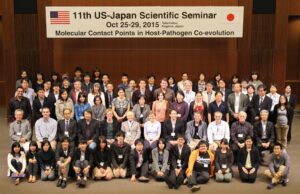
On October 25-29, 2015, one of the longest running symposia in the field of plant-pathogen interactions was held in Kagawa, Japan. It featured more than 25 speakers from the United States and Japan, with a topical focus on molecular plant-pathogen interactions. The “US-Japan Scientific Seminar: Molecular Contact Points in Host-Pathogen Co-evolution,” began in the mid-1960’s with a primary aim of enhancing dialogue between the US and Japan through scientific and cultural exchange. Almost 60 years since the first meeting, the focus has not waivered from the initial goal, and in the current meeting, the breadth and scope of scientific discovery was only surpassed by the renewal of decades-long friendships and collaboration.
Four primary themes of the 11th Symposium resonated throughout the duration of the meeting. First, as presented by Jan Leach, Adam Bogdanove, Ryouhei Terauchi, Brett Tyler, and Brad Day, the development and use of new technologies aimed at both uncovering new areas of research in the study of host-pathogen interactions, as well as those aimed at addressing fundamental unanswered questions related to pathogen virulence, adaptation, and host response have led to significant advances in the field of molecular plant-microbe interactions. Coupled to this, the use of what were considered “non-model” systems only a short time ago, studies employing rice, soybean, and vegetable crops have provided insight into the complex interactions between host, pathogen, and the environment.
As a second theme of the meeting, the use of new and emerging technologies have opened the door to a growing number of systems-level approaches, defining the complex interactions between cellular processes in response to stress. These new technologies have also provided a framework for developing biological models aimed at predicting the outcome of host-pathogen interactions. For example, as presented by Shahid Mukhtar, Fumi Katagiri, and Dan Kliebenstein, one of the next frontiers in defining the complex interactions between host, pathogen, and environment is the analysis of the complex genetic networks underpinning resistance and susceptibility. Using methods coupling next-generation sequencing with an analysis of the specificity and function of protein-protein interaction modules, we are now moving towards defining the relationship(s) between resistance signaling networks and pathogen virulence strategies. In the coming years, it is anticipated that our understanding – and future work in this area – will move beyond the traditional “pairwise” relationships to analyze pathogen virulence and host resistance, and will focus on the stochastic interactions that underpin the complex interactions that govern resistance and susceptibility.
Next, a theme almost as old as the Symposium itself, the analysis of plant-fungal interactions took center stage. From toxins, to chitin, to complex cellular interactions, substantial advances have been made over the past few years in our understanding of how this fast-evolving class of pathogens interacts with plants. Topics ranging from receptor ligand interactions (Hanae Kaku), the biosynthesis of host-specific toxins (Kazuya Akimitsu and Tom Wolpert), and the cellular analysis of these processes (Marie Nishimura, Yoko Nishizawa, Kazuhiro Toyota) were discussed, and in total, work in this area is providing a new paradigm towards our understanding of this important class of pathogens
Finally, and as a primer for future meetings, emerging themes in the field of plant-pathogen interactions were a common topic over the course of the Symposium, not only as a focus for future research in the area of plant-microbe interactions, but also as a challenge to the more than 20 students and postdocs that participated in the meeting. Issues related to sustainability, climate change, and food production were noted by all of the speakers, and from this, a call to the next generation of scientists to innovate and work globally as they tackle a growing list of important questions and challenges was made. As was the intent of the joint communiqué delivered in 1961 by US President John F. Kennedy and Japanese Prime Minister Hayato Ikeda, our ability to mitigate challenges related to food security and production must rely on persistent cooperation through collaboration, the exchange of ideas, and resources.
The 12th US-Japan Symposium will be held in Traverse City, Michigan in 2020. For inquiries related to this meeting, please contact Adam Bogdanove (ajb7@cornell.edu), Brad Day (bday@msu.edu), or Lindsay Triplett (lindsay.triplett@ct.gov).