
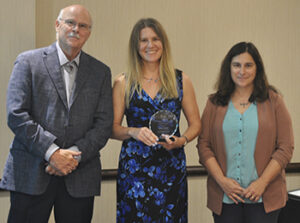
Dr. Gitta Coaker, University of California-Davis, received the Noel T. Keen Award from The American Phytopathological Society for research excellence in molecular plant pathology. Nominees have made outstanding contributions and demonstrated sustained excellence and leadership in research that significantly advances the understanding of molecular aspects of host–pathogen interactions, plant pathogens or plant-associated microbes, or molecular biology of disease development or defense mechanisms.
Q1. What area(s) of molecular plant–microbe interactions do you feel your research has impacted most?

Science is a team effort. I have been fortunate to work with bright and motivated scientists throughout my career. I am most proud of training the next generation of scientists, who are making impactful discoveries in a variety of career paths. My group studies a variety of plant–pathogen interactions, but our central research questions focus on plant immune signaling and pathogen effector biology. Our most impactful research over the years focuses on plant immune perception and signaling for both intracellular and surface-localized immune receptors. We have contributed to how plant NLR receptors recognize effectors and the role of kinases in fine-tuning plant immune responses.
Q2. What advice do you have for young scientists aspiring to achieve the level of science that has a major impact?
We are fortunate to be in a field with fascinating biological questions and clear links to the welfare of humankind. To make important discoveries, scientists need to study important problems. Science that has a major impact focuses on important biological questions and provides a foundational understanding that other groups use to drive research questions. I think it is important to always keep the biology of the plant and pathogen in mind. I encourage young scientists to spend time thinking about major unanswered questions or understudied areas in the field of plant–microbe interactions and how they fit with their expertise. It is also critical to always consider experimental design, controls, and reproducibility. Freely sharing reagents/materials, providing access to raw data/code, and posting preprints will also increase impact by allowing other scientists to validate and build upon discoveries.
Q3. When you were a postdoc, what had the largest influence on your decision to enter your specific research area in your permanent position? Was this a “hot topic” at the time, or did you choose to go in a different direction?
During my Ph.D. studies, my research focused on breeding for disease resistance in tomato. I dabbled in proteomics during the final year of my Ph.D. program and realized my passion for molecular plant pathology. I also benefitted from having excellent mentors in my Ph.D. (David Francis) and postdoc (Brian Staskawicz) programs. During my postdoc, I thought more deeply about my skill set and how I could contribute to answering important research questions. I brainstormed with Brian and other colleagues about future areas of research.
I was (and still am) fascinated with how plant immune receptors recognize pathogen invaders and how pathogen effectors drive host specificity. I get excited about mechanistic insights in plant–pathogen interactions. Plant immunity has always been a “hot topic” in MPMI, but it is also one of the keys to generating disease resistance in crops. I gained a lot of protein biochemistry experience as a postdoc and decided to focus on immune signaling when starting my lab at UC Davis. My group still studies immune signaling and effector biology. We have expanded the repertoire of plants and pathogens we investigate over time. I am also interested in the role of immunity and effectors in vectorborne disease and see this as an understudied area in MPMI.