
The August 2020 Editor’s Pick for MPMI is, “Dual Role of Auxin in Regulating Plant Defense and Bacterial Virulence Gene Expression During Pseudomonas syringae PtoDC3000 Pathogenesis,” in which Arnaud Djami Tchatchou and co-authors show how plant hormones like auxin are involved in disease resistance. Their results show that auxin signaling in the host affects salicylic acid synthesis and can lead to susceptibility. They also found that not only does auxin suppress host defense, but that it can also modulate virulence gene expression in bacteria (Pst DC3000).


Dual Role of Auxin in Regulating Plant Defense and Bacterial Virulence Gene Expression during Pseudomonas syringae PtoDC3000 Pathogenesis
Name: Arnaud Thierry Djami Tchatchou
Current Position: Research scientist at Washington University in St. Louis, MO, USA.
Education: B.S. and M.S. degrees in biochemistry from the University of Yaounde I, Cameroon, and Ph.D. degree in molecular biology from the University of the Witwatersrand, South Africa.
Non-scientific Interests: Cooking, bible study, having fun with my family.
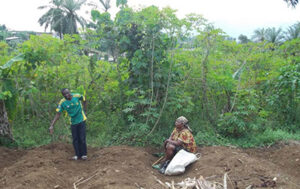
Brief-bio: I was born in a small village, Ndoungue, in Cameroon and raised up by my grandparents, who were famers and hunters. Each time my grandfather brought an animal home for food I was curious to see what was inside the stomach and the head. As a primary- and high-school student I was fascinated by biology and learning about the natural world and the ways in which organisms interact with their environment, which were more real to me than mathematics, literature, etc…. As I was growing up with my grandparents, we cultivated the ground manually to sow cassava, sweetpotatoes, maize (see photo), and many vegetable crops. This is how my passion for plants originated. Seeing my grandparents struggle with plant diseases in those days, which sometimes resulted in severe losses in agricultural yield, I was curious to know why our crops couldn’t defend themselves against those diseases. These struggles and difficulties faced by my grandparents became the motivation that led me to study and seek to understand how plants defend themselves against pathogen attacks. Since then I have been fascinated by the field of plant biology and ways to address issues of global importance, such as improving agricultural productivity and ensuring sustainable food security. As a graduate student and post-doctorate, I have sought to understand the molecular basis of plant disease resistance using a wide array of approaches, including biochemistry and molecular biology.
Throughout my scientific career I have used various organisms (Colletotrichum gloeosporioides, Colletotrichum sublineolum, Pectobacterium carotovorum, and Pseudomonas syringae), as well as some defense priming agents (isonitrosoacetophenone, hexanoic acid, azelaic acid, and bacterial lipopolysaccharide), to study their interactions with both model plants (Arabidopsis thaliana and Nicotiana tabacum) and crop species (avocado, sorghum, tomato, and chili pepper). I have identified and characterized various defense- and virulence-related genes to uncover the mechanisms of plant disease resistance and virulence. In Prof. Barbara Kunkel’s group at Washington University in St. Louis, my research focus is to investigate the roles of the plant hormone auxin (indole acetic acid [IAA]) during pathogenesis of P. syringae DC3000 on A. thaliana. I found that P. syringae uses IAA in at least two different ways to promote virulence and disease: as a plant hormone to suppress plant defenses and as a microbial signaling molecule to regulate virulence gene expression (the subject of the paper we just published in MPMI). Currently, my research focus is to translate the scientific discoveries about auxin that we made using Arabidopsis to two agriculturally important plants, tomato and cassava, using Xanthomonas campestris, an economically important pathogen. This study will provide new insights into mechanisms regulating Xanthomonas–host interactions that can be exploited to develop new strategies for protection of tomato and cassava against devastating plant diseases caused by X. campestris. During the years I spent here I have learned a lot about working with transgenic plants and gained more knowledge in microbiology with excellent mentorship from Prof. Kunkel, which I think will boost my research career.