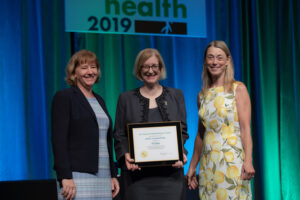
Ann Lichens Park, USDA-NIFA,(center, with President Kira Bowen and Immediate Past President Mary Palm) is a 2019 Fellow of The American Phytopathological Society (APS). This honor recognizes distinguished contributions to plant pathology in one or more of the following areas: original research, teaching, administration, professional and public service, and extension and outreach.
1. What area(s) of molecular plant-microbe interactions do you feel your work has impacted most?
When I first started working for the U.S. Department of Agriculture (USDA) in the early 1990’s, genomics was just beginning to infiltrate the agricultural sciences. By the late 1990’s, only a small number of agriculturally relevant microorganisms had been sequenced. From 2000 to 2009, along with colleagues at the National Science Foundation (NSF), I administered a Microbial Genome Sequencing competitive grants program that supported the sequencing of well over a hundred agriculturally relevant microorganisms. As a National Program Leader at USDA’s National Institute of Food and Agriculture (NIFA), I have a “bird’s eye view” of the leading edge of plant-microbe interactions. It has been thrilling to see how the work supported in the Microbial Genome Sequencing Program has advanced both basic and applied science related to plant pathology and to interactions between plants and beneficial microbes. It has turned plant pathogens that were very difficult to work on into “model systems.” More generally, it has been a privilege to be able to observe the impact of genomic sciences on agriculture.
2. What advice do you have for young scientists aspiring to achieve the level of science that has major impact?
Whether a young scientist’s research is basic, applied or both, she or he should keep in mind the work’s potential to improve people’s lives. The connection between a scientist’s work and the people who benefit from it may be direct or indirect. It may benefit people by improving the health of the environment in which we all live or the other creatures that share our environment.The work may have impact in the short-term or in the long-term. Keep thinking about how that impact might be achieved.
3. When you were a postdoc, what had the largest influence on your decision to join NIFA (CSRS)? Was there a “hot topic” that you considered researching instead?
I enjoy focusing on the “big picture” and my job allows me to do that. Molecular biology and genomics have always been areas of science that have captured my interest. It is fascinating to learn about the clever ways that plants and microorganisms overcome the challenges that they face in order to survive.