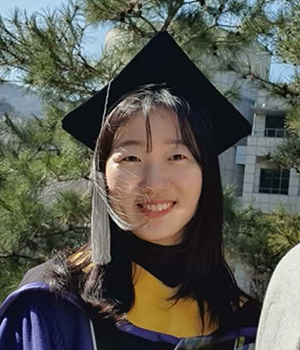
Meet Ye-Eun Seo, a current Ph.D. student from the laboratory of Prof. Doil Choi in the Department of Horticultural Science and Biotechnology at Seoul National University, South Korea. Ye-Eun received the MPMI Best Student Paper Award for her first-author paper on “Phytophthora infestans RxLR Effector PITG06478 Hijacks 14-3-3 to Suppress PMA Activity Leading to Necrotrophic Cell Death.” Her research focuses on molecular plant-microbe interactions, particularly examining the mechanisms by which pathogen effectors manipulate host cellular processes and how plants defend against these pathogens. Her recent work focused on elucidating the cell death mechanisms related to the plasma membrane proton pump in plants and on plant immune receptors and effectors from P. capsici and P. infestans. Currently, she is exploring the interactions between Solanaceae plants and P. capsici, with an emphasis on nonhost resistance mechanisms and the role of secreted proteins in pathogenicity. Through this research, she aims to contribute to expand our understanding of plant immunity and the development of sustainable crop protection strategies. To gain more insights into her research interests and scientific journey, and congratulate and celebrate her success, read this first-author interview.
1. What do you think is the most important or exciting finding from your paper?
In our paper, we investigated how the P. infestans RxLR effector PITG06478 induces cell death in Nicotiana benthamiana by targeting the plasma membrane H+-ATPase (PMA) activity and its interaction with 14-3-3 proteins. In my opinion, the most interesting finding from our paper is that fusicoccin treatment affected the association between 14-3-3 and the effector. Fusicoccin is an irreversible activator of PMA, so its application alters conditions within the plant cell—particularly the pH. This suggests that pH changes could influence the effector’s mode of action, implying that pH is a critical factor in regulating effector-host interactions and cell death mechanisms.
2. Was there a piece of data that was particularly challenging to obtain or a part of the project that was particularly difficult?
Initially, we performed a screen to test whether fusicoccin treatment affected effector-induced cell death and found that cell death was affected in the presence of several effectors, but none of them interacted with PMA. This was contrary to our initial expectations, so we had to test an alternate approach. We then conducted another screen to test whether fusicoccin treatment changed subcellular localization of the effector. That’s how we identified PITG06478 for further investigation. I think we were fortunate to be able to specify the effector’s mode of action through these two screening methods and subsequent research. This experience taught me the importance of flexibility in research and the value of pursuing unexpected results. I came to understand that sometimes interesting findings can come from results that don’t match our initial hypotheses and that being open to changing our approach can lead to new insights.
3. What research project are you most excited about right now?
Currently, I’m very excited about my work with P. capsici secreted proteins. These proteins have the potential to act as PAMPs (pathogen-associated molecular patterns) or apoplastic effectors in plant cells. I’ve identified candidates that can induce cell death in plants, and now I’m focusing on uncovering their receptors and downstream signaling pathways. I believe this research could lead to interesting findings and potentially uncover novel mechanisms in plant-pathogen interactions.
4. What drew you to your current lab?
I first met my current advisor during my first major course after declaring my major as an undergraduate. What really impressed me was that in every class, the professor introduced fascinating new cutting-edge research papers. This approach not only made the classes more engaging but also gave us insight into the latest developments in the field. I found the professor’s research area incredibly interesting, and it aligned well with my own scientific interests. The professor’s enthusiasm for the subject and dedication to keeping students updated with the most recent advancements in the field really drew me to this lab. As an undergraduate research assistant in this lab, I had an eye-opening experience. I enjoyed applying the experimental techniques I learned in class to real research situations. The process of conducting experiments was genuinely interesting, even when faced with challenges. I found the troubleshooting process, where we discussed failed experiments with other researchers, particularly enriching. These discussions not only helped solve immediate problems but also deepened my understanding of the scientific process. Through this hands-on experience, I discovered that I was truly fascinated by the process of conducting experiments and doing research.
5. How did you choose to join your current graduate program?
I chose to join my current graduate program in Horticultural Biotechnology because of my experience as an undergraduate research assistant in the lab of Prof. Doil Choi. Our lab focuses on molecular plant-microbe interactions in horticultural crops. During my time as an undergraduate researcher, I became fascinated with the molecular plant-microbe interactions field. This interest, combined with the positive experiences I had in the lab, led me to pursue graduate studies in the same department and lab. I wanted to continue working on molecular plant-microbe interactions in horticultural crops, so joining the Horticultural Biotechnology graduate program was a natural choice for me.
6. What advice would you give to starting graduate students?
As a fellow graduate student still learning and growing, I’d like to share some advice from my experiences so far. I’ve found that asking questions and seeking clarification from advisors, professors, and peers has been incredibly helpful. Staying curious and exploring various resources, as well as keeping up with recent research, has also been beneficial. I’ve noticed that keeping organized notes and documenting experiments and ideas helps me track my progress and thoughts. When possible, I try to attend conferences and seminars, which I’ve found to be great learning opportunities, though I’m still working on my networking skills. I’m also trying to view constructive criticism as a chance to improve my work and be open to feedback. These are just my personal experiences, and I’m sure every graduate student’s journey is unique.
7. Who has inspired you scientifically? Why?
The most scientifically inspiring people to me are my PI and lab members. Our weekly group lab meetings are particularly valuable. During these discussions, my professor often provides guidance from a broader perspective, offering insights that help shape our research directions. My lab mates also contribute ideas, sharing their thoughts on experiments and project approaches. These interactions have shown me the importance of collaborative thinking in science. Sometimes, discussions with lab mates have led me to consider new methods or help refine the direction of my project. I learn a lot from their experiences and approaches. Additionally, I find seminars and research papers from other scientists in our field to be informative and motivating. Seeing the work being done by researchers worldwide encourages me to continue developing my skills and knowledge in my own studies.
8. How can people find you on social media?
I have an X account, @YEEUNSEOYEEUN (although I’m not very active in posting…).
9. Is there anything else you would like to share? If so, what is it?
I’d like to take this opportunity to express my sincere gratitude to my professor, Dr. Doil Choi, and my lab members. I’m truly thankful for their guidance, support, and collaboration throughout my research journey.