June
M. Brands and P. Dörmann
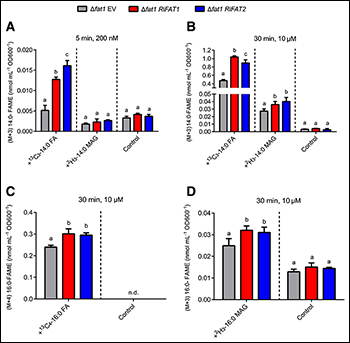
Since it is unknown how arbuscular mycorrhizal fungi (AMF) take up host-derived fatty acids, which they need for nutrients, Mathias Brands and Peter Dörmann describe the characterization of two AMP-binding domain protein genes from Rhizophagus irregularis with sequence similarity to Saccharomyces cerevisiae fatty acid transporter 1 (FAT1). Their results suggest the two proteins might be involved in fatty acid import into the fungal arbuscules in colonized roots.
July
E. P.-I. Loo, Y. Tajima, K. Yamada, S. Kido, T. Hirase, H. Ariga, T. Fujiwara, K. Tanaka, T. Taji, I. E. Somssich, J. E. Parker, and Y. Saijo
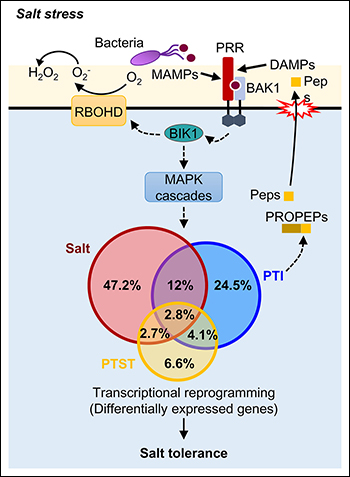
Eliza Loo et al. find that activation of MAMP/DAMP signaling by a broad array of signals primes the plant to tolerate subsequent salt stress, demonstrating integration of abiotic and biotic signals via a conserved BAK1/BIK1 signaling pathway. This example of a biotic signaling promoting subsequent tolerance of an abiotic stress reveals the complexity of interactions of plants with their living and nonliving environment and may open new avenues to promote plant health in the field.
August
Involvement of Arabidopsis Acyl Carrier Protein 1 in PAMP-Triggered Immunity
Z. Zhao, J. Fan, P. Yang, Z. Wang, S. Obol Opiyo, D. Mackey, and Y. Xia
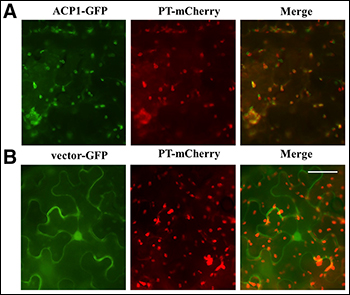
Acyl carrier proteins (ACPs) are central components of fatty acid (FA) synthesis. Zhenzhen Zhao et al. show that ACP1 influences plant immunity by maintaining the balance of defense hormones jasmonic acid and salicylic acid, providing a direct link between FA and lipid biosynthesis to plant immune responses. This opens up the possibility of engineering disease-resistant plant varieties by modifying the expression levels of ACP1 in economically important crops.