Impostor Syndrome and You: A Discussion of a Little-Discussed Phenomenon
by Katelyn Butler and Michelle Marks, Department of Plant Pathology, University of Wisconsin-Madison
Editor’s note: After participating in a roundtable discussion on impostor syndrome led by Michelle and Katelyn at the 2017 APS Annual Meeting, I invited them to develop the following article. The Interactions advisory board and I feel that impostor syndrome can have a profound impact on our individual well-being (from students to senior faculty), as well as on our interactions with members of the broader scientific community. Many of us wrestle with persistent issues that feed this phenomenon, but we are unwilling to talk about them because we feel that we’re alone. We hope that this article incites future discussions on this topic, and we invite you to share your own personal struggles with impostor syndrome in the “Comments” section of this article. I feel that the more visibility we can bring to this issue, the less of an issue it will become. This is exactly the type of article that I desire to see published in the new Interactions: a topic that affects all of us but cannot be or is not addressed in a classical research publication. –Dennis Halterman, Editor-in-Chief
Log in to join the conversation.
What Is Impostor Syndrome Anyway?

University of Wisconsin-Madison
Maybe you’ve had thoughts like these: the ones where the little voice in your head is saying “I don’t deserve to be here,” or “I’m not qualified for this,” or “They are going to figure out that I don’t know ANYTHING!” Maybe you just somehow got lucky to be where you are or happened to know the right person, instead of earning success through your own merits. And any day now, somebody is going to figure out what a sham you are and kick you out of the program, deny you tenure, or fire you from your job.
If so, you might have experienced the impostor phenomenon, as it is known in the literature, or the impostor syndrome, as it is known more colloquially. Imposter syndrome was first described by psychologists Pauline Clance and Suzanne Imes in 1978 as a feeling of “phoniness in people who believe that they are not intelligent, capable, or creative despite evidence of high achievement.” The good news is, you aren’t alone. As Carl Richards (2015) described in his New York Times article, “Learning to Deal with the Impostor Syndrome,” many highly successful people—including acclaimed author and poet Maya Angelou and several U.S. presidents—have experienced imposter syndrome.
Although the prevalence of impostor syndrome is difficult to estimate, some have offered that 70% of people will experience it at least once in their lifetimes (Sakulku and Alexander, 2011). In our own conversations with fellow graduate students, faculty, and professionals, we’ve discovered such feelings are widely experienced and often persist throughout one’s career. In this article, we’ll discuss the origins of these impostor feelings, their potential consequences, and strategies for acknowledging and overcoming them.
I’m a Fraud and Here’s Why
Impostor feelings can occur for all sorts of reasons and in all types of people. Although first studied primarily in women, impostor syndrome is now recognized to be a common phenomenon among both genders. Valerie Young (2011), author of The Secret Thoughts of Successful Women: Why Capable People Suffer from the Impostor Syndrome and How to Thrive in Spite of It, categorized individuals with the syndrome into five subgroups. As described by Melody Wilding (2017) in her article “The Five Types of Impostor Syndrome and How to Beat Them,” they are (1) The Perfectionist, (2) The Superwoman/man, (3) The Natural Genius, (4) The Rugged Individualist, and (5) The Expert. While these personality types and traits can explain a tendency toward impostor feelings, specific events can initiate and perpetuate them.
For some, hese feelings can manifest early and may be due to personal experience, background, or characteristics (e.g., having a disability). Students returning to graduate school after time spent elsewhere may feel like they don’t belong or aren’t cut out to return to academic life. Similarly, first-generation graduate students, international students, and other nontraditional students may feel like impostors in their new and unfamiliar environments. Impostor feelings may be particularly common among members of minorities, who may worry that they haven’t achieved their success on their own merits but rather by others’ good graces or by blind luck.
Even students with a family history of higher education and academic achievement may suffer from impostor feelings. When expectations are high and achievement is valued, it’s easy for students to get overwhelmed by such expectations. (Check out the description of The Perfectionist in the Wilding article.) These individuals may feel that they can never live up to these expectations and those of their families. To a person struggling with impostor-like feelings, even the encouragement received by family members can cause anxiety as the individual continues to receive what he or she feels is unjustified praise and support.
It’s no surprise that impostor feelings can often be triggered by failures, which are exceedingly common in STEM. Whether it’s an experiment that didn’t work, a grant that didn’t get funded, or a job that wasn’t offered, such events are more catastrophic to those individuals already struggling with impostor syndrome. These commonplace disappointments are added to lists of evidence of their fraudulence and lead many individuals to question their skills and value.
Perhaps one of the biggest sources of impostor feelings is self-comparison to others. Of course, measuring oneself in relation to peers isn’t always bad. However, we are rarely all on the same playing field, nor are we always racing toward the same finish line. This peer comparison seems extremely common based on conversations we’ve had with both faculty and fellow graduate students, and in many ways, it’s inevitable as we progress alongside our cohort members. It’s easy to look at a fellow graduate student who has two published papers while you have none and wonder “What’s wrong with me and my abilities?” Margie Warrell put it well in her article “Afraid of Being ‘Found Out?’ How to Overcome Impostor Syndrome”: “Too often we fall into the trap of comparing our insides with others’ outsides; our weaknesses with others’ strengths.”
More Than a Feeling
The insidious nature of the impostor syndrome is that it often manifests as more than just negative feelings, and real problems can emerge when these feelings turn into action (or nonaction). Feeling like you aren’t good enough or that the work you have been doing isn’t up to par can grind productivity to a halt. We have heard students describe being in the paradox of finding that they need help but are too afraid to ask for it for fear of outing themselves as impostors. Thus, they find themselves stymied and make little progress, further reinforcing their feelings of inadequacy. A lack of self-advocacy may also result, with individuals not pushing for professional development activities, such as speaking opportunities and outreach/teaching events, or not applying for scholarships, fellowships, or grants because they feel certain they are not worthy of such opportunities or recognition. Research productivity (of both students and faculty) could also be impacted, as those struggling with imposter syndrome may have a greater fear of asking the “big questions” and taking on risky (but potentially high-reward) experiments.
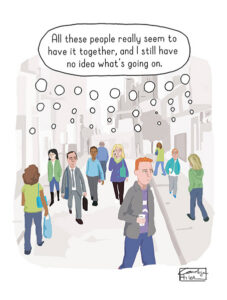
At our roundtable discussion about impostor syndrome at this year’s annual meeting of The American Phytopathological Society (APS) in San Antonio, we also talked about perhaps the most damaging effect of impostor syndrome: the self-selection out of advancement opportunities, which is especially important for graduate students applying for jobs and for early-career professionals looking for promotion. Even when faced with all evidence to the contrary and despite encouragement from mentors, students with impostor feelings may still have severe doubts about applying for a job they feel they aren’t qualified for or negotiating a raise they don’t feel they deserve. Having such doubts can, of course, have real and significant impacts on the careers of those experiencing this phenomenon acutely. Many of the participants in our discussion echoed these worries, and several shared stories of having to overcome real discomfort when applying for their jobs and facing their own feelings of inadequacy—when in reality, they were well-qualified and good fits for their positions.
Furthermore, real mental health consequences, such as anxiety and depression, have been linked to impostor syndrome (Chrisman et al., 2010; Fraenza, 2016). Higher-intensity levels of impostor syndrome have been associated with poorer mental health overall (Sonnak and Towell, 2001). As mental health becomes a significant priority at many universities and businesses, an important part of improving the lives of those suffering with these problems can be acknowledging the role that the impostor phenomenon may play.
Uncovering the Impostor
-
Talk about it. As mentioned before, we have engaged in discussions about impostor syndrome within our own department and at the APS annual meeting. Both times, we were blown away not only by the honesty of the participants but also by the widespread effects that impostor syndrome can have. However, we were pleasantly surprised by the incredible outpouring of encouragement, validation, and inspiration that occurred because of these conversations. When you hear from the graduate students that you perceive to have it all together, as well as professors and even award winners, that they struggle with the same issues, you suddenly don’t feel alone. By naming and discussing the issue, you can begin to identify impostor-like thoughts and work toward alleviating the effects of this toxic mindset. Normalizing the issue by having conversations with colleagues has been shown to play a role in relieving impostor symptoms (Mark and Smith, 2012). To that end, we think it would be immensely beneficial for our scientific society and others to have breakout sessions, roundtable discussions, and professional development training sessions at national meetings about impostor syndrome. These sessions would be helpful not only for those struggling with impostor syndrome but also for mentors and leaders.
-
Acknowledge your own skills and success. As scientists, we are driven by what we don’t know. However, it’s important to reflect on what you have learned, what you have accomplished, and what skills you have acquired. Take time to list your talents, and remember them often. One bit of advice we have been given is to celebrate even the smallest victories—the PCR that amplified the right band, the plants that grew, the cloning reaction that worked—because even these small things (which may seem mundane to you) are important and show that you are capable and productive and working toward your goals. In the same vein, share your skills and knowledge with someone else. By teaching someone something new, you will be compelled to realize that you are smart, knowledgeable, and contributing to society. Participate in department outreach, work with the new student in the lab, help your friends understand a paper outside their expertise—these are all excellent ways to convince yourself of your accomplishment.
-
Enjoy the learning process. In our second suggestion, we have you make lists of the progress you’re making and the successes you’ve had. If you do this over a period of time, you will be able to see how much you’ve learned or achieved. In your first year of graduate school, PCR may have been a chore, but now it’s routine. This is because it’s a skill you’ve obtained, and that’s important to recognize. Doing so creates a learning-driven mindset rather than performance-driven one, which can perpetuate impostor syndrome. Instead of seeing your knowledge gaps as evidence of fraudulence, see them as opportunities for personal growth. Purposely identify areas in which you’d like to grow, and plan ways to accomplish that growth. Rather than frame such an area as “I can’t do that,” think of it as “That’s something I’d like to learn.” No one comes to any position with all the skills and knowledge needed for success—so don’t put that pressure on yourself! Instead, seek out opportunities to learn, and bring others with you. As a bonus, you will be allowing someone else to teach you something, which helps refute his or her impostor feelings, too!
-
Be a good mentor. Before students skip over this section, we insist that everyone is or will be a mentor. Graduate students mentor undergraduates in their labs and classes. Senior graduate students mentor new graduate students. The earlier we can start rebutting impostor syndrome, the less persistent it will be in our culture. The best way to combat impostor syndrome is to hear from someone higher up than you that what you’re doing is okay. Impostor syndrome is fueled by misconceptions about yourself that are perpetuated in your own mind. Providing consistent, honest feedback as a mentor will give your mentees a better idea of their progress. Tell them what they’re doing well, and give them pointed areas in which they can improve. Doing so validates them as valuable members of the team while also providing targeted areas of improvement on which they can focus. Help mentees find experiences in which they can thrive, use their knowledge and talents, and continue to develop. Also, if you don’t have a good mentor right now, seek one out. Find someone you can be honest with, who has your goals in mind, and who will support you in your journey. In a recent study, mentoring was identified as a key antidote for impostor symptoms by academic faculty members (Hutchins, 2015). Thus, faculty members not only need to be good mentors but also to have good mentors.
Examining the nature and effects of impostor syndrome can feel daunting, dismal, and distressing. However, we hope that through reading this article, you have learned that impostor syndrome is a real and persistent phenomenon. If you’ve felt these feelings, you’re not alone. We’re with you! If you haven’t felt these feelings, we hope that you realize many of your colleagues do and that you will do your best to help them overcome their impostor feelings. Let’s all stop thinking that we’re inadequate and move confidently toward our goals.
References
-
Chrisman, S. M., Peiper, W. A., Clance, P. R., Holland, C. L., and Glickauf-Hughes, C. 2010. Validation of the Clance Imposter Phenomenon Scale. J. Pers. Assess. 65:456-467.
-
Clance, P. R., and Imes, S. A. 1978. The imposter phenomenon in high achieving women: Dynamics and therapeutic intervention. Psychother. Theory Res. Prac. 15:241-247.
-
Fraenza, C. B. 2016. The role of social influence in anxiety and the imposter phenomenon. J. Asynchron. Learn. Netw. 20.
-
Hutchins, H. M. 2015. Outing the imposter: A study exploring imposter phenomenon among higher education faculty. New Horiz. Ad. Ed. Hum. Res. Devel. 27(2):3-12.
-
Mark, G., and Smith, A. P. 2012. Effects of occupational stresses, job characteristics, coping, and attibutional style on the mental health and job satisfaction of university employees. Anxiety Stress Coping 25:63-78.
-
Richards, C. 2015. Learning to deal with the impostor syndrome. New York Times, Oct. 26. www.nytimes.com/2015/10/26/your-money/learning-to-deal-with-the-impostor-syndrome.html
-
Sakulku, J., and Alexander, J. 2011. The impostor phenomenon. Int. J. Behav. Sci. 6:73-92.
-
Sonnak, C., and Towell, T. 2001. The impostor phenomenon in British university students: Relationships between self-esteem, mental health, parental rearing style and socioeconomic status. Pers. Individ. Dif. 31:863-874.
-
Wartell, M. 2014. Afraid of being ‘found out?’ How to overcome impostor syndrome. Forbes, April 3. www.forbes.com/sites/margiewarrell/2014/04/03/impostor-syndrome/#2ad4a72648a9
-
Wilding, M. 2017. The five types of impostor syndrome and how to beat them. Fast Company, May 18. www.fastcompany.com/40421352/the-five-types-of-impostor-syndrome-and-how-to-beat-them
-
Young, V. 2011. The Secret Thoughts of Successful Women: Why Capable People Suffer from the Impostor Syndrome and How to Thrive in Spite of It. Crown, New York.