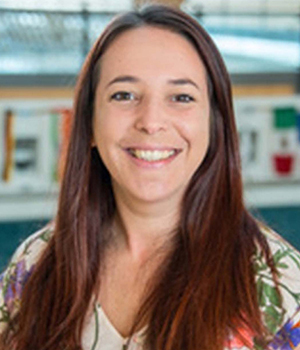
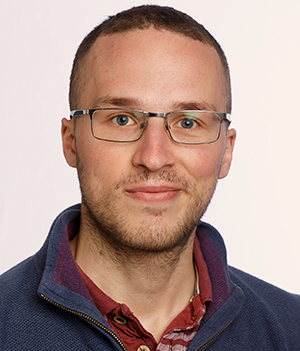
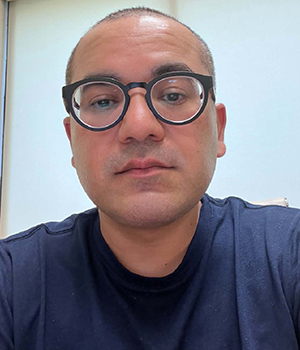
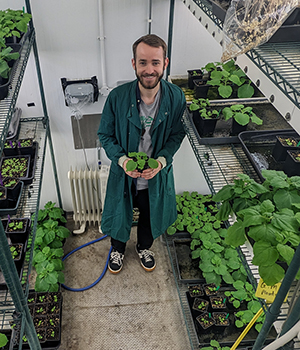
My journey as a scientist has taken me across multiple continents, allowing me to engage with diverse ecosystems, research methodologies, and scientific communities. This global perspective has been invaluable in broadening my understanding and contributing to the advancement of my knowledge in plant-microbe interactions. Let me begin by telling you about myself. I am originally from the northeast region of Spain known as Catalonia. Many people I’ve met around the world are unaware that most individuals raised in this region are bilingual from birth. We speak both Catalan and Spanish, and both languages are officially recognized. This blend of languages has granted us a unique cultural identity within Spain’s multilingual tapestry. I believe that this, combined with my parents’ love for travel, instilled in me a constant desire for new adventures.
The Spark of Passion
During my college years, I received an ERASMUS fellowship to spend six months in a laboratory in Toulouse, in the south of France. It was an incredible experience that I highly recommend to anyone who can manage it in terms of both time and finances. While it delayed my graduation by one semester, this opportunity sparked my passion for plant-microbe interactions and confirmed my desire to pursue a career in scientific research. It was also a fantastic initial experience living outside of my birth country. Being just a short four-hour drive away provided me with the comfort I needed, knowing I could return home whenever necessary or desired. When it ended, I knew it would not be my last experience abroad.
Broadening Horizons
Once I finished my master’s degree, I joined a lab in Barcelona to start my Ph.D. program working on plant-pathogen interactions in Arabidopsis and rice. I was lucky enough to find a great lab family that welcomed me and to work on a subject that I find fascinating. During one of my first meetings with my Ph.D. adviser, I boldly expressed my desire for a unique experience that would expand my horizons. I loved being close to my family and friends, but I yearned for the chance to work in a different lab environment—one that was as geographically distant from my current location as possible—for a few months. Understanding my drive for this enriching experience, my advisor leveraged her international connections and arranged for me to spend an entire summer in Taipei, Taiwan. This was facilitated through a collaboration that our lab had with a research group based there. This international exposure not only broadened my academic perspective, but also enriched me personally.
I was privileged to receive a fellowship from the Taiwanese government as part of a special program for European-Taiwanese student exchange. This marked my first experience working in a lab outside of Europe. The shift was significant, as I found myself immersed in English, both at work and in daily life, around the clock. Despite the cultural differences, I found common ground with the Taiwanese Ph.D. students in the lab. I sampled new foods and taught many people how to make “Pa amb tomaquet” (a Catalan specialty of fresh tomato and garlic on toasted sourdough bread). I danced to new music and shared my Catalan roots with my new friends, a true embodiment of cultural exchange. Immersion in a new culture can be personally and professionally challenging but also enriching, fostering cross-cultural understanding and the exchange of ideas.
New Challenges and Opportunities
As my Ph.D. graduation date approached, I decided to contact a professor in the United States whose work excited me. Luckily, he had an open spot in his lab and accepted my application. I sold all of my furniture, my car, left some belongings at my parents’ house, packed two suitcases, and left Spain with no return date. I sought new scientific horizons and experiences, aiming for a place where I could conduct experiments without budget constraints. I also hoped, however, to find a community of like-minded people passionate about science. I found that place in St. Louis, MO.
The arrival in St. Louis was bumpy. I had to rent an apartment without seeing it, get a new driver’s license, and adapt to a different language. Starting a new life in a place where I knew no one was challenging. For a couple of months, I came home to an empty house, unable to share my day with anyone familiar. My friends and family were seven time zones away, sleeping. Despite these challenges, I immersed myself in my work, joined many meet-up groups of different interests, and gradually built a new network of friends and colleagues.
During this time, I also learned how to navigate the complex and time-consuming visa and immigration processes, which include the potential for delays and complications. For example, during the pandemic, my H1B visa expired, and to get it renewed, I had to return to Spain. However, the U.S. embassy in Madrid was fully closed and not processing visas. I had to wait many months and leave the United States without the certainty that I would be able to return. This barrier was a source of stress and anxiety for me and many other immigrants.
The Ongoing Journey
Over the years, I have worked on three different continents, learning to be flexible and resourceful, while gaining a wide network of colleagues and mentors. This experience has enabled me to communicate inclusively and relate to diverse perspectives. Although it came with challenges and cultural adjustments, I would choose this path again. Now, I have a wonderful family in the United States, an amazing partner, two beautiful boys aged 5 and 3, and a big dog. We are about to embark on a new adventure, moving to Davis, CA. This move will bring new challenges and experiences, continuing the journey of growth and discovery not just about professional development, but also about discovering new aspects of myself.
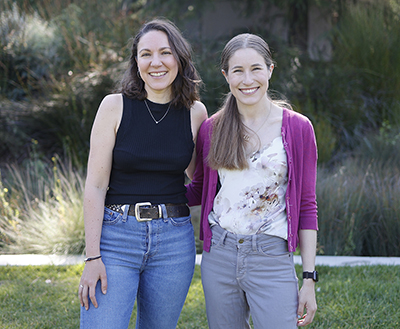
Alba Moreno Perez (left) and Danielle Stevens (right)
This is the first spotlight in our series highlighting early-career scientists and their recent discoveries. Meet graduate student Danielle Stevens and postdoctoral scientist Dr. Alba Moreno Pérez from the Coaker lab at UC Davis. Their work on the natural variation of immune epitopes was recently published in PNAS. Learn about their advice for choosing and navigating graduate school, their scientific inspirations, and their new paper.
Q&A with Dani Stevens
QWhat research project are you most excited about right now?
A As I am wrapping up my Ph.D., the discoveries I made have only led to more questions and more future project ideas. During the heart of the pandemic, I noticed most of the MAMP research was focused on characterizing the biochemical and immune outcomes of a handful of MAMPs. With so many bacterial genomes already in NCBI, I quickly realized there is an opportunity to understand the impact of epitope evolution on immune outcomes. For example, I found that multicopy csp22 epitopes can have differential immune outcomes in tomato, impacting pathogen colonization. This was one of our findings in our recent PNAS paper.
Now, I have many follow-up questions on these interactions. For example, how do different immune outcomes impact bacterial protein function? Does an intermediary PTI response provide any resistance locally or induce SAR distally? How do perception and immune outcomes change in other relative plants?
In particular, the csp22 receptor CORE is restricted to the Solanaceous family, which contains hundreds of species, and other plant species are found to respond to csp22 epitopes, though they do not encode a CORE homolog. Currently, we do not have a great understanding of the evolution of CORE, other convergently evolved csp22-receptors, and their receptor perception capabilities. With tens to thousands of receptors encoded within land plants, how do we better understand ligand-receptor interactions at scale and potentially engineer de novoreceptors. These are questions I am hoping to answer during my postdoc research in Dr. Ksenia Krasileva‘s lab at UC Berkeley.
But, if you ever meet me in person, I have (maybe too) many questions around PTI and microbial evolution. J
QWhat drew you to the Coaker lab?
A I leaned about the Coaker lab after reading a paper published in MPMI for a class I was taking during my senior year of as an undergraduate student. I had spent several years working on an actinobacterial pathogen and wanted to keep working on these understudied organisms. Additionally, Gitta Coaker was highly recommend for her mentorship abilities, and I could quickly tell it was a great fit. I feel thankful for my colleagues who helped point me in her direction and for having the opportunity to be part of her lab.
QHow did you choose to join the graduate program at UC Davis?
A I have worked in host-pathogen interactions since my first research project, yet I don’t see myself as a plant pathologist, at least not in the traditional sense. My undergraduate degree is in biochemistry and biophysics, and I spent a summer at the Max Planck Institute for Evolutionary Biology. I always have valued diverse training and, thus, sought graduate programs with this in mind, particularly focusing on those that emphasize bioinformatics, computational biology, or genomics and that allow me to conduct research in plant-microbe interactions. I landed at UC Davis as it has numerous well-regarded plant-focused departments and a well-established genetics and genomics graduate program.
QWhat advice would you give to graduate students who are just starting out?
A Be curious and flexible, read broadly and often, yet keep focused on the major questions, areas, and systems that most interest you. Sometimes the most interesting and worthwhile projects are ones you may have not planned for. Alternatively, there are far more opportunities and ideas than any one person has the time for, so it also is important to be selective. Trying to maintain this balance with funding in mind is not easy, but it is incredibly rewarding.
QWho has inspired you scientifically? Why?
A As any young scientist, I use to look up the “greats” in our field. As I have gotten older, however, I have come to realize I am much more inspired by the handful of incredible scientists who have mentored me professionally and personally. These individuals have taught me so much, treated me with kindness and respect, and provided me opportunities and independence, all while maintaining a positive life outside of their academic careers.
QAre you involved in other scientific/professional development activities? How do these contribute to your training?
A As I approach graduation, I am gradually winding down some activities to refresh before starting my next position. I want to highlight two key scientific activities that shaped my training. First, I served on my graduate group’s admissions committee for three years. This role was incredibly rewarding, as I could provide a diverse perspective and impact our incoming class. Second, I organized and ran a student-focused seminar series for genetics students. Unlike some graduate programs, genetics (also known as IGG) spans many departments and buildings, making it difficult for our community to come together. The seminar provided an opportunity for students to gather, share their science, and support each other’s progress. Both experiences were rewarding and contributed significantly to my training.
QWhat is the greatest challenge you have encountered in your career? What did you do to overcome this challenge?
A I think the most rewarding and challenging aspects of my career all revolve around people. I found it is important to stick to and stand up for one’s values. However, also having grace and patience can do wonders in conflict.
QHow can people find you on social media?
A X: @Dani_M_Stevens
QWhat’s your favorite story from an IS-MPMI society meeting?
A I don’t have a particular story to share, but I have enjoyed my last two IS-MPMI meetings and look forward to the next.
QIs there anything else you would like to share in your spotlight?
A While I am thankful for the chance to highlight myself, Alba, and our recent publication, I am also excited to wrap up some other work to share with the MPMI community in the coming month or so. Be on the lookout if you are interested!
QBonus question: What’s your favorite pathogen or disease?
A Any actinobacterial pathogen of course. J
Q&A with Alba Moreno Pérez
QWhat research project are you most excited about right now?
A During my collaboration with Dani on this project, we made an exciting discovery: some elf18 variants can induce early, but not late, plant immune responses. These MAMPs, known as deviants, have opened up intriguing questions. I am particularly fascinated by how these natural deviants manage to reduce the PTI responses. Recently, I’ve started a new project with the goal of uncovering how these deviant peptides activate the receptor and why they fail to trigger later plant immune responses. I’m really thrilled about this opportunity to identify the mechanisms by which deviants evade plant immunity and to explore their potential role in avoiding pathogen recognition.
QWhat drew you to the Coaker lab?
A In 2018, during my Ph.D. research, I did a four-month short stay in Dr. Gitta Coaker‘s laboratory in order to learn the GFP strand system. In my thesis, I investigated how pathogens inhibit plant defense systems and promote disease. My time in the Coaker lab sparked a deep curiosity about understanding the defense mechanisms plants use to prevent pathogen infections. Given the Coaker lab’s extensive experience in biochemical, posttranslational, and genetic investigations of immunological signaling, I chose to pursue a postdoctoral position there. I believe this will allow me to learn new methodologies that complement my training, providing a comprehensive understanding of both sides of plant-pathogen interactions. Additionally, during my four-month stay, I observed Dr. Coaker’s dedication as a mentor who fosters intellectual growth, critical thinking, and creativity. This positive experience motivated me to work with her on applications for various postdoctoral fellowships, ultimately securing two opportunities that enabled me to join the Coaker lab.
QHow did you choose to join the graduate program at the University of Malaga?
A During the third year of my bachelor’s degree studies in biology, I began working on a project as an undergraduate student in the lab of Dr. Cayo Ramos at the Department of Cellular Biology, Genetics, and Physiology at the University of Malaga, Spain. This project awakened my curiosity for studying plant-pathogen interactions. After completing my master’s degree, I joined the doctoral program in advanced biotechnology to pursue my Ph.D. degree under the supervision of Dr. Ramos. His research focuses on studying the role of virulence factors in the host range of Pseudomonas savastanoi, a bacterium that causes knots in woody hosts. I was particularly interested in investigating the mechanisms that bacteria use to overcome plant immunity and cause disease.
QWhat advice would you give to graduate students who are just starting out?
A My advice is, if you decide to pursue a Ph.D. degree, choose a project that you are truly passionate about. Science can be challenging, and your passion and curiosity will help make the journey easier. When you find a paper or project that excites you, don’t hesitate to contact the principal investigator. Send your CV and express your interest in the project. Don’t be afraid of rejection; if you don’t try, the answer is always no.
QWho has inspired you scientifically? Why?
A At the beginning of my career, I was inspired by Rosalind Franklin and Marie Curie, women who broke barriers and fought hard for their scientific careers in times when women were not often allowed to do so. Throughout my career, I have met many remarkable and strong women who serve as excellent examples of how it is possible to have a successful career in science without sacrificing family life. Everything is possible if you have passion and dedication.
QAre you involved in other scientific/professional development activities? How do these contribute to your training?
A I am involved in mentoring undergraduate students in the lab. Mentoring is a crucial part of our development, especially if you aspire to be an academic professor. Every student is different, so learning how to help them and bring out their best is very important. I also participate in the review of articles and serve on evaluation committees for the Postdoctoral Scholar Association. These experiences have contributed to my scientific career by enhancing my critical thinking skills, broadening my understanding of current research trends, and providing valuable insights into the peer-review process. Additionally, during my Ph.D. program, I participated in outreach activities with the goal of bringing the real image of scientists closer to the public and showing that they are people just like them. I believe outreach is very important because it provides the opportunity to connect current science with future generations.
QWhat is the greatest challenge you have encountered in your career? What did you do to overcome this challenge?
A One of my biggest challenges has been overcoming the language barrier. I am from Spain, and English has been particularly challenging for me, but I have worked hard to improve my speaking and oral presentation skills. One piece of advice: don’t hesitate to speak if your English is not perfect. It’s more important to express yourself and seize the opportunity to interact and connect with people.
QHow can people find you on social media?
A You can find me on X: @Alba_MorenoP.
QWhat’s your favorite story from an IS-MPMI society meeting?
A The IS-MPMI meetings are among my favorite conferences. They provide the perfect opportunity to reconnect with former colleagues, meet new people, and stay up-to-date with the latest discoveries in plant-pathogen interactions. A very fun moment from the IS-MPMI meeting held in Glasgow, Scotland, in 2019 was during the diversity party when everyone ended up dancing to the Spanish song “La Macarena.”
QIs there anything else you would like to share in your spotlight?
A I would like to thank Dani and Gitta for giving me the opportunity to be part of this amazing project and MPMI for highlighting our work.
QBonus question: What’s your favorite pathogen or disease?
APseudomonas syringae has always been my favorite pathogen due to its diverse virulence factors and its value in studying plant-pathogen interactions. However, since working with Ralstonia, the causative agent of bacterial wilt disease, I’ve come to appreciate it equally. Ralstonia‘s sophisticated strategies for invading and colonizing plant tissues make it an excellent model for studying plant-pathogen interactions at both single-cell and spatial resolution levels.
QBonus question: What’s your favorite molecular plant pathology-related article?
A One of my favorite plant pathology-related articles associated with MAMP perception is the article titled “Co-incidence of Damage and Microbial Patterns Controls Localized Immune Responses in Roots,” published in the journal Cell by the group of Niko Geldner. In this study, they analyzed MAMP receptor expression and responses at cellular resolution in Arabidopsis roots. They demonstrated that only a restricted subset of Arabidopsis root zones directly responds to the flagellin MAMP in the absence of damage.
Unlocking Nature’s Defense: Plant Pattern Recognition Receptors as Guardians Against Pathogenic Threats
In the February issue of Molecular Plant–Microbe Interactions, the second of the H.H. Flor Distinguished Reviews has been published, written by Chao Zhang, Yingpeng Xie, Ping He, and Libo Shan.
Yang et al. show how the Phytophthora sojae effector PsCRN108 suppresses plant immunity by inhibiting the expression of Heat Shock Protein (HSP) family genes, including NbHSP40, through interaction with NbCAMTA2, a negative regulator of plant immunity, shedding light on a new mechanism by which CRN effectors manipulate transcription factors to impact immunity.
Read Amelia Lovelace’s commentary about this Editor’s Pick.
Despite recent advances in molecular tools and genome sequencing, cereal crop diseases remain a significant challenge to global food security. Yield losses each year from fungi, bacteria, oomycete, viruses, and nematodes need substantial economic investment and impact the world’s poorest populations disproportionately. Climate change exacerbates the problem, altering pathogen ranges, allowing the spread of existing plant diseases into new growing areas while facilitating the emergence of new pathogenic strains. Global trade compounds the challenge of pathogen spread. Thus, there is a pressing need for a detailed understanding of the biology of cereal crop diseases, with an expectation that this will identify plant strengths and weaknesses that can be exploited to safeguard grain sources.
In this MPMI Focus Issue, we seek to draw together, through reviews and original research papers, the contemporary developments in understanding staple cereal crops and their pathogens. We encourage papers focused on pathogen, host biology, or both. Investigations should be at the molecular, cellular, and/or genomic level and may include studies of effector function and evolution, plant receptors, and pathogen physiology, as well as signal transduction. Both the topic and pathosystem of study are intended to be broad in order to best capture this important field of study. Our goal is that this issue will highlight potential solutions and significant breakthroughs in cereal crop disease research, as well as identify important knowledge gaps, that will guide future studies and ultimately foster the implementation of meaningful management practices.
Focus Issue Editors Lida Derevnina, Ksenia Krasileva, Benjamin Schwessinger, and Richard Wilson look forward to receiving your manuscripts addressing this globally important research area.
A Focus Issue offers authors several benefits. A single-topic issue gives scientists an opportunity to publish alongside the related work of their peers to highlight progress in a focal area. This MPMI Focus Issue will be widely promoted and is expected to be highly cited, giving authors maximum exposure.
Papers will be submitted to Crossref, allowing citation tracking and connectivity as this research area moves forward in MPMI and other scientific journals. MPMI is indexed by PubMed, Web of Science, AGRICOLA, and Scopus, and all content is open access for readers. MPMI is approved by the Directory of Open Access Journals (DOAJ) and meets gold open access grant funding requirements.
If you are working on research described herein, submit your manuscript to MPMI and select “Focus Issue” as the article type. Please also indicate in your cover letter that you would like your manuscript to be considered for the 2025 Focus Issue.
For more information about the scope of this issue, please contact MPMI Editor-in-Chief Tim Friesen.
Current Position: Postdoctoral Research Assistant, Bos Group, Department of Plant Sciences, University of Dundee, UK
Education: Master’s degree in biochemistry, University of Oxford; Ph.D. in plant science, University of Glasgow
Non-scientific Interests: Nature, hiking, music
Brief Bio: My passion for nature, science, and the environment came from my parents, education, and hiking activities. From an early age, I thought I would like to be a biologist, and I enjoyed math and chemistry, so I studied for a biochemistry degree. My research activities have focused on protein structure and interactions, plant-microbe interactions and environmental signaling.
During my master’s research project, I was involved in determining the structure of the UDP-glucose:glycoprotein glucosyltransferase (UGGT). UGGT is the glycoprotein folding quality-control checkpoint in eukaryotes—it transfers glucose to short glycans in misfolded glycoproteins, causing retention and refolding of these incorrect proteins in the endoplasmic reticulum. UGGT must be able to interact with misfolds and glucosylate glycans in any misfolded glycoprotein, covering a very wide range of protein structures—this interactive adaptability is intriguing from a protein structure perspective. Multiple crystal structures of UGGT suggested how interdomain conformational flexibility allows the enzyme to cover a great range of misfold-to-glycan distances.
Initially, I wanted to pursue a Ph.D. degree in protein structure and molecular machines. However, an inspiring summer project about nitrogen-fixing symbiosis in the group of Prof. Sharon Long at Stanford University, as well as a growing desire to work in a nature and environment context, led me to plant molecular biology research. During my Ph.D. program, I investigated blue-light signaling in Arabidopsisin Prof. John Christie‘s group at the University of Glasgow. I developed a novel in vitro phosphorylation assay method for phototropin (phot) blue-light receptor kinases, based on “gatekeeper” technology in which a kinase is engineered to use an enlarged ATP analogue. Gatekeeper-engineered Arabidopsis phot was expressed in a cell-free system and used to identify thiophosphorylate substrate candidates, which is detected by immunoblotting. I discovered that NPH3/RPT2-like proteins, known to be key signaling components since phot was discovered in the 1990s, are in fact phot substrates. Phosphorylation of a conserved phosphorylation site at the protein C-terminus contributes to blue-light response in plants.
I am now finally combining my main research interests as part of the APHIDTRAP project in the group of Jorunn Bos at the University of Dundee. My aim is to determine the structure of protein complexes comprised of aphid effectors and plant-host target proteins. For my article published in the MPMI Focus Issue on effectors, properties (including structure) of effector candidate proteins found in green peach aphid saliva were computationally predicted. We realized that many of these proteins are relatively unknown to science, unpredictable, and probably contain intrinsic disorder in their structure. Some of these unusual proteins have effector activity, so I intend to study those. I would like to use mass spectrometry methods to determine the structure of the effector-target complexes at medium to high resolution, followed by computational modeling to achieve accurate structures. X-ray crystallography or electron microscopy can be used to determine high-resolution structure if necessary, after removal of disordered regions.
As part of University of Dundee Plant Sciences, I am affiliated with the James Hutton Institute, which exposes me to diverse biological science approaches applied to agriculture and the environment. In addition, volunteering in the United Kingdom’s invasive tree disease observation program (Observatree) has reinforced my regard for environmental monitoring and nature restoration. In the future, I hope to do research in the MPMI area, linking the evolution of interspecies protein complexes to ecosystems and engineering plant resistance to insect effectors for agricultural application.
Current Position: Assistant Professor, Kenyon College (Gambier, Ohio)
Education: B.A. degree, Reed College; Ph.D. degree, Arizona State University
Non-scientific interests: Visual media
Brief Bio: I grew up in Nepal and arrived at Reed College to pursue my college education, graduating with a degree in biology. Then I met Dr. Roberto Gaxiola on a visit to Arizona State University (ASU) and was immediately fascinated by the mechanisms of photosynthate transport in phylogenetically diverse lineages of plants. During my pursuit of a Ph.D. degree at Dr. Gaxiola’s lab, I studied sugar transport and partitioning in a vascular monocot rice and a nonvascular moss, Physcomitrium, and showed that the molecular toolkit required for sugar transport evolved before phloem itself. Overall, trying to understand how structure recapitulates function in the biological universe has been the primary driving force of my research. I ultimately landed as a postdoctoral researcher in Dr. Roger Innes‘ lab at Indiana University, where I optimized and utilized state-of-the-art imaging methods like serial block-face and focused ion beam scanning electron microscopy to elucidate and reconstruct the three-dimensional ultrastructure of various Colletotrichum fungi in the process of infecting host plants like Arabidopsis, sorghum, and Medicago. Last summer, I moved to Kenyon College, a small, primarily undergraduate, liberal arts institution, to establish my own plant biology lab. At Kenyon, I have really enjoyed teaching a wide array of classes—ranging from introductory labs and lectures to upper-division courses in plant physiology and pathology. Specifically, integrating hypothesis-driven, research-oriented, publication-quality science in the classes that I teach to highly motivated undergraduate students has been a rewarding experience.
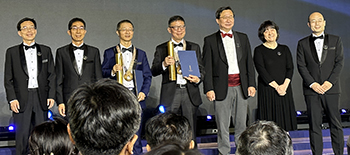
Congratulations to Dr. Jijie Chai and Dr. Jian-Min Zhou, winners of the 2023 Future Science Prize in Life Sciences in China! Dr. Chai and Dr. Zhou won this prestigious award for their discovery of resistosomes and were recently honored at a ceremony in China.
The Future Science Prize recognizes scientific breakthroughs in life science, physical science, and mathematics/computer science. The prize was initiated in 2016 by the Future Forum, a nonprofit organization based in mainland China. Learn more.
Jijie Chai was born in Liaoning, China, in 1966. He received his Ph.D. degree from the Institute of Materia Medica, Chinese Academy of Medical Sciences and Peking Union Medical College in 1997.
Jian-Min Zhou was born in Sichuan, China, in 1964. He received his Ph.D. degree from Purdue University in 1994.
Current Position: Ph.D. Student in the Bozkurt Lab at Imperial College London
Education: M.Res. degree in synthetic and systems biology from Imperial College London; M.Biol. degree in biological sciences from Balliol College, University of Oxford
Non-scientific Interests: Climbing, running, and reading
Brief Bio: My first experience of molecular plant pathology was at Rothamsted Research Station, where I undertook a summer internship in Professor Kim Hammond-Kosack‘s group. At Rothamsted, I worked on developing genetic resistance against Fusarium head blight, a fungal disease that still poses a significant threat to global cereal production.
At the University of Oxford, I joined Professor Renier van der Hoorn‘s group for my master’s project to improve plant molecular farming. Plant molecular farming uses plants as biofactories to produce valuable pharmaceutical proteins, such as antibodies and enzymes. I investigated using pathogen effectors to suppress the plant immune system and boost plant molecular farming yields.
My current Ph.D. project in Dr. Tolga Bozkurt‘s lab at Imperial College London combines my interests in synthetic biology and molecular plant pathology. I am working toward engineering plant immune receptors, using synthetic biology approaches and structural modeling, to recognize new pathogen effectors.
In our review published in MPMI, we discuss effectors from oomycete plant pathogens that accumulate near the haustorium, a specialized digit-like pathogen feeding structure.
By summarizing the current literature on perihaustorial effectors, we found that many perihaustorial effectors convergently target host endomembrane trafficking to suppress the plant immune response at this crucial interface.