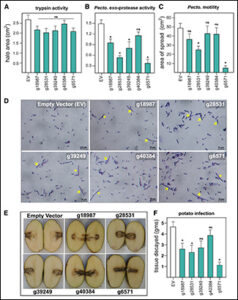
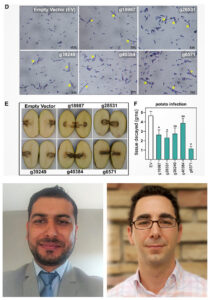
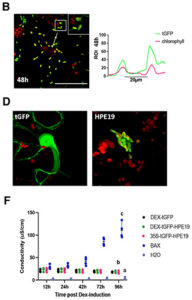
Janak Joshi and colleagues identify protease inhibitors from wild potato that inhibit disease caused by bacterial Pectobacterium pathogens. These protease inhibitors can be used in potato breeding programs and may potentially have a much more immediate effect as purified proteins that can be used to manage Pectobacterium-caused disease.
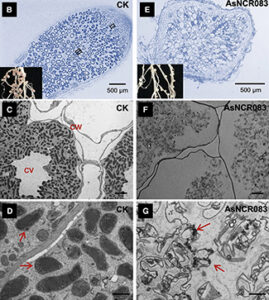
Nodule-specific cysteine-rich (NCR) peptides are targeted to the symbiosomes to regulate bacteroid differentiation. Feng Wei and colleagues identified NCR peptides from Astragalus sinicus and showed that AsNCRs expression depends on a rhizobial peptide transporter encoded by the BacA gene. Further, they established that AsNCR067 promotes rhizobial growth, whereas AsNCR083 expression in rhizobia disrupts late nodule development and bacteroid differentiation. This research highlights that NCR peptides are plant-encoded checkpoints for rhizobial differentiation in nodules and can be used as a tool to modify legume-rhizobia symbiosis.
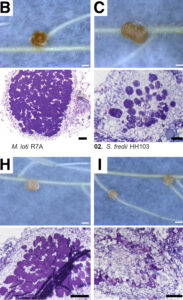
Why do some legumes interact only with one or two specialist rhizobia symbionts while others interact with many? Mohammad Zarrabian and colleagues identify a locus in Lotus burtii that determines its ability to interact with many different rhizobia strains. This study provides an opportunity to understand how host range and its restriction is controlled at a molecular level.
The IS-MPMI Board of Directors (BOD) is accepting nominations for two Directors to join the BOD beginning at the IS-MPMI Congress in July. The term lengths of these positions are four years. Nominations (self-nominations are welcome) for these positions will be accepted until May 1. Voting by the general membership will take place before the Congress.
Requirements/duties of Director positions:
Maintain membership in IS-MPMI.
Contribute to society leadership, decision making, and Congress planning by participating in monthly or bimonthly BOD video conferences and follow-up communications, averaging less than 2 hours per month.
Nominations should be sent to IS-MPMI President Roger Innes with “ISMPMI BOD Nomination” in the Subject line. Nominations should include:
Name
Current position
Contact information
All nominees will be asked to submit a one-page statement describing their motivation for serving on the BOD and their vision/priorities for IS-MPMI moving forward.
The Nominations Committee is committed to maintaining a diverse BOD and will take into consideration reasonable distribution of geographic location of all nominees.
We’re excited for you to join us in Providence, Rhode Island, for five days of programming exploring the latest research in plant–microbe interactions. Network with scientists from around the globe and connect with your peers at our first in-person meeting in four years! Register by May 22 to save with advance registration rates. Register today!
Amelia Lovelace,1 Andrew Read,2 Nichole Ginnan,3 and Kevin Cox4
1 The Sainsbury Laboratory, Norwich Research Park, NR4 7UH, UK
2 Department of Plant and Microbial Biology, University of Minnesota, St. Paul, MN, USA
3 Microbiome Center, Huck Institutes of the Life Sciences, The Pennsylvania State University, University Park, PA, USA
4 Donald Danforth Plant Science Center, St. Louis, MO, USA
The ongoing COVID pandemic has impacted many facets of our personal and professional lives, including the cancellation of in-person scientific conferences. Conferences are vital for the exchange of cutting-edge ideas and building professional networks—both of which are particularly crucial for researchers at early stages of their careers. IS-MPMI leadership recognized that our community must adapt and, thus, designed a virtual conference to create opportunities for early career scientists to share their innovative research within our community.
Members of the plant–microbe interactions community from across the globe gathered virtually for the 2022 Early Career Showcase Symposium. This seminar series took place over 4 days, June 8–9 and September 20–21, and featured talks from 35 nominated researchers housed at institutions in 15 countries. In addition to geographic diversity, topics presented spanned the spectrum of plant–microbe interactions. Several talks focused on new discoveries related to plant immunity and effector biology, in addition to advances in biological controls, symbiosis/microbiome studies, and intriguing data analysis tools. Speakers were selected for their excellence in science, as well as their efforts in creating and maintaining diversity and inclusion in STEM fields.
Each day research talks were followed by breakout sessions led by prominent members of the IS-MPMI community. These more intimate groups enhanced networking opportunities and centered discussions around future career options, fellowships and grants, scientific intuition, effective networking, and pitching concurrent IS-MPMI session ideas. In addition to the live event, research talks were recorded and are available to the IS-MPMI community online.
You can also follow the conversation on Twitter, which includes links to preprints and published manuscripts, as this symposium was tweeted live by the official IS-MPMI Twitter account (@IS-MPMI) handle using the #ISMPMIShowcase hashtag.
Although not a substitute for in-person meetings, the virtual format removed some significant hurdles, such as financial and visa requirements, that limit the ability of numerous scientists to attend national and international conferences.
We believe that the success of the Early Career Showcase should serve as a model for future virtual or hybrid opportunities that allow us to highlight the contributions of the global IS-MPMI community—especially in years when there is no in-person IS-MPMI Congress. We would like to thank the presenters, the IS-MPMI Board of Directors, and the moderators who volunteered their time to put together this wonderful showcase.
Figure 1. Summary of symposium program and speaker demographics.
Molecular Plant–Microbe Interactions (MPMI) publishes peer-reviewed fundamental and advanced applied research on the genetics, genomics, molecular biology, biochemistry, and biophysics of pathological, symbiotic, and associative interactions of microbes, insects, nematodes, or parasitic plants with plants. New Scope
MPMIpublishes cutting-edge research that investigates the molecular mechanisms of plant interactions with other organisms, including pathogens, pests, and beneficial microbes. The journal communicates novel findings that significantly advance our molecular and cellular understanding of these plant-associated interactions. New Acceptable Content for MPMI
Molecular and cell biological analysis of relevant factors involving the plant-associated organism or the plant alone or molecular analysis of components that affect or modulate plant–microbe interaction
Genetic analysis (fundamental or applied) that advances knowledge of plant and/or plant-associated organism interactions
Molecular evolution and molecular ecology of interactions between plants and other organisms
Comparative genomics of organisms associated with a plant–microbe interaction
Research addressing molecular aspects of symbiotic and associative relationships with plants
Spatial and temporal analyses of the cell biology of plant–microbe interactions, including studies focused on light and/or electron microscopy
Technical advances (methodological), if they report important novel advances in technology for studying the molecular aspects of plant–microbe interactions mentioned above
Consider submitting your next paper to MPMI, the official journal of IS-MPMI. IS-MPMI members receive a discount to publish inMPMI. Beyond gold open access publication, MPMI offers virtual presentation opportunities and an official podcast, Microgreens, to enhance reader engagement worldwide. The journal’s association with two scientific societies (MPMI is also a member journal of The American Phytopathological Society) results in dual marketing efforts, which exposes your work to a wider audience.
If you are unsure whether your manuscript is appropriate for MPMI, you are encouraged to submit a presubmission inquiry to Editor-in-Chief Tim Friesen describing the significance of your findings.
Effectors are central to determining the complex and dynamic interaction between plants and microbes. Whether those interactions result in the establishment of a beneficial or negative interaction, effectors are at the interface of any plant–microbe interaction.
Despite their role as mediators of plant–microbe interactions, gaining a full understanding of the biology and evolution of these intriguing molecules has been a challenging task. This MPMI Focus Issue will present the latest developments in the study of microbial effector biology and evolution in the context of plant immunity across diverse systems. As the scientific community seeks to respond to global challenges in agriculture and food production, we wish to highlight potential solutions and technologies emerging from research in microbial effectors.
We invite research and review articles that explore the complex role of effectors in molecular plant–microbe interactions. Articles highlighting translational research, as well as fundamental understanding, are welcome. We look forward to assembling an issue that features the excellent research in this area!
Benefits to Authors
A Focus Issue offers authors several benefits. A single-topic issue gives scientists an opportunity to publish alongside the related work of their peers to highlight progress in a focal area. The Effectors at the Interface of Plant–Microbe Interactions MPMI Focus Issue will be widely promoted and is expected to be highly cited, giving authors maximum exposure.
Articles will be submitted to Crossref, allowing citation tracking and connectivity as this research area moves forward in MPMI and other scientific journals.
If you are working on research described herein, submit your manuscript to MPMI and select “Focus Issue” as the article type. Please also indicate in your cover letter that you would like your manuscript to be considered for the 2024 Focus Issue.
For more information about the scope of this issue, please contact MPMI Editor-in-Chief Tim Friesen.
They revealed in a previous study that wild potato produces virulence-reducing metabolites. In the authors’ latest research, they compared the protein profiles of wild and domestic potato, discovering protease inhibitors that also prevent bacterial malignance.
Heuberger comments, “Our finding is the second resistance mechanism we observe in Solanum chacoense M6. This supports the idea that wild plant species have evolved with multiple resistance factors, or their own ‘pyramid’ of traits, that can be translated into our food and ornamental plant industries.”
Hear the authors talk more about this discovery and their goals to breed a generation of potato varieties that resists pathogens durably and independently. Register for the free virtual seminar today! Catch Up on Recently Recorded Seminars
Previous seminars are available for viewing. Learn more.
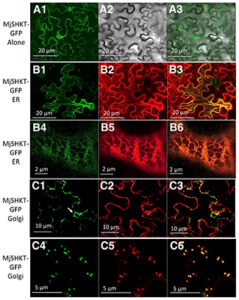
As one of the most destructive plant parasites, Meloidogyne root-knot nematodes infect thousands of plant species. AnilKumar et al. used transcriptomic data from M. javanica on tomato to identify two candidate M. javanica effectors potentially involved in nematode infection. Functional characterization of these effectors showed that MjShKT is involved in the inhibition of programmed cell death and that MjPUT3 may be involved in modifying root morphology—both of which improve the in planta fitness of the pathogen. This work provides another step toward understanding the important interaction between plants and nematodes.
Plant pathogens in the genus Phytophthora cause major economic losses globally. Brent Kronmiller and colleagues evaluated the relationships among 31 newly sequenced individual Phytophthora species using comparative genomics and transcriptomics and found variation in effector compliments, as well as predicted genes, that were likely involved in horizontal gene transfer events. This work provides a substantial resource for future studies involving Phytophthora species.
To combat the phloem-limited ‘Candidatus Liberibacter solanacearum’ pathogen, Paola Reyes Caldas and colleagues determined its effector repertoire by predicting proteins secreted via the general secretory pathway across four different haplotypes. Additionally, they investigated effector localization in planta and profiled effector expression in the vector and host. Their results reveal that ‘Candidatus Liberibacter solanacearum’ effectors possess complex expression patterns, target diverse host organelles, and the majority are unable to suppress host immune responses. This research opens the door for identifying novel targets of these effectors to manage vector-borne diseases.