Resistance gene Rpi-blb2 is broadly effective against Phytophthora infestans in potato, whereas Avrblb2, a known allele of the cognate effector, evades detection. In the August issue, Oliva and colleagues report their extensive analysis of the Avrblb2 gene family. They found that Avrblb2 is present in multiple copies and types in P. infestans isolates, which suggests that expansion of this family contributes to pathogen fitness.


The IS-MPMI Job Center will help job seekers and employers start fresh this fall. Job seekers can find targeted job listings and connect with employers who are also IS-MPMI members. Employers, if you are looking to grow your organization and find a qualified job seeker, the IS-MPMI Job Center is a great way to gain exposure. Members receive a discount on postings! Check your IS-MPMI News Capsule for more information.
Dear members,

I would like to give you an update on a recent IS-MPMI Board of Directors (BODs) meeting, during which a number of society matters, including our next society congress MPMI2016, journal MPMI, and newsletter Interactions were discussed.
As you know, the biennial IS-MPMI Congresses bring us together to share exciting results, exchange new ideas and catch up with new and old friends. The next IS-MPMI congress will be held in Portland, Oregon, USA, on July 17-21, 2016. To ensure that the next Congresses delivers not only exciting science, but also high-quality services, the local organizing committee led by Brett Tyler at Oregon State University is working closely with our BOD members in the organization of this congress. In addition, a professional team at the IS-MPMI Headquarters is involved in handling the logistics for the congress. I am happy to report that the organization process is going well and is on schedule. Current efforts are devoted to identifying plenary and concurrent session speakers who can highlight exciting developments in key areas of research that represents our society’s broad membership. An important goal is to feature many new speakers (i.e., who did not speak in recent congresses) and to leave a substantial number of time slots for oral presentations to be selected from submitted abstracts. Another goal is to keep the cost as low as possible for student and postdoc attendees. Efforts are also being made to secure various funds to partially support the travel of potentially dozens of junior members to attend the congress. Please check the MPMI 2016 website for updates).
Our society journal MPMI has played a leading role in publishing the bulk of cutting-edge research on molecular aspects of plant-microbe interactions. I am sure that you are aware of many challenges in further elevating the status of MPMI in the publishing arena. There are a number of highly successful new journals that now publish many of our members’ original research. In this sense, the high-profile research conducted by our members has contributed to the competitiveness of publishing. Facing these new challenges, the current Editor-in-Chief, Jane Glazebrook, and her team (senior editors and members of the editorial board) have implemented several innovative approaches (including Focus Issues) to improve both the attractiveness of MPMI and the rapid dissemination of accepted manuscripts via the “First Look” section. The next Focus Issue to be edited by John Carr and Steven Whitham will feature “Noncoding RNA-Mediated Regulation of Plant-Microbe Interactions,” with a submission deadline of October 15, 2015. These Focus Issues are expected to be highly cited, giving authors maximum exposure. At the end of this year, Jane would have completed her 3-year term as the EIC. On behalf of our members, I would like to thank Jane and her editorial team for their dedication, creativity and time for maintaining a high standard of MPMI in publishing original MPMI research.

The BOD has selected John McDowell to succeed Jane as the EIC of MPMI. As many of you know, John is a professor in the Department of Plant Pathology, Physiology, and Weed Science at Virginia Tech. He has been a member of the MPMI Editorial Board for 10 years. Most recently, he was a senior editor of MPMI. John has a long-standing research record in plant-pathogen interactions, particularly in the study of plant-oomycete interactions. He will lead a new editorial board, starting January 2016. We wish John and his team all the best in taking on this important responsibility and in further elevating the status of MPMI as a place to publish some of our society’s best original research and opinions.
With the creation of our society website and the conversion of our society newsletter to online format, Interactions, communication and networking in our community have become more dynamic and timely. For example, through Interactions I hope that you have become aware of efforts toward a new research initiative (“Phytobiomes Initiative”) in the United States that will likely impact many of our members. A draft Phytobiomes Roadmap is currently available for comment. If you have not commented, please do so as soon as you can. For a detailed perspective of this initiative by Jan Leach, please visit www.phytobiomes.org.
Soon, Interactions will also implement a member highlights piece and perspectives articles. The EIC of Interactions, Brad Day, has been working with IS-MPMI Headquarters to ensure the news source is regularly populated with new content. Keeping content fresh in this new format is critical. This will require active involvement of our members to contribute new stories and events. I encourage you to contact Brad if you have a research story or an academic event that will be of interest to our community.
Finally, I want to take this opportunity to thank the IS-MPMI BOD for their work in the past year. These elected BOD members have volunteered their valuable time and ideas, beyond their demanding academic jobs, to advance various functions of our society. I also would like to thank the help of an excellent staff at the IS-MPMI Headquarters.
With best wishes,
Sheng Yang He
IS-MPMI President
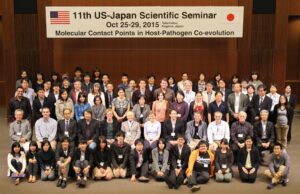
On October 25-29, 2015, one of the longest running symposia in the field of plant-pathogen interactions was held in Kagawa, Japan. It featured more than 25 speakers from the United States and Japan, with a topical focus on molecular plant-pathogen interactions. The “US-Japan Scientific Seminar: Molecular Contact Points in Host-Pathogen Co-evolution,” began in the mid-1960’s with a primary aim of enhancing dialogue between the US and Japan through scientific and cultural exchange. Almost 60 years since the first meeting, the focus has not waivered from the initial goal, and in the current meeting, the breadth and scope of scientific discovery was only surpassed by the renewal of decades-long friendships and collaboration.
Four primary themes of the 11th Symposium resonated throughout the duration of the meeting. First, as presented by Jan Leach, Adam Bogdanove, Ryouhei Terauchi, Brett Tyler, and Brad Day, the development and use of new technologies aimed at both uncovering new areas of research in the study of host-pathogen interactions, as well as those aimed at addressing fundamental unanswered questions related to pathogen virulence, adaptation, and host response have led to significant advances in the field of molecular plant-microbe interactions. Coupled to this, the use of what were considered “non-model” systems only a short time ago, studies employing rice, soybean, and vegetable crops have provided insight into the complex interactions between host, pathogen, and the environment.
As a second theme of the meeting, the use of new and emerging technologies have opened the door to a growing number of systems-level approaches, defining the complex interactions between cellular processes in response to stress. These new technologies have also provided a framework for developing biological models aimed at predicting the outcome of host-pathogen interactions. For example, as presented by Shahid Mukhtar, Fumi Katagiri, and Dan Kliebenstein, one of the next frontiers in defining the complex interactions between host, pathogen, and environment is the analysis of the complex genetic networks underpinning resistance and susceptibility. Using methods coupling next-generation sequencing with an analysis of the specificity and function of protein-protein interaction modules, we are now moving towards defining the relationship(s) between resistance signaling networks and pathogen virulence strategies. In the coming years, it is anticipated that our understanding – and future work in this area – will move beyond the traditional “pairwise” relationships to analyze pathogen virulence and host resistance, and will focus on the stochastic interactions that underpin the complex interactions that govern resistance and susceptibility.
Next, a theme almost as old as the Symposium itself, the analysis of plant-fungal interactions took center stage. From toxins, to chitin, to complex cellular interactions, substantial advances have been made over the past few years in our understanding of how this fast-evolving class of pathogens interacts with plants. Topics ranging from receptor ligand interactions (Hanae Kaku), the biosynthesis of host-specific toxins (Kazuya Akimitsu and Tom Wolpert), and the cellular analysis of these processes (Marie Nishimura, Yoko Nishizawa, Kazuhiro Toyota) were discussed, and in total, work in this area is providing a new paradigm towards our understanding of this important class of pathogens
Finally, and as a primer for future meetings, emerging themes in the field of plant-pathogen interactions were a common topic over the course of the Symposium, not only as a focus for future research in the area of plant-microbe interactions, but also as a challenge to the more than 20 students and postdocs that participated in the meeting. Issues related to sustainability, climate change, and food production were noted by all of the speakers, and from this, a call to the next generation of scientists to innovate and work globally as they tackle a growing list of important questions and challenges was made. As was the intent of the joint communiqué delivered in 1961 by US President John F. Kennedy and Japanese Prime Minister Hayato Ikeda, our ability to mitigate challenges related to food security and production must rely on persistent cooperation through collaboration, the exchange of ideas, and resources.
The 12th US-Japan Symposium will be held in Traverse City, Michigan in 2020. For inquiries related to this meeting, please contact Adam Bogdanove (ajb7@cornell.edu), Brad Day (bday@msu.edu), or Lindsay Triplett (lindsay.triplett@ct.gov).
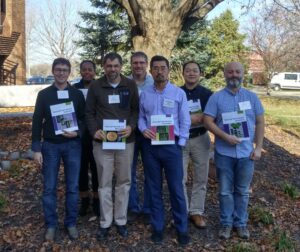
The new MPMI editorial board met together at IS-MPMI headquarters in Minnesota to mark the beginning of their three-year oversight of the journal. Watch for an upcoming Q&A article with the new Editor-in-Chief John McDowell.