

The MPMI Editor’s pick for March 2020 is “Comparative Genomics Screen Identifies Microbe-Associated Molecular Patterns from ‘Candidatus Liberibacter’ spp. That Elicit Immune Responses in Plants” with first author Yuan Chen, a postdoctoral researcher in the lab of Jennifer Lewis at the USDA Plant Gene Expression Center and UC-Berkeley. Lewis shared some background for their work and how collaborations and feedback from colleagues can really help to bring a project together.
Submitted by Jennifer Lewis
Citrus greening, or Huanglongbing, caused by ‘Candidatus Liberibacter asiaticus,’ has decimated citrus groves in Florida and is spreading through other citrus-growing areas of the United States. Citrus greening causes blotchy mottle (random yellowing) on leaves; bitter, misshapen, and discolored (green) fruit; and tree decline—all of which affects the quality and flavor of oranges.
Citrus greening is a difficult scientific problem to investigate, because it is caused by an unculturable phloem-restricted pathogen and because it affects a woody species (which means plants grow very slowly and take a lot of time to produce the next generation). I was familiar with the work done by Honour McCann, formerly at the University of Toronto and now at the Max Planck Institute in Tübingen, and David Guttman, at the University of Toronto, to identify microbe-/pathogen-associated molecular patterns (MAMPs/PAMPs) by bioinformatic approaches (McCann et al., 2012). Work from Cyril Zipfel, University of Zurich, and others had shown that applying purified MAMPs to Arabidopsis induces immune responses, such as the production of reactive oxygen species (ROS), and that this so-called pattern-triggered immunity (PTI) response protects plants from infection (Lacombe et al., 2010; Zipfel et al., 2004). We therefore thought that we could boost the immune response in citrus if we could identify endogenous MAMPs in ‘Ca. L. asiaticus.’
MAMPs are highly conserved peptides and therefore believed to be essential for the microbe. However, individual amino acid residues in a MAMP might be under positive selection to avoid recognition by the plant’s defenses. Positive selection leads to an increase in variants in the population, because the variants are beneficial to the pathogen. In contrast, deleterious variants are subject to negative selection, because they impair fitness.
Claire Bendix, a former USDA postdoc in my lab, carried out computational analyses to identify putative MAMPs with signatures of positive selection from ‘Ca. L. asiaticus’ genomes. We hypothesized that putative MAMPs should be specific to strains that infect citrus—not found in the nonpathogenic relative L. crescens and possibly also absent in ‘Ca. L. solanacearum,’ which infects solanaceous plants.
Yuan Chen, a University of California, Berkeley postdoc in my lab, tested the role of putative MAMPs in eliciting immune responses, starting first in Arabidopsis and Nicotiana benthamiana, as these plants are commonly used to look at ROS production, which is a feature of the immune response. These assays gave exciting results, showing that two of the ‘Ca. L. asiaticus’ peptides could elicit ROS production. However, it was well known that peptides could be contaminated with flagellin peptide (flg22), which is a very strong elicitor of PTI, and therefore give a false-positive result. To ensure that the ‘Ca. L. asiaticus’ peptides were not contaminated, Yuan tested for ROS production in the Arabidopsis flagellin receptor (fls2) mutant, as well as in the Ws ecotype of Arabidopsis, which lacks FLS2. She found that both ‘Ca. L. asiaticus’ peptides still elicited ROS responses, indicating that they were not contaminated with flg22. This control was very important in convincing us the results were real. In addition, Yuan read about some MAMPs that could induce a second ROS burst (Segonzac et al., 2011; Shang-Guan et al., 2018), which might lead to longer immune responses. She tested all of our peptides, but none was able to induce a second ROS burst.
Yuan then turned to optimizing ROS assays in citrus, first using flg22 as the elicitor. This proved to be quite challenging, as citrus has a waxy cuticle on the leaves and it was difficult to deliver the peptides. Yuan tried many different approaches (including different surfactants, inoculation methods, and nanoparticle delivery systems) before developing a reliable and reproducible protocol using vacuum infiltration of new flush (leaves) and luminescence-based detection of ROS production. She then tested our peptides on several Citrus species and found one (pksG) that elicited strong ROS production.
For the last few years, we have been collaborating with Bill Dawson, University of Florida, to test our peptides in sweet orange. Bill and his colleagues developed a viral delivery system using Citrus tristeza virus (CTV) that allows them to deliver novel molecules to the phloem of citrus trees (Dawson et al., 2015). They are testing whether CTV-mediated delivery of our peptides reduces symptoms from ‘Ca. L. asiaticus’ in the field.
Our work shows how fundamental work can be applied to an important agricultural problem. It combined bioinformatics, evolutionary biology, genomics, plant pathology, and cell biology to find ways of fighting against a devastating disease. Our work also illustrates the importance of delving into the literature and having key controls to have confidence in your data. This work also raises many interesting questions regarding the evolution of phloem-restricted pathogens. For example, perhaps ‘Ca. L. asiaticus’ adapted to colonize the phloem in part to avoid PTI.
We were fortunate to have great discussions with lab members; excellent greenhouse support from greenhouse manager Lia Poasa; nursery technicians Shawna Kelley, Julie Calfas, and Christopher Tucker; and a great collaboration with Bill Dawson and members of the Dawson lab, Choaa El–Mohtar and Cecile Robertson.
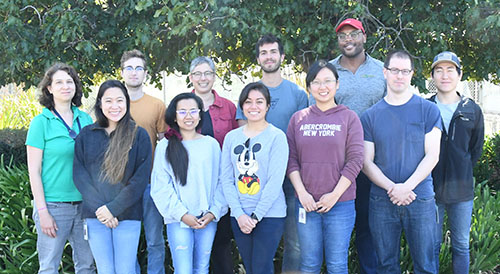
Front left to right: Ilea Chau, Jamie Calma, Yuritzy Rodriguez, Yuan Chen, Karl Schreiber
Back left to right: Jana Hassan, Hunter Thornton, Jennifer Lewis, Maël Baudin, Jacob Carroll-Johnson, Jack Kim.
References
Dawson, W. O., Bar-Joseph, M., Garnsey, S. M., and Moreno, P. 2015. Citrus tristeza virus: Making an ally from an enemy. Annu. Rev. Phytopathol. 53:137-155.
Lacombe, S., Rougon-Cardoso, A., Sherwood, E., Peeters, N., Dahlbeck, D., van Esse, H. P., Smoker, M., Rallapalli, G., Thomma, B., Staskawicz, B. J., Jones, J. D. G., and Zipfel, C. 2010. Interfamily transfer of a plant pattern-recognition receptor confers broad-spectrum bacterial resistance. Nat. Biotechnol. 28:365-369.
McCann, H. C., Nahal, H., Thakur, S., and Guttman, D. S. 2012. Identification of innate immunity elicitors using molecular signatures of natural selection. Proc. Natl. Acad. Sci. U.S.A. 109:4215-4220.
Segonzac, C., Feike, D., Gimenez-Ibanez, S., Hann, D. R., Zipfel, C., and Rathjen, J. P. 2011. Hierarchy and roles of pathogen-associated molecular pattern-induced responses in Nicotiana benthamiana. Plant Physiol. 156:687-699.
Shang-Guan, K., Wang, M., Htwe, N., Li, P., Li, Y., Qi, F., Zhang, D., Cao, M., Kim, C., and Weng, H. 2018. Lipopolysaccharides trigger two successive bursts of reactive oxygen species at distinct cellular locations. Plant Physiol. 176:2543-2556.
Zipfel, C., Robatzek, S., Navarro, L., Oakeley, E. J., Jones, J. D. G., Felix, G., and Boller, T. 2004. Bacterial disease resistance in Arabidopsis through flagellin perception. Nature 428:764-767.
 After many years, it is great to have our work on the role of EDR1 in the regulation of PAD4 and EDS1 published in MPMI. This project was initially intended to be a short investigation, however, it evolved greatly over time. The winding story of this project highlights how accidental discoveries and observations can enable important scientific discoveries.