Category: Issue 1 •​ 2021​

A Recap of the 2017 APS Annual Meeting

ISMPMI 285 2 1955560 removebg preview

Issue 1

2017

interactions

Did You Know

This year’s Annual Meeting of The American Phytopathological Society was held in San Antonio, TX, on August 5–9.
meetinggraphic

As someone whose research program is based primarily on studying molecular plant-microbe interactions, I have always found that the science presented at the APS Annual Meeting is more focused on the applied aspects of plant pathology and that the basic research kind of takes a backseat. However, there were many MPMI-focused talks and sessions, including a Special Session on “New Insights into NLR on Plant Immunity.” I have included some of the meeting highlights, including APS awards to four IS-MPMI members.

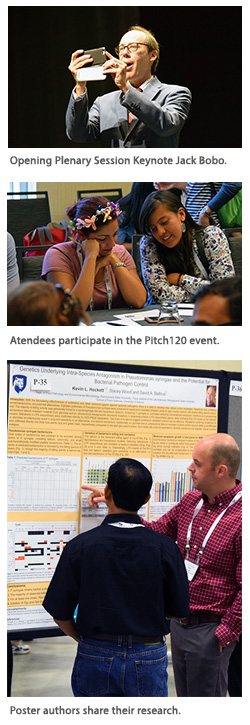
The meeting began with an Opening Plenary Session led by Jack Bobo, senior vice president and chief communications officer for Intrexon (subsidiaries include Arctic apple, AquAdvantage salmon, Oxitec sterile mosquitoes). His talk, entitled “Can Agriculture Save the Planet Before It Destroys It?,” started with a live tweet of the audience cheering “Go plant health!” He followed with a discussion of global trends in food and agriculture, with a take-home message that we need to get to year 2050 without destroying the environment through agriculture (deforestation, draining aquifers). After this date, population growth will slow dramatically and productivity gains will allow us to reduce the global footprint of agriculture. Beyond 2050, he predicts that “for the first time in human history, we will not need more food.” He concluded his talk with something that stuck in my mind: “The next 35 years are not just the most important 35 years there have ever been in the history of agriculture, they’re the most important 35 years there will ever be in the history of agriculture.”

A mid-meeting Plenary Session, entitled “Changing Landscapes in Plant Pathology,” featured three early career scientists using new technologies that impact our science. This session included presenters Greg Heck, science strategy operations manager at Monsanto, who spoke on “RNA-Based Applications for Agricultural Productivity”; Erica Goss, University of Florida, who spoke on “Global Movement, Local Consequences: Using Population Genomics to Understand the Changing Landscape of Plant Pathogens”; and Lav Khot, from Washington State University, who spoke on “State-of-the-Art on Sensing Technologies for Plant Disease Detection.” Recordings of Bobo and the other plenary speakers are available online.

The Closing Session speaker was Jeff Hurt, executive vice president of Velvet Chainsaw Consulting, with a talk entitled “Making the Science of Plant Pathology Work for You: What Now? What’s Next?” His talk was focused on tools and resources to help us summarize our meeting experience and identify actionable items that we can use to impact our own research.

One of the most welcome trends I saw at the meeting was a focus on communicating our science with the public. A networking event led by the APS Office of Public Relations and Outreach trained attendees on developing their own Pitch120—a 120-second summary of their research projects that could be understood by both scientists and nonscientists. Jim Bradeen, University of Minnesota, led a session entitled “Science as Story and Story as Science: Telling Plant Pathology Research Stories.” Another session, entitled “Navigating Contentious Conversations,” was led by Paul Vincelli, University of Kentucky, and focused on engaging the public on controversial topics (GMOs, fungicide usage).

Many of the presentations at the meeting were recorded and can be purchased and viewed online.

APS members are looking forward to next year’s International Congress of Plant Pathology: Plant Health in a Global Economy, which will be held in Boston, MA, from July 29 to August 3, 2018. More information and a preliminary list of plenary and keynote talks is available at the meeting website.

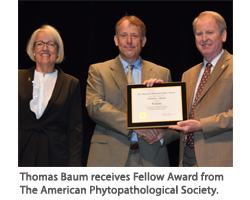
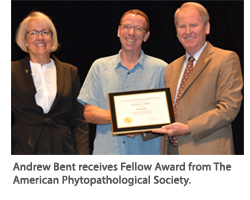
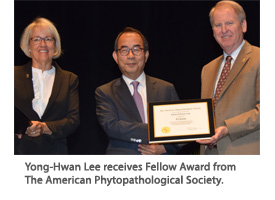
Four IS-MPMI members were recognized at the meeting for their outstanding contributions to the study of plant-pathogen interactions. Thomas Baum, Iowa State University; Andrew Bent, University of Wisconsin-Madison; and Yong-Hwan Lee, Seoul National University, were named APS Fellows. APS Fellow recognition is based on significant contributions in one or more of the following areas: original research, teaching, administration, professional and public service, and/or extension and outreach.

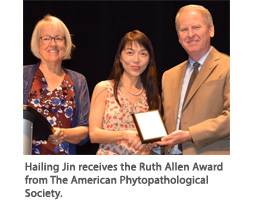
Hailing Jin, University of California-Riverside, was given the Ruth Allen Award, which honors individuals who have made an outstanding, innovative research contribution that has changed, or has the potential to change, the direction of research in any field of plant pathology.

Each of the awardees was asked to provide their perspective on their award and provide insights/advice for aspiring young scientists. Read the interviews in this issue of Interactions.

InterView: Thomas Baum

ISMPMI 285 2 1955560 removebg preview

Issue 2

2017

interactions

Did You Know

interviews

Thomas J. Baum
Iowa State University
  1. What area(s) of molecular plant-microbe interactions do you feel your research has impacted most?
    I think our work and that of our collaborators was instrumental in bringing plant nematology into the next phase of research questions and approaches. We led plant nematology awaybaumfrom pure field work aimed at identifying novel management options and toward using molecular and genomic tools to explore plant-nematode interactions.
  2. What advice do you have for young scientists aspiring to achieve the level of science that has major impact?
    You are probably in it for the long haul. Find something you are passionate about because “(professional) life goes on long after the thrill of living (as a researcher) has gone”—John Mellencamp got it right. You need to be able to maintain your curiosity, idealism, and fun. Otherwise, you might run out of steam down the road. You need to be able to reinvent yourself and let go of old ideas to embrace new ones. Otherwise, you just might run out of funding down the road. You need to take care of your people and collaborators and be a trusted team member. Otherwise, you just might run out of friends down the road.
  3. When you were a post-doc, what had the largest influence on your decision to enter your specific research area in your permanent position? Was this a “hot topic” at the time, or did you choose to go in a different direction?
    My field of research was not a hot topic when I entered it. I got into it because it was exciting biologically—and it still is. I listened to Dick Hussey, University of Georgia, give a talk when I was a graduate student and that was all I needed. I knew that was what I wanted to do. Sedentary nematodes delivering proteins into their host plants to reprogram plant cells to form a feeding structure is just cool. And over the years, our field developed into one of the hottest areas in plant pathology. As it turned out, we were working on effectors all these years and we never knew it! We thought we were working on nematode “spit”—how naïve ☺.

InterViews: Andrew Bent

ISMPMI 285 2 1955560 removebg preview

Issue 2

2017

interactions

Did You Know

interviews

Andrew F. Bent
University of Wisconsin – Madison
  1. What area(s) of molecular plant-microbe interactions do you feel your research has impacted most?
    From my early days, it would have to be developing and popularizing Arabidopsis and Pseudomonas syringae as experimental models for plant pathology research and discovering thatbentR genes encode NB-LRR proteins. A number of people contributed to that early work, which opened up whole fields of discovery. From midcareer, we had some impact with “defense-no-death” work on the hypersensitive response, improvements to floral-dip Arabidopsis transformation, and findings about flagellins and FLS2 that offered broader insights into MAMPs and MAMP receptors. Recently, our work on soybean resistance to soybean cyst nematode has been pretty big, especially in the soybean and nematology fields, because the disease and the Rhg1 locus are so important in agriculture and because we found a novel mechanism, resistance through infection-site expression of toxic versions of plant housekeeping genes
  2. What advice do you have for young scientists aspiring to achieve the level of science that has major impact?
    Think explicitly and extensively about all the areas you could work in, looking for the things that seem like “the future”—things that may have a higher impact because of the science or the pathosystem. Find achievable higher-impact work. Form the habit of exploratory thinking and reading and of active dreaming. When you sit in a seminar or read a paper, actively think of ways that their work could be further developed into something exciting. Do the same explicit dreaming with your own work. Then be ready to do the hard work over multiple years to make it happen.
  3. When you were a post-doc, what had the largest influence on your decision to enter your specific research area in your permanent position? Was this a “hot topic” at the time, or did you choose to go in a different direction?
    As a post-doc, we and others had set up Arabidopsis and Pseudomonas syringae as a great pathosystem for making research progress, and our R gene discovery was brand new. So when looking to form my own lab, there were a huge number of molecular plant pathology topics out there waiting to be explored, and we did have a “hot” system in place to study them. Over time, I took things in many new directions, but coming out of my post-doc, I proposed direct offshoots of my post-doctoral work to get an assistant professor job and my first independent funding.

InterView: Yong-Hwan Lee

ISMPMI 285 2 1955560 removebg preview

Issue 2

2017

interactions

Did You Know

interviews

Yong-Hwan Lee
Seoul National University
  1. What area(s) of molecular plant-microbe interactions do you feel your research has impacted most?
    My research group has been undertaking comprehensive and integrative approaches to understand the molecular and genomic basis of fungal pathogenesis in the rice blast fungus. Weleealso developed a powerful bioinformatics platform for comparative and evolutionary fungal genomics.
  2. What advice do you have for young scientists aspiring to achieve the level of science that has major impact?
    Be confident and passionate! I also like to recommend to understand the complex and subtle nature of pathogenesis by combining wet lab and bioinformatics approaches as a comparative interface biology.
  3. When you were a post-doc, what had the largest influence on your decision to enter your specific research area in your permanent position? Was this a “hot topic” at the time, or did you choose to go in a different direction?
    To understand the fundamental principles/topics on fungal infection mechanism, I chose the rice blast fungus as a model pathogen and tried to adapt cutting-edge technologies. This led to the discovery that cAMP acts as a crucial second messenger in stimulating the infection process (1993).

InterView: Hailing Jin

ISMPMI 285 2 1955560 removebg preview

Issue 2

2017

interactions

Did You Know

interviews

Hailing Jin
University of California
  1. What area(s) of molecular plant-microbe interactions do you feel your research has impacted most?
    I think my research has the most impact on the areas of cross-kingdom RNAi and how this affects host-pathogen communications and of small RNA and epigenetics-mediated regulationjinin plant-pathogen interactions.
  2. What advice do you have for young scientists aspiring to achieve the level of science that has major impact?
    Identify a research topic or area that interests you the most, then work hard on it. It is also important to be persistent once you start a project. Don’t give up easily or get frustrated when your experiments don’t work. It is always very helpful to find a way to improve your experimental design and to find multiple alternative approaches to address the problem and confirm your findings.
  3. When you were a post-doc, what had the largest influence on your decision to enter your specific research area in your permanent position? Was this a “hot topic” at the time, or did you choose to go in a different direction?
    I have always been interested in developing eco-friendly strategies and effective means to increase the quality and production of crops. During my post-doctoral training in Barbara Baker’s lab at the Plant Gene Expression Center, at the University of California-Berkeley, I used a virus-induced gene silencing approach to dissect the signal transduction pathway of Tobacco mosaic virus-resistance gene N, which not only attracted me to the plant defense and small RNA world but also allowed me to gain experience in all the small RNA techniques. At that time, the important role of small RNAs in plant development was just emerging, but very few labs were working on the role of small RNAs in stress responses, especially in the field of plant immune responses against bacterial and fungal pathogens. After I got my independent position, I felt that it would be an excellent opportunity for me to start a new research direction—regulatory role of small RNAs in plant immunity—instead of continuing working on the hot topic “plant resistance genes.” This research area is my passion and I will continue to work on improving our crops and food for many years to come.

Expand on Discussions Reported in New, Open-Access MPMI Whitepaper

ISMPMI 285 2 1955560 removebg preview

Issue 2

2017

interactions

Did You Know

A new whitepaper published in Molecular Plant-Microbe Interactions, entitled “Foundational and Translational Research Opportunities to Improve Plant Health,” offers a detailed accounting of deliberations at a recent workshop focused on the various biotic challenges to maintaining plant health.

This fully open-access paper provides an outline and an accounting of the discussions between Richard W. Michelmore, University of California, Davis; MPMI Editor-in-Chief John M. McDowell; and nearly 40 other researchers at the British Embassy in Washington, DC, in late 2016.

Members are encouraged to view the whitepaper and extend this engaging conversation about the many challenges and solutions for maintaining the quality and productivity of crops to secure food for the rapidly growing human population.

MPMI and the participants invite reader comments about this paper. Visit apsjournals.apsnet.org/page/MPMI-01-17-0010-CR to become part of this important and timely discussion.

Save the Date for the IS-MPMI XVIII Congress

ISMPMI 285 2 1955560 removebg preview

Issue 2

2017

interactions

Did You Know

We are pleased to announce that the next iteration of the IS-MPMI Congress will take place among the beautiful vistas only found in Scotland. During July 14–18, 2019, you will be able to interact with your molecular plant-microbe interactions community from around the world. Witness the majesty and history of this magical land while you engage and participate in stimulating lectures. Keep an eye on the congress website for more information. It is never too early to start making plans for this exciting event!

2019 ISMPMI Logo

Make Plans to Attend ICPP2018

ISMPMI 285 2 1955560 removebg preview

Issue 2

2017

interactions

Did You Know

The International Congress of Plant Pathology (ICPP) is an exciting global event that takes place once every five years. In 2018, Boston, Massachusetts, U.S.A., will host plant health scientists from around the world from July 29 to August 3. Leading experts from around the world will present the latest advances and innovations, celebrate progress, and set a vision for assuring plant health in a global economy. The vision of the congress—An engaged world community of plant health scientists advancing knowledge for a safe, affordable, secure supply of food, feed, and fiber for a growing population.

Members of IS-MPMI are encouraged to attend this one-of-a-kind event during which several presentations will cover aspects of molecular plant-microbe interactions. Visit the ICPP2018 website to see a list of Keynote Sessions and Plenary Sessions.

Featured MPMI Presentation:

Wednesday, August 1

Keynote Session II: Novel Approaches to Controlling Insect-Vectored Plant Diseases
Organizer and Chair: Saskia A. Hogenhout, John Innes Centre, U.K.

Invited Speakers and Presentations:

Utilize Effector Targets to Generate Plant Resistance to Both Phytoplasma and Insect Vectors
Saskia A. Hogenhout, Department of Crop Genetics, John Innes Centre, U.K.

The Many Cell Density-Dependent Behaviors of Xylella fastidiosa: Achieving Disease Control via Pathogen Confusion
Steven Lindow, University of California, U.S.A.

Citrus Huanglongbing: What Can We Learn from Pathogen Effectors
Wenbo Ma, University of California, U.S.A.

header

Oomycete Molecular Genetics Network Annual Meeting

ISMPMI 285 2 1955560 removebg preview

Issue 1

2020

interactions

Did You Know

IS-MPMI member Francine Govers recently informed IS-MPMI of the Oomycete Molecular Genetics Network Annual Meeting. The OMGN meeting will take place April 8-12, 2018 in Shandong Agricultural University (SDAU), Tai’an City, Shandong Province, China. Contact the organizer Xiuguo Zhang or visit the meeting webiste http://omgn.org/program/ for more information.

IS-MPMI Interactions • Issue 2 • 2017

ISMPMI 285 2 1955560 removebg preview

Issue 1

2020

interactions

Did You Know

02 2017

Issue 2 features an InterView with Pamela C. Ronald, of the University of California, by Gazala Ameen, a student travel awardee from North Dakota State University. Also read recaps of the Plant Biotic Interactions Workshop and the APS Annual Meeting. Several IS-MPMI members received awards at the annual meeting and are interviewed in this issue. All of this and more in issue 2!

Featured InterViews: Pamela C. Ronald

This InterView with Pamela C. Ronald, University of California, was performed by one of the 2016 IS-MPMI student travel awardees, Gazala Ameen, North Dakota State University.

Fat Cats Can Jump Over The Wall: Plant Biotic Interactions Workshop in Hohhot, Inner Mongolia, China

Read a recap of key findings presented at the Plant Biotic Interaction Workshop in Hohhot, Inner Mongolia, China.

A Recap of the 2017 APS Annual Meeting

Learn about the MPMI aspects and takeaways from The American Phytopathological Society’s Annual Meeting.

InterViews with Award Winners

News

IS-MPMI Interactions

Editor-in-Chief: Dennis Halterman
Staff Editor: Michelle Bjerkness
The deadline for submitting items to the next issue of Interactions is February 23, 2018.
IS-MPMI Interactions is a quarterly publication by the International Society of Molecular Plant-Microbe Interactions
3340 Pilot Knob Rd. • St. Paul, MN 55121
Phone: +1.651.454.7250 • Fax: +1.651.454.0766
E-mail: IS-MPMI HQ Web: www.ismpmi.org
Share views on “hot topics,” anecdotal stories about research findings published in the MPMI journal, or science-related events within the community. E-mail Dennis Halterman or submit items online.
Scroll to Top