Category: Issue 1 •​ 2021​

XVI Congress Report Now Available

ISMPMI 285 2 1955560 removebg preview

Issue 1

2020

interactions

Did You Know

The report of the XVI Congress is now available as a supplement to the November issue of MPMI. In honor of Ko Shimamoto, a student travel fellowship program was initiated to enrich graduate student and postdoctoral participation at this congress.  The fellows contributed to the dissemination of the meeting findings by releasing daily scientific highlights via social networking. A group of fellows were selected to summarize their perspectives of the meeting highlights to share this information with our broader IS-MPMI community. Contributions to this meeting report were made by: Cris Argüeso, Bethany Huot, Panya Kim, Derek Lundberg, Morgan Halane and Irene Serrano, in collaboration with two IS-MPMI Board members, Roger Innes and Mary Beth Mudgett. Read the full report now.

A SWEET Sugar Transporter in Cassava

ISMPMI 285 2 1955560 removebg preview

Issue 1

2020

interactions

Did You Know

MPMI Nov14 press ready

A Xanthomonas pathogen of rice produces transcription activator-like (TAL) effectors that activate expression of SWEET sucrose exporters in the host, providing a carbon source for the pathogen. In the November issue, Cohn and colleagues present a comprehensive study showing that Xanthomonas pathogens of cassava also produce TAL effectors critical for virulence that activate expression of a sucrose and glucose exporter. This work provides a strategy for engineering Xanthomonas resistance in cassava, an important food crop. View article.

Publications Available for Purchase Online!

ISMPMI 285 2 1955560 removebg preview

Issue 1

2020

interactions

Did You Know

The new media section on ISMPMI.org makes locating and purchasing molecular titles easier than ever! The media section offers a simple browsing experience, an easy-to-use shopping cart, and shipping information at your fingertips. Check out the latest molecular titles, and take advantage of your 10% member discount with any purchase!

Meeting Recap: Attendees Discover Excellent Science and New Ideas at XVI Congress

ISMPMI 285 2 1955560 removebg preview

Issue 1

2020

interactions

Did You Know

The XVI International Congress on Molecular Plant-Microbe Interactions was held in Rhodes Island, Greece, from Sunday, July 6, to Thursday, July 10, 2014. We are very pleased and privileged to have hosted one of the largest international congresses concerning plant diseases and molecular plant-microbe interactions organized in Greece and really grateful that top world scientists joined
us in Rhodes.

CONGRESS IMG1
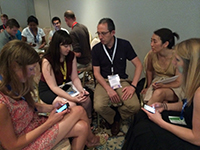
​Attendees network between sessions.
CONGRESS IMG10
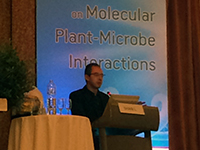
​Sophien Kamoun, president duringthis year’s congress, gives remarks at the opening session.
CONGRESS IMG11
Sophien Kamoun chats with students about social media and science.


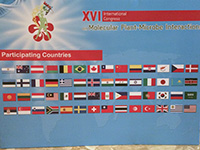
For XVI IS-MPMI Congress 2014, the final turnout was 1,133 scientists from 55 countries worldwide. Seventeen countries were represented by more than 20 participants each: United States–165, Germany–160, United Kingdom–129, Japan–81, France–64, Republic of Korea–56, The Netherlands–54, Greece–44, Spain–40, Italy–35, China–34, Australia–30, Poland–28, Denmark–23, Israel–23, Switzerland–23, and Brazil–20.

The 10 institutions with the highest attendance were:
1. Sainsbury Laboratory, United Kingdom–34
2. Max Planck Institute, Germany–34
3. Agricultural University of Athens, Greece–30
4. University of California, United States: Riverside–10; Davis–9; Berkeley–6
5. Wageningen University, The Netherlands–24
6. INRA, France–23
7. Utrecht University, The Netherlands–13
8. Seoul National University, Republic of Korea–12
9. John Innes Centre, United Kingdom–10
10. RIKEN Center, Japan–9
CONGRESS IMG12
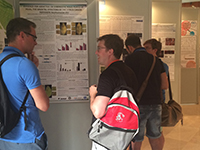
Attendees exchange ideas during a busy poster session.
CONGRESS IMG13
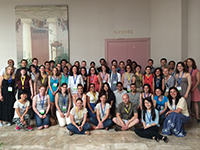
The 2014 IS-MPMI Student Travel Awardees gather to network and learn from the top scientists in the MPMI field.
CONGRESS IMG2
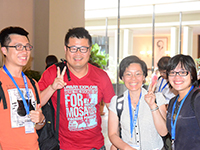
​Finding new connections and having a good time in Greece.
The scientific program started on Sunday afternoon, July 6, with the opening lecture entitled Signaling in Host-Pathogen Interactions, delivered by Fred Ausubel. Ausubel is a professor of genetics with the Department of Genetics, Harvard Medical School and a molecular biologist with the Department of Molecular Biology, Massachusetts General Hospital. Ausubel was also the awardee of the 2014 IS-MPMI Award.
The program continued with the first plenary session, followed the next few days by seven more plenary sessions for a total of 32 presentations. There were also 32 concurrent sessions covering a wide range of topics. For each concurrent session, oral presentations were made by two invited speakers as well as four presenters who were selected from those who submitted an abstract. So, 192 concurrent topics were presented.
More than 750 posters were displayed for poster sessions. The table below shows the number of posters presented in each topic area.
Microbial Pathogenesis………………………………………………………….67
Large-Scale (OMICS) Approaches…………………………………………..55
Biocontrol…………………………………………………………………………..24
Epigenetics……………………………………………………………………………7
Evolution and Ecology………………………………………………………….22
Local – Systemic Resistance……………………………………………………17
Diagnostics………………………………………………………………………….21
Plant Hormones…………………………………………………………………..21
Commonalities Path/Symbionts……………………………………………..10
Neglected Systems………………………………………………………………….8
Effector Biology…………………………………………………………………104
Plant Immunity………………………………………………………………….116
Plant Microbiome………………………………………………………………..35
Toxins………………………………………………………………………………….2
Chemical Biology of Host Pathogen Interaction………………………….6
Programmed Cell Death………………………………………………………….9
Host-Virus Interactions…………………………………………………………..5
Induced Resistance – Priming…………………………………………………25
Biotechnology – Breakthrough Techs……………………………………….19
Novel Approaches to Disease Control………………………………………12
Symbiosis……………………………………………………………………………40
Cell Biology………………………………………………………………………..31
Signaling…………………………………………………………………………….43
Secondary Metabolism………………………………………………………….11
Apoplastic Defenses………………………………………………………………..5

Recognition of Microbes……………………………………………………….37
CONGRESS IMG8
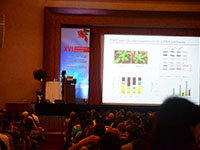
Scientists shared exciting new MPMI breakthroughs.
CONGRESS IMG4
Sharing science during a lunch break.
CONGRESS IMG6
​IS-MPMI members and nonmembers learned about the new IS-MPMI website and engaged with IS-MPMI staff.


Poster Award winners were as follows.
M. Franceschetti (1), M.-E. Segretin (2,3), M. Pais (2), A. Chaparro-Garcia (2), J. I. Bos (2,4), M. J. Banfield (1), and S. Kamoun (2) for “Resurrecting potato R3a: Expanded response to Phytophthora effectors”; (1) Department of Biological Chemistry, John Innes Centre, Norwich, UK; (2) The Sainsbury Laboratory, Norwich, UK; (3) Instituto de Investigaciones en Ingenieria Genetica y Biologia Molecular, Buenos Aires, Argentina; (4) The James Hutton Institute, Dundee, UK.
M. Marchetti (1), A. Juaneau (2), P. Remigi (1), D. Guetta (1), J. Batut (1), and C. Masson-Boivin (1) for “Experimental evolution of the plant pathogen Ralstonia solanacearum into a legume symbiont”; (1) CNRS/INRA, Laboratoire des Interactions Plantes-Microorganismes (LIPM), Castanet-Tolosan, France; (2) CNRS, Federation de Recherches Agrobiosciences, Interactions, Biodiversity, Plateforme d’Imagerie TRI, Castanet-Tolosan, France.
E. Luna, R. Schwarzenbacher, P. Petriacq, J. Stassen, and J. Ton for “Signalling events downstream of β-amino butyric acid perception by IBI1”; Department of Animal and Plant Sciences, The University of Sheffield, UK.
E. Henry, N. Fung, G. Drakakaki, and G.Coaker for “Beyond glycolysis: GAPDHs are multi-functional enzymes involved in regulation of ROS, autophagy and plant immune responses”; University of California, Davis, USA.
J. K. Ishida (1,2), S. Yoshida (2), T. Watakake (1,2), H. Kasahara (2), E. Wafula (3), C. W. de Pamphilis (3), S. Namba (1), and K. Shirasu (2) for “Auxin biosynthesis mediated by the YUC3 flavin monooxygenase is essential for the haustorium development in the root parasitic plant Phtheirospermum japonicum”; (1) Graduate School of Agricultural and Life Sciences, The University of Tokyo, Tokyo, Japan, (2) RIKEN Center of Sustainable Resource Science, Yokohama, Japan, (3) Department of Biology, Pennsylvania State University, University Park, PA, USA.
CONGRESS IMG9
Attendees hear MPMI research at a congress plenary session.
photo
​The hallways were buzzing about exciting science during each break.
photo2
Dozens of countries were represented
at this year’s congress.


We thank all scientists from every country of the world who honored the congress. We deeply thank all participants who were involved in this congress for their effort, commitment, and enthusiasm. We are particularly indebted to chairs of the plenary and concurrent sessions for their excellent work. We appreciate the positive comments received by several colleagues and apologize for any inconvenience caused during the running of the meeting due to unforeseen snags.
To view photographs from the event, visit the congress website (www.mpmi2014rhodes-hellas.gr). Please also note that the abstracts of the congress are free and available for everybody on the congress website.
See you in Portland, Oregon, United States, in August 2016.
Eris Tjamos
Chief Congress Organizer, IS-MPMI 2014

A Letter From the President

ISMPMI 285 2 1955560 removebg preview

Issue 1

2020

interactions

Did You Know

He Shang Yang

I feel so humbled to serve as the president of the International Society for Molecular Plant-Microbe Interactions (IS-MPMI) for the next two years. IS-MPMI has been my professional home for more than 25 years, during which I have learned so much from so many of you who inspire me to be a good scientist and a sincere colleague. I would like to thank the previous IS-MPMI presidents and Board of Directors (BOD), including immediate Past President Sophien Kamoun, for all they have done to make IS-MPMI a vibrant and attractive society for colleagues from more than 30 countries who study the molecular aspects of plant-microbe interactions. Knowing my limited ability, I will work very hard and very closely with the current members of the IS-MPMI BOD to ensure an exciting congress in 2016, a strong society flagship journal (MPMI), and dynamic communication/networking venues through the society website and IS-MPMI Reporter.
The biennial IS-MPMI congresses are special to us because they bring us together to share exciting results, exchange new ideas, and catch up with new and old friends. The XVI IC-MPMI, held on the beautiful island of Rhodes, Greece, was no exception in this respect. With approximately 1,200 attendees (the largest in IS-MPMI history), the congress featured exciting and expansive science, marking another wave of progress in the understanding of diverse plant-pathogen, plant-symbiont, and plant-commensal interactions. Although the topics of immune/symbiosis signaling and effector biology dominated the congress, it was great to see substantial coverage of plant-microbiome interactions, translational research toward disease control and diagnosis, and new insights on plant-pathogen battles over the gene silencing machinery. The XVI IC-MPMI was a great success in terms of the science presented and the networking opportunities provided for the attendees, despite a number of logistic problems (the BOD is taking steps to clarify these problems). A unique highlight of the congress in Rhodes, thanks to the leadership of BOD members Roger Innes and Mary Beth Mudgett, was the involvement of 57 student travel awardees, who actively summarized and disseminated meeting presentations by multimedia during the congress (see the IS-MPMI website). More than 400 students attended the congress, displaying the uplifting youthfulness of our society on the 30th anniversary of the cloning of a pathogen avirulence gene and the 20th anniversary of the cloning of disease resistance genes.
The next IS-MPMI congress will be held in Portland, Oregon, United States, in 2016. Normally, we would have an IS-MPMI congress in 2018, but because the 11th International Congress of Plant Pathology has already been scheduled in 2018 (Boston, U.S.A.), the BOD decided to postpone the following IS-MPMI congress until 2019 (to be held in Glasgow, Scotland). To ensure that IS-MPMI congresses deliver not only exciting science, but also high-quality services, the local organizing committees led by Brett Tyler (Portland) and Paul Birch (Glasgow) will work closely with the BODs in the organization of these congresses, and a professional team at IS-MPMI Headquarters will be involved in handling the logistics for both congresses.
As you know, the society journal MPMI provides a central portal for publishing cutting-edge results from molecular studies of plant-microbe interactions. Editor-in-Chief Jane Glazebrook, senior editors, and members of the Editorial Board have done an exemplary job so far and are implementing innovative approaches (including Focus Issues) to improve both the attractiveness of MPMI and the rapid dissemination of accepted manuscripts via the First Look section. A new Focus Issue, entitled “The Good, the Bad, and the Unknown: Genomics-Enabled Discovery of Plant-Associated Microbial Processes and Diversity,” is planned for March 2015. This Focus Issue will be widely promoted and is expected to be highly cited, giving authors maximum exposure. With the creation of our new society website and under the leadership of Brad Day, IS-MPMI Reporter will be converted to an online format only. The new format will utilize the features of the new IS-MPMI website via an online platform and feed new information directly to the homepage and social media. The print version of IS-MPMI Reporter will be discontinued after this issue. We hope that the new IS-MPMI Reporter concept will make communication and networking in the IS-MPMI community more dynamic and time sensitive.
I would like to end my first letter to you with a brief reflection on the XVI IC-MPMI. I heard many interesting talks during the congress, including two memorable award talks: the Opening Lecture by Fred Ausubel, introduced by his former post-doc Jonathan Jones, and one of the final Plenary Talks by Nick Panopolous, introduced by his former student Brian Staskawicz. Fred and Nick are among the pioneers who have created new frontiers of research in MPMI. Looking ahead, there are many plant-microbe interactions in nature that await us to explore. With many cutting-edge toolkits that were unthinkable even a few years ago, this is truly an exciting time for the IS-MPMI community to break new ground and to translate fundamental knowledge to solve major problems in agriculture. I wish you good luck in your research and look forward to h aring fascinating stories from you in Portland, Oregon, in 2016.

MPMI Editor’s Pick: Phytophthora Suppressors of RNA Silencing

ISMPMI 285 2 1955560 removebg preview

Issue 1

2020

interactions

Did You Know

MPMIdec14

 Phytophthora species produce hundreds of effector molecules, so it has been difficult to determine which ones are important for virulence and what their activities are. In the December issue, Xiong et al. demonstrate that one of these effectors, which is conserved among Phytophthora species, interferes with RNA silencing systems in the host and substantially promotes virulence. In addition to demonstrating the function of an important Phytophthora effector, this work shows that host RNA silencing systems interfere with Phytophthora virulence.

Spanish translation courtesy of Diana Trujillo, University of Minnesota

Especies de Phytophthora producen cientos de moléculas efectoras, por lo que ha sido difícil determinar cuáles de éstas son importantes para la virulencia y cuáles son las actividades de estas moléculas. En esta edición, Xiong et al. demuestran que uno de estos efectores, el cual es conservado entre especies de Phytophthora, interfiere con sistemas de silenciamiento de RNA en el huésped y promueve la virulencia. Además de mostrar la función de un importante efector de Phytophthora, este trabajo muestra que los sistemas de silenciamiento de RNA del huésped interfieren con la virulencia de Phytophthora.

Chinese translation courtesy of You Lu, University of Minnesota 

疫霉属 (Phytophthora)致病菌可以产生数百种效应子分子,因此一直以来分析出哪些效应子对致病性有重要作用以及它们的活性是很困难的。在本月期刊中,Xiong及同事展示了其中一个疫霉属致病菌中共有的效应子可以干扰寄主中的RNA沉默系统,并极大地促进致病性。除了证实此疫霉属致病菌效应子的功能外,这项研究还表明了寄主的RNA沉默系统能够抑制疫霉属致病菌的毒性。

VAAM Conference

ISMPMI 285 2 1955560 removebg preview

Issue 1

2020

interactions

Did You Know

The Annual Conference of the Association for General and Applied Microbiology (VAAM) will take place March 1–4, 2015, in Marburg, Germany. The Hans-Günter Schlegel Lecture will be presented by Bärbel Friedrich, Humboldt-Universität zu Berlin.
The topics for the main symposia of the VAAM Annual Conference will be microbial evolution, synthetic microbiology, CRISPR systems and viruses, bacterial cell biology, and symbiosis.
A panel of international speakers will discuss the latest developments in the aforementioned fields. In addition, a broad range of topics in general microbiology will be covered in 24 symposia.
Current information regarding the conference, scientific topics, and organization can be found on the conference website.

Latest Edition of Fungal RNA Biology Now Available

ISMPMI 285 2 1955560 removebg preview

Issue 1

2020

interactions

Did You Know

fungalrna

 Fungal RNA Biology presents the latest insights in a wide range of RNA-mediated biological mechanisms in yeasts and filamentous fungi and has applications in medicine, agriculture, and industrial settings. This important new book, written by international experts in the field, includes a comprehensive overview of key RNA-dependent processes regulating fungal gene expression. Its 15 chapters cover the RNA-dependent processes that take place in fungal cells, ranging from the  formation of coding and non-coding RNAs to mRNA translation, ribosomal RNA biogenesis, gene silencing, RNA editing, and epigenetic regulation.
MPMI Editor’s Pick: Fungal MAP Kinase Cascade Crucial for Symbiosis

ISMPMI 285 2 1955560 removebg preview

Issue 1

2020

interactions

Did You Know

MPMIJan15

The fungus Epichloë festucae is a mutualistic symbiont of the grass Lolium perenne. In the January issue, Becker et al. report on using a forward genetic screen and finding that mutations in the cell-wall integrity MAP kinase cascade cause symbiotic defects, including increased proliferation of hyphae, early senescence of the host, and colonization of the vasculature. These results show that the cell-wall integrity MAP kinase cascade plays a key role in control of the symbiotic development of the fungus.

Spanish translation courtesy of Diana Trujillo, University of Minnesota

El hongo Epichloë festucae es un simbionte mutualista de la hierba Lolium perenne. En la edición de enero, Becker et al. usaron técnicas de genética directa y encontraron que mutaciones en la cascada de MAP quinasas para integridad de la pared celular causan defectos simbióticos, incluyendo un aumento en la proliferación de hifas, senescencia temprana del huésped y colonización de la vasculatura. Estos resultados demuestran que la cascada de MAP quinasas para la integridad de la pared celular juega un papel clave en el control del desarrollo simbiótico del hongo.

Chinese translation courtesy of You Lu, University of Minnesota 

羊茅香柱菌(Epichloë festucae)多年生黑麦草(Lolium perenne)的一种共生真菌。在1月份期刊中,Becker及同事报道了运用正向遗传学筛选发现了细胞壁结构完整性MAP激酶级联反应途径的突变导致共生作用的缺陷,包括真菌菌丝增生,寄主早衰,以及在维管组织中定植。这些实验结果表明细胞壁结构完整性MAP激酶级联反应途径在控制这种真菌的共生生长过程中起到关键作用。

MPMI Journal Advancing to a New Modern Era

ISMPMI 285 2 1955560 removebg preview

Issue 1

2020

interactions

Did You Know

Q&A with Niklaus Grünwald
In this Q&A session, IS-MPMI staff interviewed Niklaus Grünwald, chair of The American Phytopathological Society (APS) Publications Board and research plant pathologist at USDA-ARS, Oregon State University, about the many efforts to further modernize—and bring additional speed and agility— to the publishing process by moving to a new workflow for Molecular Plant-Microbe Interactions and the other journals on the APS platform: Plant Disease and Phytopathology. (As noted in Jane Glazebrook’s article published in Issue No. 2, 2014, of the IS-MPMI Reporter, IS-MPMI holds a royalty agreement with APS, who is the publisher and owner of MPMI.)  
Q: Can you give a general overview of the changes coming to MPMI?
A: Investments are being made to modernize our production workflow and presentation online. To accomplish this, we’ll be producing the journals using an XML-based workflow that will allow us to produce research papers for web and print delivery simultaneously from the same source. We anticipate these changes will allow for faster publication times from acceptance to finished paper, easier discoverability, and a better viewing experience across all electronic devices.  
Q: What is XML?
A: XML stands for “Extensible Markup Language,” a standardized format that should help us publish in new systems going forward, even as delivery channels change. It’s one of the most universally supported text-based formats existing today, and many journals use it as the basis for journal production. XML allows the creation of full-text HTML in the academic publishing world, on almost any platform. The XML is coded and produced first from the text of journal manuscripts and then converted into other formats, such as HTML, PDF, and print. This process will be facilitated through Dartmouth Journal Services, a division of the Sheridan Publishing Group. They handle similar workflows for hundreds of prestigious journals, such as the Proceedings of the National Academy of Sciences.
Q: What are the advantages of employing an XML-first workflow in the articles?
A: We can do the article preparation once and present it in multiple formats. For example, we will be able to deliver full-text HTML, which allows for a better, more universal viewing experience across all browsers and platforms, from your desktop computer to your mobile device. It doesn’t matter what the size of your screen is or which operating system you use. It will just work! The HTML article presentation will also allow the reader to jump to any section of the article with just a tap or a click.
Q: What about the PDFs? Will they still be available?
A: Yes, we will be keeping the PDF format. It will look identical to what you’d see in the print edition. This is the most common format people prefer for printing articles from the web. PDFs allow for a more graphically enhanced organized look to printed articles and we will continue to offer them.
Q: Features and functionality aside, what other changes will this new XML format allow?
A: I’m glad you asked, and I’m really excited about this one. Publishing in this new workflow will help us to get our final edited articles published much more quickly. Currently, we publish MPMI manuscripts in First Look upon acceptance in their unpolished form, allowing authors and readers to see their work published online within days of acceptance. But the final edited and formatted versions do not appear until the issue appears in print. With the new workflow, edited and formatted articles will appear online as soon as they are ready, well ahead of print. Most importantly, articles can be fully indexed in search engines such a PubMed and are citable as soon as they appear on First Look.
Q: How will these changes specifically affect authors?
A: These changes will benefit the authors in many ways. First and foremost, this new system allows for faster time to publication. Second, authors of accepted manuscripts will be sent to a new author portal where they can directly pay any publishing fees, or purchase immediate open access for their article, or order reprints. And third, authors will have the ability to see their articles published and cited at three different publication stages, each with a consistent DOI number for citing. I would like to emphasize that there will also be changes to the editorial submission process. Before authors publish their next articles in MPMI, they should make sure to check the author instructions carefully. The author instructions will be updated in November or December of 2014.  
Q: Will these changes affect the editors of APS journals and the reviewers?
A: The peer-review process, led by Editor-in-Chief Jane Glazebrook for MPMI is the heart and soul of our journals. Based on a recent MPMI survey, it was clear that the quality of the research papers published in our journals is one of our key strengths. It takes strong participation from APS and IS-MPMI editors, as well as reviewers, to produce quality papers for our authors. The headquarters staff technical editors will also be editing manuscripts in Dartmouth Journals Services’ proprietary Edit Express system. This system allows editing in a word-processing environment that automatically tracks and maintains XML formatting in the background. Edit Express also helps the technical editors by flagging potential errors and items for checking before returning the manuscript to authors. Also, the graphics and the text editing will be happening simultaneously, rather than in a linear manner as is the current practice. And these editors will be further assisted by the new author center, which will contact and remind authors to check their proofs, formerly a manual process. Every change is being made to improve speed without sacrificing quality.
Q. How will these changes affect readers?
A. As I mentioned earlier, readers can expect to have an excellent viewing experience across platforms earlier than ever before. The APS Publications Board, of which Jane Glazebrook is a member as editor-in-chief of MPMI, is looking at other improvements too. We are looking at ways for authors and readers to see the impact their article is having in the scientific community. So, in addition to showing which articles are citing a particular article, we are planning to add article-based metrics that might tell the reader how many times it has been downloaded, tweeted, or shared in other forms of social media. These are also known as Altmetrics in the academic publishing world.
Q.  When will full-text HTML and Altmetrics be coming?
A. HTML will appear sometime in the first half of 2015, with Altmetrics to follow.  
Q. Anything else on the journals horizon?
A. We are looking at other improvements to the review process and publishing platforms. Molecular Plant-Microbe InteractionsPlant Disease, and Phytopathology are highly respected journals, thanks to the work by thousands of dedicated IS-MPMI and APS member scientists over the years. We want to make sure our journals remain the number one source for research in our coverage areas.
Scroll to Top