
Dear IS-MPMI members, dear friends,

I am excited to serve as IS-MPMI president for the next 2 years. With your input, I aim to set new directions for our society. Toward that goal, I plan to revisit our society’s mission statement as it relates to our growing and diverse community. My aspiration is to combine core operational goals with strategic planning to leverage our science and its impact in multiple forums. To help facilitate this, I call on you as members to engage in conversations—both within your institutions and within your national and international networks—that refocus our aspirations as a society and to propose action items that we can collectively execute during the coming years.
Let me express my tremendous gratitude to our colleagues who delivered an exciting congress program last summer in Glasgow. Many thanks to Paul Birch and John Jones and to Immediate Past President Regine Kahmann for their leadership! We look forward to the upcoming IS-MPMI Congress in Jeju, Korea, in 2021. We plan to have another exciting meeting in a very attractive venue that’s sure to highlight the diversity of MPMI research and researchers.
Even though the meeting is still 2 years away, I encourage you to contemplate possible candidates for our prestigious prizes in 2021: The IS-MPMI Award and the IS-MPMI Young Investigator Award. I welcome emails highlighting the achievements within our community. You bring much to our foundational knowledge, translational accomplishments, training, outreach, and more, and we want to learn about your accomplishments and the efforts that impact our international communities. This year, we recognized Brian Staskawicz (University of California, Berkeley), who received The IS-MPMI Award, and Katharina Markmann (University of Tübingen), who received the IS-MPMI Young Investigator Award. Congratulations to you both!
Importantly, you should know that the society has moved to a new model regarding congress site selection. Although we still welcome your suggestions, the IS-MPMI staff will select the site to ensure that it’s within budget and will accommodate our growing membership. Staff will also oversee conference logistics. Once a site has been identified, a team of scientists will be identified and assembled. We are currently looking for a 2023 congress site and welcome both your suggestions and your input on this new selection process. The science and activities for the congress will remain the core responsibilities of the scientific organization committee.
While our science is reaching new frontiers, we know that our members are facing challenges that impact our work and mission. We are conscious of the difficult economic situations in parts of the world, including issues regarding research funding, publication costs, open access to publications, and inequities within our communities. Some of these problems, we can help resolve as a society with the will to do so. An important initiative that you should know about is the Developing Countries Discounted Membership. Watch for more information about this important initiative.
The remarkable strengths that underlie IS-MPMI are its backbone of membership, ongoing research quality, and exceptional training of students. It’s important to note that our not-for-profit MPMI journal and online forum Interactions are operated by devoted members of our society. The proceeds directly support our congress meetings and awards. The vitality and direction of our society thus depend on your continued membership and journal support.
As a reminder, your membership provides you with these benefits:
-A platform to share your science by participating in international congress meetings and/or publishing your manuscripts in the MPMI journal
-Opportunities to collaborate and network with the top scientists (both established and early investigators) in our niche field
-Access to valuable knowledge distributed through the MPMI journal and Interactions
MPMI, spearheaded by Editor-in-Chief Jeanne Harris at the University of Vermont, is moving toward full open-access publishing (more updates soon), and “Technical Advances” and “Resource Announcements” are currently freely available to all readers. In addition, efforts have been made to simplify submission practices (single PDF for initial review) and offer discounts for members for publications. The “Top 10 Unanswered Questions of MPMI” drew strong enthusiasm in Glasgow. Watch for new articles relating to the “Top 10” in upcoming issues. In addition, MPMI now has an official podcast called Microgreens. This forum, hosted and produced by Raka Mitra, shares stories of microbes, plants, and the people who study them. Stay tuned for new clips!
Interactions, crafted by Editor-in-Chief Dennis Halterman at USDA–ARS in Wisconsin, continues to be a source of member news and views throughout the year. It includes InterViews between students and established experts in the field of plant–microbe interactions, articles about issues affecting the field, and other updates and society news. Interactions is always looking for new content. Please submit your stories and articles.
I hope that you continue to engage in the society by contributing to IS-MPMI. Enrolling in Auto-Renew will ensure that your membership never expires!
With your help, we can continue to be an enthusiastic and forward-thinking community. I look forward to hearing from you.
Best,
Mary Beth Mudgett
IS-MPMI President




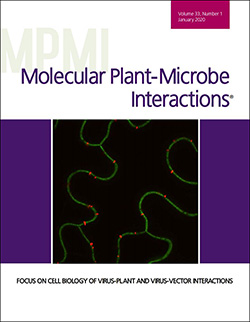 Plants, viruses, and insects function in a complex tripartite interaction. Lu and colleagues describe an interesting twist on this interaction, demonstrating that an insect viral symbiont improves the fitness of its insect host by reducing plant defense responses and thus allowing the aphid to feed longer.