Kick Off 2023 with the Next What’s New in MPMI! Virtual Seminar
Discover the Editor’s Picks from the September, October, and November issues of MPMI.
Kick Off 2023 with the Next What’s New in MPMI! Virtual Seminar
Discover the Editor’s Picks from the September, October, and November issues of MPMI.
Join IS-MPMIConnect on March 29 for the complimentary LGBTQ+ Webinar, where scientists at various stages in their professions will share their experiences with inequality and bias in STEM. Register today!
We are always looking for content for Interactions. Please contact Interactions Editor-in-Chief Dennis Halterman with questions or article ideas.
|
Also in this issue…
|
|
University of California-Davis distinguished professor and IS-MPMI member Dr. Pam Ronald has been awarded the 2022 International Wolf Prize in Agriculture “for pioneering work on disease resistance and environmental stress tolerance in rice.” The Wolf Prize is awarded for achievements in the interest of humankind and friendly relations among people.
Pyrenophora tritici-repentis causes tan spot, an important foliar disease of wheat worldwide. This fungal pathogen produces three necrotrophic effectors (Ptr ToxA, Ptr ToxB, and Ptr ToxC) to induce necrosis or chlorosis in wheat. Here, Gongjun Shi and colleagues report the genetic mapping, molecular cloning, and functional analysis of the fungal gene (ToxC1) required for Ptr ToxC production.
Senior graduate students and postdoctoral scholars are encouraged to present their MPMI research at the new Early Career Showcase. The showcase will take place online June 8–9 and September 20–21 and is free to all IS-MPMI members. Nominate yourself, a colleague, or a student before March 31.
What Is the Molecular Basis of Nonhost Resistance? Find out the interesting way Ralph Panstruga and Matthew Moscou reframe the #6 Top 10 Unanswered Question in MPMI during the March MPMI Microgreens podcast.
Li-Jun Ma and Houlin Yu discuss their MPMI Editor’s Pick paper, “Metatranscriptomic Comparison of Endophytic and Pathogenic Fusarium–Arabidopsis Interactions Reveals Plant Transcriptional Plasticity,” in the latest What’s New in MPMI! Virtual Seminar.
Pritha Ganguly will discuss her recent MPMI Editor’s Pick paper, “The Natural Antisense Transcript DONE40 Derived from the lncRNA ENOD40 Locus Interacts with SET Domain Protein ASHR3 During Inception of Symbiosis in Arachis hypogaea,” during the upcoming What’s New in MPMI! Virtual Seminar. Register today!
The theme of the 2023 MPMI Focus Issue is The Plant Endomembrane System in MPMI. Learn more about the scope of the Focus Issue and plan to submit your manuscript by June 30, 2022.
Abstracts from the December 1–2 eSymposia Series ePoster presentations are now available in the December 2021 issue of MPMI. This is a great opportunity to learn about the emerging science presented at the 2021 IS-MPMI online meeting.
Learn about new evidence revealing variability in the epitope regions of bacterial flagellin, including regions harboring the microbe-associated molecular patterns flg22 and flgII-28 that are recognized by pattern recognition receptors. Maria Malvino and colleagues discuss the “Influence of Flagellin Polymorphisms, Gene Regulation, and Responsive Memory on the Motility of Xanthomonas Species That Cause Bacterial Spot Disease of Solanaceous Plants.”
|
|
We are always looking for content for Interactions. Please contact Interactions Editor-in-Chief Dennis Halterman with questions or article ideas.
|
Also in this issue…
What Is the Molecular Basis of Nonhost Resistance?

Submit your paper by September 9, 2022! Learn more about the scope of the MPMI 2023 Focus Issue on the Plant Endomembrane System in Molecular Plant–Microbe Interactions and submit your manuscript for consideration. Focus Issue Guest editors are H. Jin, E. Park, A. Wang, and D. Wang.
Two Related Picks from the MPMI Editors: We’ve studied rhizobia and legumes for a long time, and here we highlight two Editor’s Picks that are beginning to address a whole new field: positive effects on nonhost plant growth and development by rhizobia. Both the Mercedes Schroeder et al. and the Casandra Hernández-Reyes et al. papers identify specific mechanisms by which symbiotic rhizobium bacteria promote the root growth of a nonhost, Arabidopsis, altering root architecture via auxin transport (Schroeder et al.) and modulating cell division and cell elongation via NLP-mediated nitrate signaling (Hernández-Reyes et al.).

Mercedes M. Schroeder, Melissa Y. Gomez, Nathan McLain, and Emma W. Gachomo
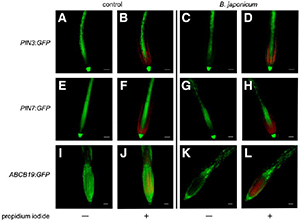
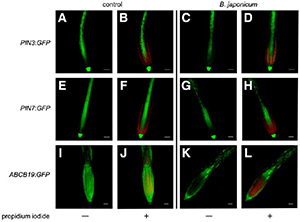
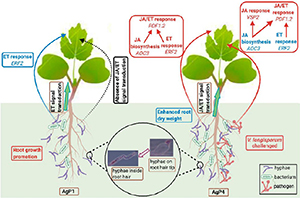
Plant root development changes in response to beneficial rhizobacteria. This MPMI paper by Schroeder et al. shows B. japonicum’s influence on host transcriptional reprogramming during their beneficial interaction. Through bacterial association with knockout lines, plant auxin efflux transporters were identified as critical to developing the B. japonicum-modified root architecture.

Casandra Hernández-Reyes, Elisabeth Lichtenberg, Jean Keller, Pierre-Marc Delaux, Thomas Ott, and Sebastian T. Schenk
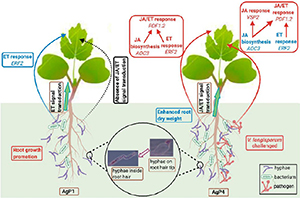
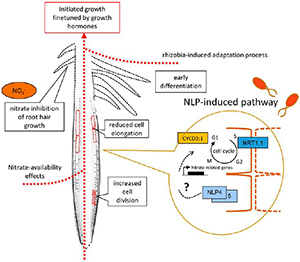
As an essential macronutrient, nitrogen plays an important role in plant development and plant–microbe symbioses, including legume–rhizobia interactions. Hernández-Reyes et al. demonstrate that a nitrate-related NLP signaling pathway in Arabidopsis regulates rhizobium-induced lateral root growth and increased root hair length and density. The involvement of two NLP transcription factors in mediating this response and their similarity to known legume NLPs involved in nodule symbiosis suggests the response to rhizobia is a trait shared within that protein clade.

Dongzhi Li, Ziqi Li, Jing Wu, Zhide Tang, Fuli Xie, Dasong Chen, Hui Lin, and Youguo Li
Gram-negative bacteria can produce outer membrane vesicles (OMVs), and most functional studies of OMVs have been focused on mammalian-bacterial interactions. Research on the OMVs of rhizobia is limited. In this work, Dhongzhi Li et al. isolated and purified OMVs from Sinorhizobium fredii HH103 under free-living conditions that were set as control (C-OMVs) and symbiosis-mimicking conditions that were induced by genistein (G-OMVs).

Fatema Binte Hafiz, Narges Moradtalab, Simon Goertz, Steffen Rietz, Kristin Dietel, Wilfried Rozhon, Klaus Humbeck, Joerg Geistlinger, Günter Neumann, and Ingo Schellenberg
Rhizosphere-competent microbes often interact with plant roots and exhibit beneficial effects on plant performance. Numerous bacterial and fungal isolates are able to prime host plants for fast adaptive responses against pathogen attacks. The combined action of fungi and bacteria may lead to synergisms exceeding the effects of single strains. This study by Fatema Binte Hafiz et al. offers a perspective for the development of alternative and sustainable approaches to enhance the tolerance of rapeseed cultures against fungal infections.

Registration is open for the APS Annual Meeting, Plant Health 2022, taking place August 6–10 in Pittsburgh, PA. Don’t miss this in-person meeting and the opportunity to network with plant pathologists and explore the profound changes in plant health research being driven by transformations in climate, technology, and society. We hope you can join us for this exciting event! Learn more and register.
Submit your paper by September 9, 2022! Learn more about the scope of the MPMI 2023 Focus Issue on the Plant Endomembrane System in Molecular Plant–Microbe Interactions and submit

your manuscript for consideration. Focus Issue Guest editors are H. Jin, E. Park, A. Wang, and D. Wang.
Two Related Picks from the MPMI Editors: We’ve studied rhizobia and legumes for a long time, and here we highlight two Editor’s Picks that are beginning to address a whole new field: positive effects on nonhost plant growth and development by rhizobia. Both the Mercedes Schroeder et al. and the Casandra Hernández-Reyes et al. papers identify specific mechanisms by which symbiotic rhizobium bacteria promote the root growth of a nonhost, Arabidopsis, altering root architecture via auxin transport (Schroeder et al.) and modulating cell division and cell elongation via NLP-mediated nitrate signaling (Hernández-Reyes et al.).

Mercedes M. Schroeder, Melissa Y. Gomez, Nathan McLain, and Emma W. Gachomo
Plant root development changes in response to beneficial rhizobacteria. This MPMI paper by Schroeder et al. shows B. japonicum’s influence on host transcriptional reprogramming during their beneficial interaction. Through bacterial association with knockout lines, plant auxin efflux transporters were identified as critical to developing the B. japonicum-modified root architecture.
Casandra Hernández-Reyes, Elisabeth Lichtenberg, Jean Keller, Pierre-Marc Delaux, Thomas Ott, and Sebastian T. Schenk
As an essential macronutrient, nitrogen plays an important role in plant development and plant–microbe symbioses, including legume–rhizobia interactions. Hernández-Reyes et al.
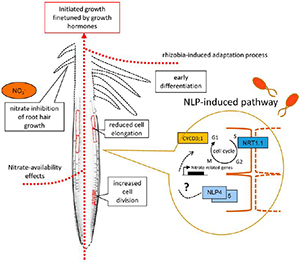
demonstrate that a nitrate-related NLP signaling pathway in Arabidopsis regulates rhizobium-induced lateral root growth and increased root hair length and density. The involvement of two NLP transcription factors in mediating this response and their similarity to known legume NLPs involved in nodule symbiosis suggests the response to rhizobia is a trait shared within that protein clade.

Dongzhi Li, Ziqi Li, Jing Wu, Zhide Tang, Fuli Xie, Dasong Chen, Hui Lin, and Youguo Li
Gram-negative bacteria can produce outer membrane vesicles (OMVs), and most functional studies of OMVs have been focused on mammalian-bacterial interactions. Research on the OMVs of rhizobia is limited. In this work, Dhongzhi Li et al. isolated and purified OMVs from Sinorhizobium fredii HH103 under free-living conditions that were set as control (C-OMVs) and symbiosis-mimicking conditions that were induced by genistein (G-OMVs).

Fatema Binte Hafiz, Narges Moradtalab, Simon Goertz, Steffen Rietz, Kristin Dietel, Wilfried Rozhon, Klaus Humbeck, Joerg Geistlinger, Günter Neumann, and Ingo Schellenberg
Rhizosphere-competent microbes often interact with plant roots and exhibit beneficial effects on plant performance. Numerous bacterial and fungal isolates are able to prime host plants for fast adaptive responses against pathogen attacks. The combined action of fungi and bacteria may lead to synergisms exceeding the effects of single strains. This study by Fatema Binte Hafiz et al. offers a perspective for the development of alternative and sustainable approaches to enhance the tolerance of rapeseed cultures against fungal infections.