Category: Issue 1 •​ 2021​

Opportunity for Scientists in Under-Resourced Countries to Publish in MPMI

ISMPMI 285 2 1955560 removebg preview

Issue 1

2020

interactions

Did You Know

MPMI 2021Cover

Microbes Biosciences has generously sponsored MPMI to cover the publication fees for a limited number of authors from countries with low-income or lower-middle income economies (as defined by The World Bank) who elect to publish in MPMI. To apply for a fee waiver, scientists from under-resourced countries must contact MPMI Editor-in-Chief Tim Friesen in advance of their submission and include a detailed cover letter about their submission.

Waivers are available on a first-come, first-served basis, and each manuscript must undergo the standard peer-review process and be accepted for publication. Learn more about how to submit your manuscript.

06WhatsNewMPMI BioSciences Logo

Thank you to Microbes Biosciences for its gracious support of our science!


Catch Up on MPMI Editor’s Picks and Virtual Seminars

ISMPMI 285 2 1955560 removebg preview

Issue 1

2020

interactions

Did You Know

MPMI EdPick banner700

07EdPick Hao120

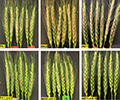
NX Trichothecenes Are Required for Fusarium graminearum Infection of Wheat

While the mycotoxin deoxynivalenol was previously shown to be a major virulence factor for Fusarium graminearum on wheat, the more recently discovered NX trichothecenes have not been characterized for their role in virulence. Guixia Hao and colleagues evaluated the role of NX trichothecenes in virulence using TRI5 gene disruptions that eliminated trichothecene biosynthesis during F. graminearum infection of wheat heads to show that the reduction in NX trichothecenes decreased both the initial infection of the wheat head and the subsequent spread compared to the wild-type strains. This work provides novel information on the mode of action of a new class of trichothecenes and exposes the TRI5 gene as a promising target for controlling Fusarium head blight of both wheat and barley.​

07EdPick Ekanayake120

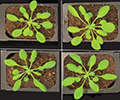
Arabidopsis Dynamin-Related Protein AtDRP2A Contributes to Late Flg22-Signaling and Effective Immunity Against Pseudomonas syringae Bacteria

Arabidopsis thaliana encodes two paralogs of the endocytic accessory protein DRP2. Gayani Enkanayake and colleagues further defined the functions of these two paralogs using the FLS2-flg22 system. Loss of AtDRP2A led to increased susceptibility to Pseudomonas syringae, and the effects resulting from the loss of AtDRP2A were distinct from the effects caused by the loss of AtDRP2B—with DRP2A being important for late flg22-mediated responses but not early responses, unlike DRP2B. This finding provides a new tool for investigating ligand-induced endocytosis of receptors in immunity.

07EdPick Prakash120

 The Potyviral Protein 6K2 from Turnip Mosaic Virus Increases Plant Resilience to Drought

Ved Prakash and colleagues demonstrated that Turnip mosaic virus (TuMV) can positively impact host plants by increasing plant survival under drought conditions. Their results show that at least three viral proteins contribute to enhanced drought tolerance in TuMV-infected Arabidopsis thaliana, with one of these proteins also conveying drought tolerance when expressed in Nicotiana benthamiana. This protein enhanced salicylic acid accumulation in both Athaliana and N. benthamiana, demonstrating an ecological function in the plant during drought conditions.

MPMI VirtualSeminar120

On May 9, 2023, Janak JoshiAmy Charkowski, and Adam Heuberger presented their MPMI Editor’s  Pick, “Protease Inhibitors from Solanum chacoense Inhibit Pectobacterium Virulence by Reducing Bacterial Protease Activity and Motility.”
Watch the recorded presentation to learn more about proteomics, wild potato disease resistance, and the potential for protecting cultivated potatoes in the field. Watch now.
View all virtual seminars.​

2023​ – ISSUE 2

ISMPMI 285 2 1955560 removebg preview

Issue 2

2023

interactions
01SocNews BODElect circle 2559457
2023 IS-MPMI Board of Directors Election All eligible voting members of IS-MPMI have been sent an electronic ballot to vote in this year's Board of Directors election. Three of six candidates will be elected to the Board of Directors to serve a 4-year term. Those elected will be installed during the Board meeting at the 2023 IS-MPMI Congress. Cast your vote by July 6, 2023 (midnight CDT).

Did You Know

The 2023 IS-MPMI Congress is less than a month away, and we’re excited to see everyone in Providence, Rhode Island. There is still time to register and join us in July for our first in-person meeting in four years!
 
Congratulations to Jonathan D. G. Jones, the 2023 Outstanding Achievement Award recipient, and to Cara Haney and Xiufang Xin, the 2023 Early Career Achievement Award recipients. The awardees will be recognized and celebrated at the 2023 IS-MPMI Congress.
ISMPMI is seeking a new Editor-in-Chief for IS-MPMI Interactions. Learn more about the responsibilities, resources, and opportunities associated with this position. The term for the position will officially begin after the 2023 IS-MPMI Congress.

“The Next Big Idea” Session at 2023 IS-MPMI Congress

The 2023 IS-MPMI Congress will include an innovative and interactive plenary pession focused on the “WHY” behind our research. During the “The Next Big Idea” session, five IS-MPMI community members from diverse backgrounds and career stages will convey why you should care about their research and answer audience questions.

Interact with MPMI at 2023 IS-MPMI Congress: Attend a Special Session, Visit the Editors of MPMI, and Potentially Win a Poster Award!

MPMI editors are providing several opportunities to engage with and learn more about the journal and publishing during the 2023 IS-MPMI Congress. MPMI editors will host “The Making of a Story—Building Narratives and Communicating Science Effectively” session; the MPMI booth, and the Student Poster Award competition.

InterView with Dr. Wenbo Ma

Tianrun Li, Ph.D. candidate in the Plant Pathology program at the University of California, Davis, interviewed Dr. Wenbo Ma, senior group leader at The Sainsbury Laboratory and honorary professor at the University of East Anglia. Li spoke with Dr. Ma about being named a 2022 AAAS Fellow, her career journey, and what the future may hold.

InterView with Dr. Maeli Melotto

Aline Sartor Chicowski recently interviewed Dr. Maeli Melotto, professor and scientist at the University of California, Davis. Chicowski spoke with Dr. Melotto about being named a 2022 AAAS Fellow, how she became interested in plant pathology, her research goals, and challenges in her career.

InterView with Munir Nur and Kelsey Wood

Munir Nur, software engineer, Big Data, and Kelsey Wood, postdoctoral scholar, Michelmore Lab, University of California, Davis, answered questions about their collaboration on the EffectorO project and publication of their paper, “EffectorO: Motif-Independent Prediction of Effectors in Oomycete Genomes Using Machine Learning and Lineage-Specificity,” in MPMI.

InterView with Dr. Bing Yang

Ashley C. Nelson, Ph.D. student in the Plant Pathology Department at North Dakota State University, interviewed Dr. Bing Yang, principal investigator and member at the Donald Danforth Plant Science Center, professor of plant science and technology, University of Missouri–Columbia, and 2022 AAAS Fellow. Nelson spoke with Dr. Yang about his career, the importance of collaboration in science, and his advice for young scientists.

InterView with Dr. Cyril Zipfel

Dr. Amelia H. Lovelace, postdoctoral researcher at The Sainsbury Laboratory, interviewed Prof. Cyril Zipfel, chair of Molecular and Cellular Physiology at the University of Zurich, and senior group leader at The Sainsbury Laboratory. Dr. Lovelace spoke with Prof. Zipfel about the evolution of his research interests, his approach to mentorship, and his advice for early-career researchers.

InterConnections: Get to Know Munir Nur and Kelsey Wood

Learn about Munir Nur and Kelsey Wood and how their diverse backgrounds led to a fruitful collaboration on EffectorO and publication of their paper, “EffectorO: Motif-Independent Prediction of Effectors in Oomycete Genomes Using Machine Learning and Lineage-Specificity,” in MPMI.

InterConnections: Get to Know Stefan Sanow

Learn about Stefan Sanow, coauthor of the review paper “Molecular Mechanisms of Pseudomonas Assisted Plant Nitrogen Uptake—Opportunities for Modern Agriculture” recently published in MPMI, and the unexpected bacterium that led to new insights into the complex genus Pseudomonas.

Review Highlight: Molecular Mechanisms of Pseudomonas Assisted Plant Nitrogen Uptake—Opportunities for Modern Agriculture

Dr. Borjana Arsova, Root Dynamics group in the Plant Sciences Institute in the Research Center in Jülich (IBG-2), discusses how receipt of an unexpected Pseudomonas strain led to experiments with plants grown under low-nitrogen conditions and compilation of evidence about known processes relevant to the Pseudomonadaceae. The resulting review paper published in MPMI offers a novel perspective on this complex genus.

MPMI Journal Publishes Special Focus Issue on a Critical, Emerging Area of Study

The recently published MPMI Focus Issue on “The Plant Endomembrane System in Molecular Plant–Microbe Interactions” explores how microbes affect the plant endomembrane system and its role in plant disease, defense, and beneficial interactions.

Opportunity for Scientists in Under-Resourced Countries to Publish in MPMI

Microbes Biosciences is generously sponsoring MPMI to cover the publication fees for a limited number of authors from countries with low-income or lower-middle income economies who elect to publish in MPMI.

Catch Up on MPMI Editor’s Picks and Virtual Seminars

Discover the Editor’s picks from the March, April, and May issues of MPMI and listen to the What’s New in MPMI Virtual Seminar presented by Janak JoshiAmy Charkowski, and Adam Heuberger on their MPMI Editor’s Pick.
We are always looking for content for Interactions. Please contact Interactions Editor-in-Chief Dennis Halterman with questions or article ideas.

2023​ – Issue 2

ISMPMI 285 2 1955560 removebg preview

Issue 1

2020

interactions
01SocNews BODElect circle 2559457

Did You Know

The 2023 IS-MPMI Congress is less than a month away, and we’re excited to see everyone in Providence, Rhode Island. There is still time to register and join us in July for our first in-person meeting in four years!
 
Congratulations to Jonathan D. G. Jones, the 2023 Outstanding Achievement Award recipient, and to Cara Haney and Xiufang Xin, the 2023 Early Career Achievement Award recipients. The awardees will be recognized and celebrated at the 2023 IS-MPMI Congress.
ISMPMI is seeking a new Editor-in-Chief for IS-MPMI Interactions. Learn more about the responsibilities, resources, and opportunities associated with this position. The term for the position will officially begin after the 2023 IS-MPMI Congress.
“The Next Big Idea” Session at 2023 IS-MPMI Congress

The 2023 IS-MPMI Congress will include an innovative and interactive plenary pession focused on the “WHY” behind our research. During the “The Next Big Idea” session, five IS-MPMI community members from diverse backgrounds and career stages will convey why you should care about their research and answer audience questions.
Interact with MPMI at 2023 IS-MPMI Congress: Attend a Special Session, Visit the Editors of MPMI, and Potentially Win a Poster Award!

MPMI editors are providing several opportunities to engage with and learn more about the journal and publishing during the 2023 IS-MPMI Congress. MPMI editors will host “The Making of a Story—Building Narratives and Communicating Science Effectively” session; the MPMI booth, and the Student Poster Award competition.
InterView with Dr. Wenbo Ma

Tianrun Li, Ph.D. candidate in the Plant Pathology program at the University of California, Davis, interviewed Dr. Wenbo Ma, senior group leader at The Sainsbury Laboratory and honorary professor at the University of East Anglia. Li spoke with Dr. Ma about being named a 2022 AAAS Fellow, her career journey, and what the future may hold.
InterView with Dr. Maeli Melotto

Aline Sartor Chicowski recently interviewed Dr. Maeli Melotto, professor and scientist at the University of California, Davis. Chicowski spoke with Dr. Melotto about being named a 2022 AAAS Fellow, how she became interested in plant pathology, her research goals, and challenges in her career.
InterView with Munir Nur and Kelsey Wood

Munir Nur, software engineer, Big Data, and Kelsey Wood, postdoctoral scholar, Michelmore Lab, University of California, Davis, answered questions about their collaboration on the EffectorO project and publication of their paper, “EffectorO: Motif-Independent Prediction of Effectors in Oomycete Genomes Using Machine Learning and Lineage-Specificity,” in MPMI.
InterView with Dr. Bing Yang

Ashley C. Nelson, Ph.D. student in the Plant Pathology Department at North Dakota State University, interviewed Dr. Bing Yang, principal investigator and member at the Donald Danforth Plant Science Center, professor of plant science and technology, University of Missouri–Columbia, and 2022 AAAS Fellow. Nelson spoke with Dr. Yang about his career, the importance of collaboration in science, and his advice for young scientists.
InterView with Dr. Cyril Zipfel

Dr. Amelia H. Lovelace, postdoctoral researcher at The Sainsbury Laboratory, interviewed Prof. Cyril Zipfel, chair of Molecular and Cellular Physiology at the University of Zurich, and senior group leader at The Sainsbury Laboratory. Dr. Lovelace spoke with Prof. Zipfel about the evolution of his research interests, his approach to mentorship, and his advice for early-career researchers.
InterConnections: Get to Know Munir Nur and Kelsey Wood

Learn about Munir Nur and Kelsey Wood and how their diverse backgrounds led to a fruitful collaboration on EffectorO and publication of their paper, “EffectorO: Motif-Independent Prediction of Effectors in Oomycete Genomes Using Machine Learning and Lineage-Specificity,” in MPMI.
InterConnections: Get to Know Stefan Sanow

Learn about Stefan Sanow, coauthor of the review paper “Molecular Mechanisms of Pseudomonas Assisted Plant Nitrogen Uptake—Opportunities for Modern Agriculture” recently published in MPMI, and the unexpected bacterium that led to new insights into the complex genus Pseudomonas.
Review Highlight: Molecular Mechanisms of Pseudomonas Assisted Plant Nitrogen Uptake—Opportunities for Modern Agriculture

Dr. Borjana Arsova, Root Dynamics group in the Plant Sciences Institute in the Research Center in Jülich (IBG-2), discusses how receipt of an unexpected Pseudomonas strain led to experiments with plants grown under low-nitrogen conditions and compilation of evidence about known processes relevant to the Pseudomonadaceae. The resulting review paper published in MPMI offers a novel perspective on this complex genus.
MPMI Journal Publishes Special Focus Issue on a Critical, Emerging Area of Study

The recently published MPMI Focus Issue on “The Plant Endomembrane System in Molecular Plant–Microbe Interactions” explores how microbes affect the plant endomembrane system and its role in plant disease, defense, and beneficial interactions.
Opportunity for Scientists in Under-Resourced Countries to Publish in MPMI

Microbes Biosciences is generously sponsoring MPMI to cover the publication fees for a limited number of authors from countries with low-income or lower-middle income economies who elect to publish in MPMI.
Catch Up on MPMI Editor’s Picks and Virtual Seminars

Discover the Editor’s picks from the March, April, and May issues of MPMI and listen to the What’s New in MPMI Virtual Seminar presented by Janak JoshiAmy Charkowski, and Adam Heuberger on their MPMI Editor’s Pick.
We are always looking for content for Interactions. Please contact Interactions Editor-in-Chief Dennis Halterman with questions or article ideas.

Call for President-Elect Candidates

ISMPMI 285 2 1955560 removebg preview

Issue 3

2023

interactions

Did You Know

The IS-MPMI Election Committee is accepting nominations for President-Elect to join the IS-MPMI Board of Directors. Board member responsibilities include participating in monthly board

01SocNews Nominate graphic

video conferences, including congress meeting planning, fundraising, and communications to the membership. They also partner in new initiatives to support and cultivate diversity and inclusion within our IS-MPMI community. Nominations will be accepted through October 6, 2023. ​

IS-MPMI Welcomes Anjali Iyer-Pascuzzi as Incoming Editor-in-Chief of Interactions

ISMPMI 285 2 1955560 removebg preview

Issue 3

2023

interactions

Did You Know

Anjali Iyer-Pascuzzi is a professor in the Botany and Plant Pathology Department at Purdue University. She grew up in Los Angeles and earned her B.S. degree in molecular environmental

01SocNews IyerPascuzzi

biology from the University of California, Berkeley. She then moved across the country to Cornell University for both her M.S. degree in plant pathology (with Greg Martin) and Ph.D. degree in plant genetics (with Susan McCouch). After a postdoc in root biology with Philip Benfey at Duke University, she started her own laboratory at Purdue in 2013. At Purdue she combines her love of plant–microbe interactions with plant development. Research in her laboratory is currently aimed at elucidating mechanisms underlying root resistance to the bacterial wilt disease pathogen Ralstonia solanacearum in tomato and maize responses to Phyllachora maydis, the causal agent of tar spot disease. Her work spans biological scales—from cell types to whole plants—and combines tools from cell and developmental biology, genomics, and phenomics to improve understanding of plant–microbe interactions. She has previously served in leadership positions in ASPB and is excited to take a more active role in IS-MPMI as the editor-in-chief for Interactions! 

2023 IS-MPMI Congress Recap

ISMPMI 285 2 1955560 removebg preview

Issue 3

2023

interactions

Did You Know

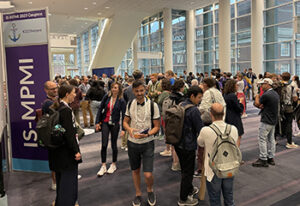
The 20th IS-MPMI Congress was held in Providence, Rhode Island, on July 16–20, 2023, and featured a keynote talk by Russell Vance (professor and HHMI investigator, UC Berkeley) and a talk by IS-MPMI Outstanding Achievement
01SocNews Congress image1

Award winner Jonathan Jones (professor, The Sainsbury Laboratory). Early Career Achievement Award winners Cara Haney (associate professor and Canada Research Chair, University of British Columbia) and Xiufang Xin (Chinese Academy of Sciences Center for Excellence in Molecular Plant Sciences) were also recognized for their outstanding achievements, and new IS-MPMI President Adam Bogdanove was introduced. The meeting included 33 plenary speakers and approximately 80 concurrent session speakers. For the first time, concurrent session topics were selected by members and included a wide range of themes, comprising traditional research talks, insights into the publishing process, undergraduate research and networking, and TED-style flash talks.

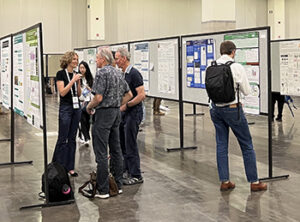
There were 762 attendees at the Congress, representing 40 different countries. Remarkably, more than two-thirds of the attendees joined us for the first time! There were 495 posters at this year’s congress, and graduate students and postdocs competed for the best poster presentation.


Graduate Poster winners (Sponsored by the MPMI Journal) 
01SocNews Congress image2

1st Place: Tamar A-Shalom (University of Toronto)—”Epistatic Interactions Between Immune Eliciting Effectors of Pseudomonas syringae Reveal New Genetic Requirements in Immune Elicitation”

2nd Place: Milena Malisic (Max Planck Institute for Plant Breeding Research, Cologne)—”pH-Dependent Interaction of Coumarins and the Root Microbiota in Plant Iron Nutrition”

3rd Place: An-Po Cheng (University of Munich)—”Fungal Argonaute Proteins Control Pathogenicity and Cross-Kingdom RNA Interference”

Postdoc Poster Winners (Sponsored by The EMBO Journal)

Poster Prize 1: Reza Sohrabi (Duke University)—”A Critical Role of Eubiotic Microbiota in Gating Proper Immunocompetence in Arabidopsis”

Poster Prize 2: Manuel Gonzalez Fuente (University of Tubingen)—”Processing Bodies: Novel Regulators of Plant Immunity Targeted by Bacterial Effectors”

Lunches during the meeting focused on networking opportunities, with a Corteva and 2Blades-sponsored lunch on Monday and topic-based discussions on the other days. The IS-MPMI Diversity, Equity and Inclusion Committee sponsored a social event on Tuesday that included science, music, and networking opportunities.


Other highlights of the meeting included the Who Wants to Be an MPMillionaire? Trivia Contest, sponsored by Corteva, which challenged attendees to recall details of concurrent session talks,01SocNews Congress image3

and The Next Big Idea session sponsored by Cell Press, which encouraged speakers to talk about the importance of their work in five minutes. The finalists for the Who Wants to Be an MPMillionaire? contest were Samuel Eastman (Princeton University), Mauricio Contreras (The Sainsbury Laboratory), Unnati Sonawala (University of Cambridge), Jake Schumacher (North Dakota State University), Caroline Stone (John Innes Centre), Miette Hennessy (University of Wisconsin-Madison), Kelsey Wood (UC Davis), and Emma Turley (John Innes Centre). This year’s MPMillionaire was Mauricio Contreras! Prizes for the finalists and winner were provided by Corteva Agriscience. The Next Big Idea session, organized by Pat Baldrich and Ryan DelPercio, included TED-talk like pitches from some outstanding early-career scientists and was won by Juliana González-Tobón (Cornell University).

The location of the 2025 IS-MPMI Congress is still being determined. If you have ideas for locations, please contact an IS-MPMI Board member.


Introducing the H. H. Flor Distinguished Review in MPMI

ISMPMI 285 2 1955560 removebg preview

Issue 3

2023

interactions

Did You Know

Timothy L. Friesen, Editor-in-Chief Molecular Plant–Microbe Interactions

For each gene that conditions reaction in the host there is a corresponding gene in the parasite that conditions pathogenicity.

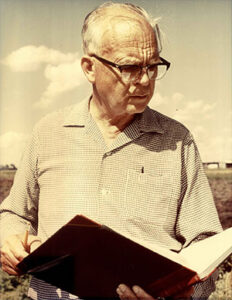
In these words, Harold H. Flor summed up his gene-for-gene concept in his 1971 Annual Review of Phytopathology article (Flor 1971). Flor’s gene-for-gene concept provided a new

04WhatsNew Flor

framework for how we think about plant–microbe interactions. Harold H. Flor was born May 27, 1900. He obtained a B.S. degree in agriculture in 1922, an M.S. degree working on covered smuts of small grains in 1924 and was granted a Ph.D. degree for his work on root rot complex of sugar cane in 1929—all three degrees from the University of Minnesota. Dr. Flor then took a position with the U.S. Department of Agriculture in Pullman, WA, where he worked on wheat bunt. In 1931, he moved to Fargo, ND, to take a position with the USDA on the North Dakota State University campus, where he was tasked with studying diseases of flax. It was during his time with the USDA in Fargo that he performed his landmark research on the flax–flax rust interaction, which ultimately was used to define the gene-for-gene hypothesis that became so prevalent in describing many host–pathogen interactions. The gene-for-gene concept still stands as one of the most significant contributions to plant pathology and was established long before modern molecular biology or even a complete understanding of genetic material or protein–protein interactions.


Based on the landmark research performed by Dr. Flor, it was an obvious choice to use his name to help define what this distinguished review category is all about. An H.H. Flor Distinguished Review is a review written by visionary scientists who have also changed the way we think about an area of molecular plant–microbe interactions. These

04WhatsNew Flor logo (1)

distinguished reviews will ultimately include all categories of plant–microbe interactions from pathogenic to symbiotic interactions. It is our intent to invite leaders in the MPMI field to write authoritative reviews that provide not only a historical perspective but also to provide a vision for where their respective fields are moving, ultimately providing a valuable resource to the MPMI community.

In the August issue of Molecular Plant–Microbe Interactions, the first of the H.H. Flor Distinguished Reviews will be published, including “From Gene-for-Gene to Resistosomes: Flor’s Enduring Legacy,” written by Peter N. Dodds and “New Biochemical Principles for NLR Immunity in Plants,” written by Jijie Chai, Wen Song, and Jane E. Parker.

Final Call for Papers! Submit Your Research on Effectors

ISMPMI 285 2 1955560 removebg preview

Issue 3

2023

interactions

Did You Know

Don’t miss the chance to have your latest findings on effectors published in the open access MPMI Focus Issue “Effectors at the Interface of PlantMicrobe Interactions.”

04WhatsNew FI2024

This focus issue will present the latest developments in the study of microbial effector biology and evolution in the context of plant immunity across diverse systems. As the scientific community seeks to respond to global challenges in agriculture and food production, this focus issue will highlight potential solutions and technology emerging from research on microbial effectors. 

Editors Melania FigueroaGitta Coaker, and Kostya Kanyuka invite research and review articles that explore the complex role of effectors in molecular plant–microbe interactions. Articles highlighting translational research, as well as fundamental understanding, are welcome. 

Submissions are due by the end of September 2023. 

Submit Now!​ 

Read the Newest MPMI Editor’s Pick and Register for Upcoming Virtual Seminars

ISMPMI 285 2 1955560 removebg preview

Issue 3

2023

interactions

Did You Know

MPMI EdPick banner700 (1)

Elucidating the Obligate Nature and Biological Capacity of an Invasive Fungal Corn Pathogen

05MPMI EdPick MacCready image

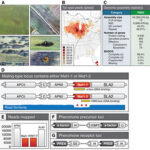
​Tar spot, caused by the fungal pathogen Phyllachora maydis, was first identified in the United States in 2015 and has since evolved into a major impediment to corn production. Joshua MacCready and colleagues used both genomic and transcriptomic data to provide foundational insights into how this pathogen is invading its plant host corn to ultimately complete its life cycle. This work is fundamental to understanding this host-pathogen interaction, as well as to developing control strategies for tar spot of corn.​

MPMI VirtualSeminar banner700

What’s New in MPMI!” is an open access series of live, online seminars that highlight trending MPMI papers presented by their authors. To increase accessibility and encourage global participation in the MPMI community, all virtual seminars are free to attend and open to anyone interested in molecular plant–microbe interactions.

Upcoming Seminars

November 13, 2023, at 7:00 p.m. CT

Hyelim Jeon and Cécile Segonzac will present “Manipulation of the Host Endomembrane System by Bacterial Effectors.”

Register to attend this free presentation.

December 5, 2023, at 10:00 a.m. CT

Hasna Boubakri will present “A Nonspecific Lipid Transfer Protein with Potential Functions in Infection and Nodulation.”

Register to attend this free presentation.

Recently Recorded Seminar

Sajjan Grover discusses his trending research that uncovered a dichotomous role of jasmonic acid in modulating sorghum defense against aphids. Watch this free presentation to learn more about the complexity of a plant–aphid interaction.

Watch Now!​

Scroll to Top