Computational Prediction of Structure, Function, and Interaction of Myzus persicae (Green Peach Aphid) Salivary Effector Proteins
Name: Thomas Waksman

Current Position: Postdoctoral Research Assistant, Bos Group, Department of Plant Sciences, University of Dundee, UK
Education: Master’s degree in biochemistry, University of Oxford; Ph.D. in plant science, University of Glasgow
Non-scientific Interests: Nature, hiking, music
Brief Bio: My passion for nature, science, and the environment came from my parents, education, and hiking activities. From an early age, I thought I would like to be a biologist, and I enjoyed math and chemistry, so I studied for a biochemistry degree. My research activities have focused on protein structure and interactions, plant-microbe interactions and environmental signaling.
During my master’s research project, I was involved in determining the structure of the UDP-glucose:glycoprotein glucosyltransferase (UGGT). UGGT is the glycoprotein folding quality-control checkpoint in eukaryotes—it transfers glucose to short glycans in misfolded glycoproteins, causing retention and refolding of these incorrect proteins in the endoplasmic reticulum. UGGT must be able to interact with misfolds and glucosylate glycans in any misfolded glycoprotein, covering a very wide range of protein structures—this interactive adaptability is intriguing from a protein structure perspective. Multiple crystal structures of UGGT suggested how interdomain conformational flexibility allows the enzyme to cover a great range of misfold-to-glycan distances.
Initially, I wanted to pursue a Ph.D. degree in protein structure and molecular machines. However, an inspiring summer project about nitrogen-fixing symbiosis in the group of Prof. Sharon Long at Stanford University, as well as a growing desire to work in a nature and environment context, led me to plant molecular biology research. During my Ph.D. program, I investigated blue-light signaling in Arabidopsis in Prof. John Christie‘s group at the University of Glasgow. I developed a novel in vitro phosphorylation assay method for phototropin (phot) blue-light receptor kinases, based on “gatekeeper” technology in which a kinase is engineered to use an enlarged ATP analogue. Gatekeeper-engineered Arabidopsis phot was expressed in a cell-free system and used to identify thiophosphorylate substrate candidates, which is detected by immunoblotting. I discovered that NPH3/RPT2-like proteins, known to be key signaling components since phot was discovered in the 1990s, are in fact phot substrates. Phosphorylation of a conserved phosphorylation site at the protein C-terminus contributes to blue-light response in plants.
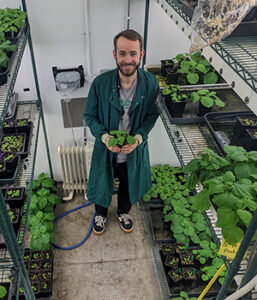
I am now finally combining my main research interests as part of the APHIDTRAP project in the group of Jorunn Bos at the University of Dundee. My aim is to determine the structure of protein complexes comprised of aphid effectors and plant-host target proteins. For my article published in the MPMI Focus Issue on effectors, properties (including structure) of effector candidate proteins found in green peach aphid saliva were computationally predicted. We realized that many of these proteins are relatively unknown to science, unpredictable, and probably contain intrinsic disorder in their structure. Some of these unusual proteins have effector activity, so I intend to study those. I would like to use mass spectrometry methods to determine the structure of the effector-target complexes at medium to high resolution, followed by computational modeling to achieve accurate structures. X-ray crystallography or electron microscopy can be used to determine high-resolution structure if necessary, after removal of disordered regions.
As part of University of Dundee Plant Sciences, I am affiliated with the James Hutton Institute, which exposes me to diverse biological science approaches applied to agriculture and the environment. In addition, volunteering in the United Kingdom’s invasive tree disease observation program (Observatree) has reinforced my regard for environmental monitoring and nature restoration. In the future, I hope to do research in the MPMI area, linking the evolution of interspecies protein complexes to ecosystems and engineering plant resistance to insect effectors for agricultural application.






 Pathogenic Threats