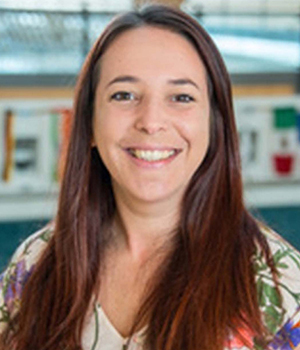
Patricia Baldrich González
My journey as a scientist has taken me across multiple continents, allowing me to engage with diverse ecosystems, research methodologies, and scientific communities. This global perspective has been invaluable in broadening my understanding and contributing to the advancement of my knowledge in plant-microbe interactions. Let me begin by telling you about myself. I am originally from the northeast region of Spain known as Catalonia. Many people I’ve met around the world are unaware that most individuals raised in this region are bilingual from birth. We speak both Catalan and Spanish, and both languages are officially recognized. This blend of languages has granted us a unique cultural identity within Spain’s multilingual tapestry. I believe that this, combined with my parents’ love for travel, instilled in me a constant desire for new adventures.
The Spark of Passion
During my college years, I received an ERASMUS fellowship to spend six months in a laboratory in Toulouse, in the south of France. It was an incredible experience that I highly recommend to anyone who can manage it in terms of both time and finances. While it delayed my graduation by one semester, this opportunity sparked my passion for plant-microbe interactions and confirmed my desire to pursue a career in scientific research. It was also a fantastic initial experience living outside of my birth country. Being just a short four-hour drive away provided me with the comfort I needed, knowing I could return home whenever necessary or desired. When it ended, I knew it would not be my last experience abroad.
Broadening Horizons
Once I finished my master’s degree, I joined a lab in Barcelona to start my Ph.D. program working on plant-pathogen interactions in Arabidopsis and rice. I was lucky enough to find a great lab family that welcomed me and to work on a subject that I find fascinating. During one of my first meetings with my Ph.D. adviser, I boldly expressed my desire for a unique experience that would expand my horizons. I loved being close to my family and friends, but I yearned for the chance to work in a different lab environment—one that was as geographically distant from my current location as possible—for a few months. Understanding my drive for this enriching experience, my advisor leveraged her international connections and arranged for me to spend an entire summer in Taipei, Taiwan. This was facilitated through a collaboration that our lab had with a research group based there. This international exposure not only broadened my academic perspective, but also enriched me personally.
I was privileged to receive a fellowship from the Taiwanese government as part of a special program for European-Taiwanese student exchange. This marked my first experience working in a lab outside of Europe. The shift was significant, as I found myself immersed in English, both at work and in daily life, around the clock. Despite the cultural differences, I found common ground with the Taiwanese Ph.D. students in the lab. I sampled new foods and taught many people how to make “Pa amb tomaquet” (a Catalan specialty of fresh tomato and garlic on toasted sourdough bread). I danced to new music and shared my Catalan roots with my new friends, a true embodiment of cultural exchange. Immersion in a new culture can be personally and professionally challenging but also enriching, fostering cross-cultural understanding and the exchange of ideas.
New Challenges and Opportunities
As my Ph.D. graduation date approached, I decided to contact a professor in the United States whose work excited me. Luckily, he had an open spot in his lab and accepted my application. I sold all of my furniture, my car, left some belongings at my parents’ house, packed two suitcases, and left Spain with no return date. I sought new scientific horizons and experiences, aiming for a place where I could conduct experiments without budget constraints. I also hoped, however, to find a community of like-minded people passionate about science. I found that place in St. Louis, MO.
The arrival in St. Louis was bumpy. I had to rent an apartment without seeing it, get a new driver’s license, and adapt to a different language. Starting a new life in a place where I knew no one was challenging. For a couple of months, I came home to an empty house, unable to share my day with anyone familiar. My friends and family were seven time zones away, sleeping. Despite these challenges, I immersed myself in my work, joined many meet-up groups of different interests, and gradually built a new network of friends and colleagues.
During this time, I also learned how to navigate the complex and time-consuming visa and immigration processes, which include the potential for delays and complications. For example, during the pandemic, my H1B visa expired, and to get it renewed, I had to return to Spain. However, the U.S. embassy in Madrid was fully closed and not processing visas. I had to wait many months and leave the United States without the certainty that I would be able to return. This barrier was a source of stress and anxiety for me and many other immigrants.
The Ongoing Journey
Over the years, I have worked on three different continents, learning to be flexible and resourceful, while gaining a wide network of colleagues and mentors. This experience has enabled me to communicate inclusively and relate to diverse perspectives. Although it came with challenges and cultural adjustments, I would choose this path again. Now, I have a wonderful family in the United States, an amazing partner, two beautiful boys aged 5 and 3, and a big dog. We are about to embark on a new adventure, moving to Davis, CA. This move will bring new challenges and experiences, continuing the journey of growth and discovery not just about professional development, but also about discovering new aspects of myself.