IS-MPMI is an endorsing organization of the Phytobiomes Roadmap.
A new approach for agriculture to achieve sustainable crop production
25 February 2016 – Washington DC, USA—On 25 February 2016, a group of scientific societies, companies, research institutes, and governmental agencies launched the Phytobiomes Roadmap presenting a new vision for agriculture to increase health, productivity, and sustainability of our current cropping and forest systems.
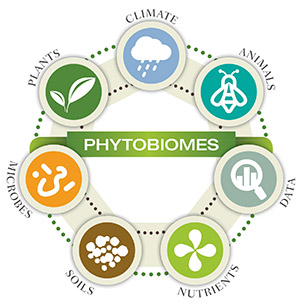
The Roadmap outlines a strategic plan for acquiring critical knowledge of how all of the components on a farm interact and affect each other. These components – the crops, plants, microbes, animals, soils, and climate – are collectively called the phytobiome.
The document lays out an action plan to translate that knowledge into powerful new tools for crop management to produce a sufficient supply of food, feed and fiber to meet global needs in the future.
“The Phytobiomes Roadmap provides a vision of integrating the many diverse components of agroecosystems, including the environment, all of the macroorganisms, and the microorganisms, into a systems-level understanding” explains Gwyn Beattie, Professor & Robert Earle Buchanan Distinguished Professor of Bacteriology at Iowa State University and co-leader of an initiative on phytobiomes.
This Roadmap comes at a critical time in which new innovative approaches are needed to sustainably increase global crop productivity to meet the demand of an additional 2.4 billion people by 2050. During that timeframe, experts predict that current agricultural systems will be facing multiple challenges due to more frequent extreme weather events, plateauing crop yields, and diminishing availability of land, water and other critical inputs.
Interactions within phytobiomes are dynamic and complex. The Roadmap advocates for a systems-level understanding of all the phytobiome components. It proposes to bring together current approaches and leverage and coordinate currently disparate activities to generate critical knowledge on how all constituents of phytobiomes interact with each other to affect crop health and yield.
Jan Leach, University Distinguished Professor at Colorado State University and phytobiomes initiative co-leader stresses that “the success of this systems approach will require international collaborations of scientists with diverse expertise who can collect and interpret data that integrate interactions among organisms and their environments.”
Current technological developments – such as advances in genomic technologies, computational sciences, system-level approaches and precision agriculture – are enabling unprecedented insights for probing the complex interactions within phytobiomes. These technologies are providing extensive biological and environmental datasets. The Roadmap proposes to integrate these “big data” into predictive modeling systems to provide critical information to drive agricultural innovations.
The primary outcome is expected to be a shift in agricultural production from managing primarily individual components of cropping systems to managing whole systems using comprehensive systems-based knowledge of phytobiomes.
“By bringing together all ongoing initiatives from diverse scientific disciplines and connecting the dots between fundamental science and application, we aim to provide growers with practical tools with which each farmer manages his/her own crop biomes for maximum efficiency, sustainability, and profitability,” explains Kellye Eversole, phytobiomes initiative co-leader.
Translating knowledge of phytobiomes into next generation precision agriculture tools and techniques will empower farmers to produce sufficient crops to meet global demands. For example, it could be envisioned that growers will have at their disposal crop varieties that better exploit phytobiome components in specific environments for stronger resilience to pests and limited water and nutrients. Another application would be new innovative management practices to grow crops on marginal and degraded lands with minimized negative impacts on the environment.
The Phytobiomes Roadmap was developed under the leadership of the American Phytopathological Society (APS), based on discussions and input provided by over 200 academic, industry, and government representatives at a workshop organized in Washington DC in July 2015, as well as from input by the scientific community and the general public through the Phytobiomes website.
The Roadmap has broad support from professional societies, industry, government agencies, private foundations, non-profit institutes, and government-supported research networks.
About Phytobiomes
Initially developed by the American Phytopathological Society (APS) Public Policy Board, the phytobiomes vision is an effort to increase interest and funding in phytobiome research and to apply knowledge of phytobiomes to promote food, feed and fiber production.
www.phytobiomes.org


 The LSC and IS-MPMI Board realize that the limited travel funds do not allow us to support all student and postdoc attendees (we wish we could!). Nevertheless, we would strongly encourage you to come to the congress in Portland regardless of the ultimate sources of funding that support your travel. Personally, I cannot overemphasize the positive impact that attending an IS-MPMI congress could have on the career of a student/postdoc/early career professional, especially if they are a first-time IS-MPMI Congress attendee. I remember my first time attending an IS-MPMI Congress (Interlaken, Switzerland, 1990). That congress was such an eye-opening experience for me, listening to one amazing talk after another describing major advances in the study of rhizobia, agrobacteria and various pathogens. It was in that congress, after listening to the inspiring talks by Fred Ausubel, Brian Staskawicz, and Jeff Dangl on the development of the Arabidopsis-Pseudomonas syringae pathosystem for cloning avirulence genes and studying plant defense responses, when I began to think about possibly using this system for my future study of bacterial pathogenesis and disease susceptibility. This type of IS-MPMI Congress experience is not unique to me as students in my own lab have come back from these meetings with a renewed enthusiasm and better perspective as well. I can easily imagine students/postdocs who attend the congress in Portland will be similarly inspired to nurture some creative ideas that will eventually help to launch their scientific careers. Plus, how often do you get a chance to talk to a large number of peers and friends whose scientific interests are so closely aligned with your own? My bottom line: please take advantage of the IS-MPMI congress venue to communicate your exciting findings and to network with colleagues who could one day help your career, either directly or indirectly.