

Category: ​​Issue 1 •​ 2023​

Preliminary Lineup of Concurrent Sessions and Workshops for 2023 IS-MPMI Congress Announced

ISMPMI 285 2 1955560 removebg preview

Issue 1

2020

interactions

Did You Know

02SocNews 2023Congress logo

The 2023 IS-MPMI Congress will be held July 16–20 in Providence, Rhode Island, USA. The goal of the IS-MPMI Board of Directors is to feature new and exciting speakers and topics. This year IS-MPMI members were asked to submit their ideas for concurrent sessions to be held throughout the meeting.

Submissions were accepted from all members but were particularly encouraged from students, postdocs, and early-career scientists in order to give members of these groups a chance to take a leadership role and propose interesting and engaging science programming for the 2023 congress.

A total of 26 proposals were received for the 18 session slots in the agenda. Some of the proposals were focused on duplicate or similar topics, and in these cases, it made the most sense to merge the topics into a single session. Other proposals were asked to share a 2-hour timeslot with another session. In these cases, each topic will be covered but will only have 1 hour. This resulted in the filling of all 18 concurrent session slots with proposals from the membership and the addition of a premeeting workshop to cover important topics. Here is the tentative lineup of concurrent sessions and workshops for the 2023 IS-MPMI Congress:

1. Biomolecular condensation-mediated signaling during plant–microbe interactions

2. Biotrophy and necrotrophy in the plant–microbe dynamic (ECR TED talks)

3. Cell autonomous and cell-type-specific immunity

4. Environmental impacts on plant–pathogen/microbiome interactions

5. Extracellular RNA-mediated interactions and crop protection strategies

6. Suppression of innate immunity during nitrogen-fixing symbiosis, causes and consequences

7a. Revisiting the publishing system to promote open science and adopt better practices in the assessment of research: Trust “preprint and exist” and forget “publish or perish”

7b. Showcasing undergraduate research and mentoring in plant–microbe interactions

8. The making of a story—Building narratives and communicating science effectively

9. Organelle functions in plant–microbe interactions

10. Molecular diagnostics-point-of-care plant disease diagnosis

11. Peptides as diverse molecular messengers in plant–microbe Interactions

12. Vascular pathogens and their hosts

13. Plant-derived metabolites and microbial organisms—A complex interactive relationship

14. PRR evolution in model and crop plants

15. Microbiomes

16. Systems and spatial biology in host–pathogen interactions (networks)

17. The long and short of it: Intercellular communication in MPMI

18a. The next big idea @ IS-MPMI 2023

18b. Who wants to be a MPMIllionaire?

Workshop 1a. AlphaFold user workshop

Workshop 1b. Biological sequence modeling and genome mining to discover virulence factors in plant pathogens​

IS-MPMI Welcomes Timothy Friesen as Incoming Editor-in-Chief of MPMI

ISMPMI 285 2 1955560 removebg preview

Issue 1

2020

interactions

Did You Know

With the start of 2023 comes new year’s resolutions…and editorial board transitions. On January 1, 2023, outgoing MPMI Editor-in-Chief Jeanne Harris will hand over the proverbial reins to USDA-ARS researcher Timothy Friesen, whose long-standing involvement with MPMI makes him uniquely qualified for the role of editor-in-chief.

Friesen has been involved with MPMI at all stages of publication as a reviewer, author, associate editor, and senior editor. “I believe strongly in supporting society journals, and MPMI is one of my favorite journals,” he remarked, “and therefore, I can’t imagine a better way to serve the IS-MPMI research community than by being editor-in-chief.”

There is much to anticipate during Friesen’s term. To boost the visibility of MPMI and maintain its status as the premier journal for plant–microbe interactions, Friesen and his editorial board plan to add new article categories, including the H.H. Flor Distinguished Review series. These will be invited reviews written by scientists who have made significant scientific contributions in an area involving plant–microbe interactions.

They also intend to add Interactions Reviews, which will provide current reviews written about important plant–microbe interactions. According to Friesen, “Both review categories will bring visibility to MPMI and will be highly useful to young researchers, as well as scientists interested in gaining insight into new areas of research.”

Lastly, they will implement Commentaries on selected articles published in MPMI, highlighting exceptional work.

Friesen is thrilled to utilize his passion for, and knowledge of, scientific publications as editor-in-chief of MPMI. “A scientist’s goal is always the publication of their work, and with each publication, filling a gap in scientific understanding. Regardless of whether this is a small or large piece of the scientific puzzle, it is always satisfying to put a complete story together and polish it for publication,” Friesen said. He looks forward to overseeing this process and working with his editorial board to provide the best possible author and reviewer experience.​

Learn More About Timothy Friesen

02SocNews Friesen photo

Dr. Friesen received his Ph.D. degree in plant pathology from North Dakota State University in 2001 and then joined the USDA-ARS later that year as an ARS post-doc working in the Sugar

Beet and Potato Research Unit in Fargo, ND. In 2002, he accepted a research plant pathologist position in the Cereal Crops Research Unit, Red River Valley Agricultural Research Center in Fargo, ND. Dr. Friesen’s research program focuses on the genetics and molecular biology of virulence associated with foliar pathogens of wheat and barley, concentrating on how pathogens interact with their respective host plants. Examples of research highlights include the cloning and validation of pathogen-produced effector genes involved in host–pathogen interactions and the functional characterization of how necrotrophic pathogens use necrotrophic effectors in virulence.


IS-MPMI and MPMI sincerely thank Jeanne Harris for her enthusiastic dedication to and leadership of MPMI. During her term, Harris guided the publicat​ion of highly successful articles and

02SocNews Harris photo

focus issues. She also oversaw pivotal changes to the journal, including

Harris plans to stay involved with MPMI as coordinator and host of What’s New in MPMI! Virtual Seminars.​

Celebrate a Great Year of MPMI Science: Most Cited and Most Read Articles Published in 2022

ISMPMI 285 2 1955560 removebg preview

Issue 1

2020

interactions

Did You Know

Most Cited

MPMI 2021Cover (5)

EffectorP 3.0: Prediction of Apoplastic and Cytoplasmic Effectors in Fungi and Oomycetes
Jana Sperschneider and Peter N. Dodds

Identification of Adhesins in Plant Beneficial Rhizobacteria Bacillus velezensis SQR9 and Their Effect on Root Colonization
Rong Huang, Haichao Feng, Zhihui Xu, Nan Zhang, Yunpeng Liu et al.

OsRAM2 Function in Lipid Biosynthesis Is Required for Arbuscular Mycorrhizal Symbiosis in Rice
Ying-Na Liu, Cheng-Chen Liu, An-Qi Zhu, Ke-Xin Niu, Rui Guo et al.

The Mechanosensitive Ion Channel MSL10 Modulates Susceptibility to Pseudomonas syringae in Arabidopsis thaliana
Debarati Basu, Jennette M. Codjoe, Kira M. Veley, and Elizabeth S. Haswell​

Most Read

Recognition of Microbe- and Damage-Associated Molecular Patterns by Leucine-Rich Repeat Pattern Recognition Receptor Kinases Confers Salt Tolerance in Plants
Eliza P.-I. Loo, Yuri Tajima, Kohji Yamada, Shota Kido, Taishi Hirase et al.

EffectorP 3.0: Prediction of Apoplastic and Cytoplasmic Effectors in Fungi and Oomycetes
Jana Sperschneider and Peter N. Dodds

Cell-to-Cell Communication During Plant–Pathogen Interaction
Naheed Tabassum and Ikram Blilou

Plant–Microbiota Interactions in Abiotic Stress Environments
Natsuki Omae and Kenichi Tsuda

Growth Promotion of Giant Duckweed Spirodela polyrhiza (Lemnaceae) by Ensifer sp. SP4 Through Enhancement of Nitrogen Metabolism and Photosynthesis
Tadashi Toyama, Kazuhiro Mori, Yasuhiro Tanaka, Michihiko Ike, and Masaaki Morikawa

Influence of Flagellin Polymorphisms, Gene Regulation, and Responsive Memory on the Motility of Xanthomonas Species That Cause Bacterial Spot Disease of Solanaceous Plants
Maria L. Malvino, Amie J. Bott, Cory E. Green, Tanvi Majumdar, and Sarah R. Hind

Production of Agrocinopine A by Ipomoea batatas Agrocinopine Synthase in Transgenic Tobacco and Its Effect on the Rhizosphere Microbial Community
Aiko Tanaka, Maarten H. Ryder, Takamasa Suzuki, Kazuma Uesaka, Nobuo Yamaguchi et al.

Microscopic and Transcriptomic Analyses of Dalbergoid Legume Peanut Reveal a Divergent Evolution Leading to Nod-Factor-Dependent Epidermal Crack-Entry and Terminal Bacteroid Differentiation
Bikash Raul, Oindrila Bhattacharjee, Amit Ghosh, Priya Upadhyay, Kunal Tembhare et al.

RNAi-Based Gene Silencing of RXLR Effectors Protects Plants Against the Oomycete Pathogen Phytophthora capsici
Wei Cheng, Menglan Lin, Moli Chu, Guixiang Xiang, Jianwen Guo et al.

Involvement of Arabidopsis Acyl Carrier Protein 1 in PAMP-Triggered Immunity
Zhenzhen Zhao, Jiangbo Fan, Piao Yang, Zonghua Wang, Stephen Obol Opiyo et al.​

Kick Off 2023 with the Next What’s New in MPMI! Virtual Seminar

ISMPMI 285 2 1955560 removebg preview

Issue 1

2020

interactions

Did You Know

MPMI VitrualSeminar 650x97 (1)

Register to hear Emma Gachomo present the Editor’s Pick “Bradyrhizobium japonicum IRAT FA3 Alters Arabidopsis thaliana Root Architecture via Regulation of Auxin Efflux Transporters PIN2PIN3PIN7, and ABCB19” on January 17, 2023, at 11:00 a.m. CST.​

Watch Recent What’s New in MPMI! Virtual Seminars

Kyungyong Seong presented the award-winning Editor’s Pick “Computational Structural Genomics Unravels Common Folds and Novel Families in the Secretome of Fungal Phytopathogen Magnaporthe oryzae” on November 15, 2022.

Yusuke Saijo presented “Recognition of Microbe- and Damage-Associated Molecular Patterns by Leucine-Rich Repeat Pattern Recognition Receptor Kinases Confers Salt Tolerance in Plants,” the Editor’s Pick from a special focus issue, on October 11, 2022.​

Don’t Miss the MPMI Editor’s Picks from This Fall

ISMPMI 285 2 1955560 removebg preview

Issue 1

2020

interactions

Did You Know

September​

05EdPick Sep

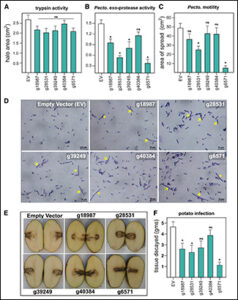
Protease Inhibitors from Solanum chacoense Inhibit Pectobacterium Virulence by Reducing Bacterial Protease Activity and Motility

Janak Joshi and colleagues identify protease inhibitors from wild potato that inhibit disease caused by bacterial Pectobacterium pathogens. These protease inhibitors can be used in potato breeding programs and may potentially have a much more immediate effect as purified proteins that can be used to manage Pectobacterium-caused disease.

October​​

05EdPick Oct (1)

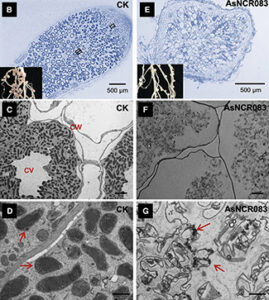
Transcriptomic Identification of a Unique Set of Nodule-Specific Cysteine-Rich Peptides Expressed in the Nitrogen-Fixing Root Nodule of Astragalus sinicus

Nodule-specific cysteine-rich (NCR) peptides are targeted to the symbiosomes to regulate bacteroid differentiation. Feng Wei and colleagues identified NCR peptides from Astragalus sinicus and showed that AsNCRs expression depends on a rhizobial peptide transporter encoded by the BacA gene. Further, they established that AsNCR067 promotes rhizobial growth, whereas AsNCR083 expression in rhizobia disrupts late nodule development and bacteroid differentiation. This research highlights that NCR peptides are plant-encoded checkpoints for rhizobial differentiation in nodules and can be used as a tool to modify legume-rhizobia symbiosis.​

November

MPMI Nov22 Promiscuity Locus PR copy

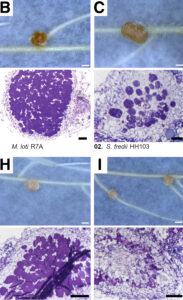
A Promiscuity Locus Confers Lotus burttii Nodulation with Rhizobia from Five Different Genera

Why do some legumes interact only with one or two specialist rhizobia symbionts while others interact with many? Mohammad Zarrabian and colleagues identify a locus in Lotus burtii that determines its ability to interact with many different rhizobia strains. This study provides an opportunity to understand how host range and its restriction is controlled at a molecular level.​

ROOT & SHOOT Is Accepting Travel Award Applications for Members of SACNAS or MANRRS

ISMPMI 285 2 1955560 removebg preview

Issue 4

2022

interactions

Did You Know

01Community RootShoot logo

Did you know that IS-MPMI is a partner society with the NSF-funded LEAPS Research Coordination Network? This partnership helps support the Rooting Out Oppression Together and SHaring Our Outcomes Transparently (ROOT & SHOOT) program, which aims to make plant science more equitable and inclusive. Part of this mission involves building strong connections with organizations that support people of marginalized identities, including members of the Society for the Advancement of Chicano/Hispanics and Native Americans in Science (SACNAS) and Minorities in Agriculture, Natural Resources, and Related Sciences (MANRRS).

ROOT & SHOOT is currently accepting travel award applications for members of SACNAS or MANRRS to attend certain plant science conferences in 2023—and the 2023 IS-MPMI Congress, which will be held from July 16 to 20 in Rhode Island, is included in this list! These awards provide up to $3,000 to defray travel costs for a mentee/mentor pair that includes at least one member of SACNAS or MANRRS.

Applications for the ROOT & SHOOT Travel Awards are due January 9, 2023. We encourage all SACNAS or MANRRS members who are planning to travel to the IS-MPMI Congress from within the United States or internationally on a U.S. carrier (e.g., United, American, Delta) to take advantage of this amazing opportunity.

You can find the application, requirements, and more information on the ROOT & SHOOT website.

Discover more about the 2023 IS-MPMI Congress here. Abstract submission is now open through March 1, 2023.

Preliminary Lineup of Concurrent Sessions and Workshops for 2023 IS-MPMI Congress Announced

ISMPMI 285 2 1955560 removebg preview

Issue 4

2022

interactions

Did You Know

02SocNews 2023Congress logo

The 2023 IS-MPMI Congress will be held July 16–20 in Providence, Rhode Island, USA. The goal of the IS-MPMI Board of Directors is to feature new and exciting speakers and topics. This year IS-MPMI members were asked to submit their ideas for concurrent sessions to be held throughout the meeting.

Submissions were accepted from all members but were particularly encouraged from students, postdocs, and early-career scientists in order to give members of these groups a chance to take a leadership role and propose interesting and engaging science programming for the 2023 congress.

A total of 26 proposals were received for the 18 session slots in the agenda. Some of the proposals were focused on duplicate or similar topics, and in these cases, it made the most sense to merge the topics into a single session. Other proposals were asked to share a 2-hour timeslot with another session. In these cases, each topic will be covered but will only have 1 hour. This resulted in the filling of all 18 concurrent session slots with proposals from the membership and the addition of a premeeting workshop to cover important topics. Here is the tentative lineup of concurrent sessions and workshops for the 2023 IS-MPMI Congress:

1. Biomolecular condensation-mediated signaling during plant–microbe interactions

2. Biotrophy and necrotrophy in the plant–microbe dynamic (ECR TED talks)

3. Cell autonomous and cell-type-specific immunity

4. Environmental impacts on plant–pathogen/microbiome interactions

5. Extracellular RNA-mediated interactions and crop protection strategies

6. Suppression of innate immunity during nitrogen-fixing symbiosis, causes and consequences

7a. Revisiting the publishing system to promote open science and adopt better practices in the assessment of research: Trust “preprint and exist” and forget “publish or perish”

7b. Showcasing undergraduate research and mentoring in plant–microbe interactions

8. The making of a story—Building narratives and communicating science effectively

9. Organelle functions in plant–microbe interactions

10. Molecular diagnostics-point-of-care plant disease diagnosis

11. Peptides as diverse molecular messengers in plant–microbe Interactions

12. Vascular pathogens and their hosts

13. Plant-derived metabolites and microbial organisms—A complex interactive relationship

14. PRR evolution in model and crop plants

15. Microbiomes

16. Systems and spatial biology in host–pathogen interactions (networks)

17. The long and short of it: Intercellular communication in MPMI

18a. The next big idea @ IS-MPMI 2023

18b. Who wants to be a MPMIllionaire?

Workshop 1a. AlphaFold user workshop

Workshop 1b. Biological sequence modeling and genome mining to discover virulence factors in plant pathogens​

IS-MPMI Welcomes Timothy Friesen as Incoming Editor-in-Chief of MPMI

ISMPMI 285 2 1955560 removebg preview

Issue 4

2022

interactions

Did You Know

With the start of 2023 comes new year’s resolutions…and editorial board transitions. On January 1, 2023, outgoing MPMI Editor-in-Chief Jeanne Harris will hand over the proverbial reins to USDA-ARS researcher Timothy Friesen, whose long-standing involvement with MPMI makes him uniquely qualified for the role of editor-in-chief.

Friesen has been involved with MPMI at all stages of publication as a reviewer, author, associate editor, and senior editor. “I believe strongly in supporting society journals, and MPMI is one of my favorite journals,” he remarked, “and therefore, I can’t imagine a better way to serve the IS-MPMI research community than by being editor-in-chief.”

There is much to anticipate during Friesen’s term. To boost the visibility of MPMI and maintain its status as the premier journal for plant–microbe interactions, Friesen and his editorial board plan to add new article categories, including the H.H. Flor Distinguished Review series. These will be invited reviews written by scientists who have made significant scientific contributions in an area involving plant–microbe interactions.

They also intend to add Interactions Reviews, which will provide current reviews written about important plant–microbe interactions. According to Friesen, “Both review categories will bring visibility to MPMI and will be highly useful to young researchers, as well as scientists interested in gaining insight into new areas of research.”

Lastly, they will implement Commentaries on selected articles published in MPMI, highlighting exceptional work.

Friesen is thrilled to utilize his passion for, and knowledge of, scientific publications as editor-in-chief of MPMI. “A scientist’s goal is always the publication of their work, and with each publication, filling a gap in scientific understanding. Regardless of whether this is a small or large piece of the scientific puzzle, it is always satisfying to put a complete story together and polish it for publication,” Friesen said. He looks forward to overseeing this process and working with his editorial board to provide the best possible author and reviewer experience.​

Learn More About Timothy Friesen

02SocNews Friesen photo

Dr. Friesen received his Ph.D. degree in plant pathology from North Dakota State University in 2001 and then joined the USDA-ARS later that year as an ARS post-doc working in the Sugar Beet and Potato Research Unit in Fargo, ND. In 2002, he accepted a research plant pathologist position in the Cereal Crops Research Unit, Red River Valley Agricultural Research Center in Fargo, ND. Dr. Friesen’s research program focuses on the genetics and molecular biology of virulence associated with foliar pathogens of wheat and barley, concentrating on how pathogens interact with their respective host plants. Examples of research highlights include the cloning and validation of pathogen-produced effector genes involved in host–pathogen interactions and the functional characterization of how necrotrophic pathogens use necrotrophic effectors in virulence.02SocNews Harris photo

IS-MPMI and MPMI sincerely thank Jeanne Harris for her enthusiastic dedication to and leadership of MPMI. During her term, Harris guided the publicat​ion of highly successful articles and focus issues. She also oversaw pivotal changes to the journal, including

Harris plans to stay involved with MPMI as coordinator and host of What’s New in MPMI! Virtual Seminars.​

Celebrate a Great Year of MPMI Science: Most Cited and Most Read Articles Published in 2022

ISMPMI 285 2 1955560 removebg preview

Issue 3

2022

interactions

Did You Know

 Most Cited

MPMI 2021Cover (1)

EffectorP 3.0: Prediction of Apoplastic and Cytoplasmic Effectors in Fungi and Oomycetes
Jana Sperschneider and Peter N. Dodds

Identification of Adhesins in Plant Beneficial Rhizobacteria Bacillus velezensis SQR9 and Their Effect on Root Colonization
Rong Huang, Haichao Feng, Zhihui Xu, Nan Zhang, Yunpeng Liu et al.

OsRAM2 Function in Lipid Biosynthesis Is Required for Arbuscular Mycorrhizal Symbiosis in Rice
Ying-Na Liu, Cheng-Chen Liu, An-Qi Zhu, Ke-Xin Niu, Rui Guo et al.

The Mechanosensitive Ion Channel MSL10 Modulates Susceptibility to Pseudomonas syringae in Arabidopsis thaliana
Debarati Basu, Jennette M. Codjoe, Kira M. Veley, and Elizabeth S. Haswell​

Most Read

Recognition of Microbe- and Damage-Associated Molecular Patterns by Leucine-Rich Repeat Pattern Recognition Receptor Kinases Confers Salt Tolerance in Plants
Eliza P.-I. Loo, Yuri Tajima, Kohji Yamada, Shota Kido, Taishi Hirase et al.

EffectorP 3.0: Prediction of Apoplastic and Cytoplasmic Effectors in Fungi and Oomycetes
Jana Sperschneider and Peter N. Dodds

Cell-to-Cell Communication During Plant–Pathogen Interaction
Naheed Tabassum and Ikram Blilou

Plant–Microbiota Interactions in Abiotic Stress Environments
Natsuki Omae and Kenichi Tsuda

Growth Promotion of Giant Duckweed Spirodela polyrhiza (Lemnaceae) by Ensifer sp. SP4 Through Enhancement of Nitrogen Metabolism and Photosynthesis
Tadashi Toyama, Kazuhiro Mori, Yasuhiro Tanaka, Michihiko Ike, and Masaaki Morikawa

Influence of Flagellin Polymorphisms, Gene Regulation, and Responsive Memory on the Motility of Xanthomonas Species That Cause Bacterial Spot Disease of Solanaceous Plants
Maria L. Malvino, Amie J. Bott, Cory E. Green, Tanvi Majumdar, and Sarah R. Hind

Production of Agrocinopine A by Ipomoea batatas Agrocinopine Synthase in Transgenic Tobacco and Its Effect on the Rhizosphere Microbial Community
Aiko Tanaka, Maarten H. Ryder, Takamasa Suzuki, Kazuma Uesaka, Nobuo Yamaguchi et al.

Microscopic and Transcriptomic Analyses of Dalbergoid Legume Peanut Reveal a Divergent Evolution Leading to Nod-Factor-Dependent Epidermal Crack-Entry and Terminal Bacteroid Differentiation
Bikash Raul, Oindrila Bhattacharjee, Amit Ghosh, Priya Upadhyay, Kunal Tembhare et al.

RNAi-Based Gene Silencing of RXLR Effectors Protects Plants Against the Oomycete Pathogen Phytophthora capsici
Wei Cheng, Menglan Lin, Moli Chu, Guixiang Xiang, Jianwen Guo et al.

Involvement of Arabidopsis Acyl Carrier Protein 1 in PAMP-Triggered Immunity
Zhenzhen Zhao, Jiangbo Fan, Piao Yang, Zonghua Wang, Stephen Obol Opiyo et al.​

Kick Off 2023 with the Next What’s New in MPMI! Virtual Seminar

ISMPMI 285 2 1955560 removebg preview

Issue 4

2022

interactions

Did You Know

MPMI VitrualSeminar 650x97 (1)

Register to hear Emma Gachomo present the Editor’s Pick “Bradyrhizobium japonicum IRAT FA3 Alters Arabidopsis thaliana Root Architecture via Regulation of Auxin Efflux Transporters PIN2PIN3PIN7, and ABCB19” on January 17, 2023, at 11:00 a.m. CST.​

Watch Recent What’s New in MPMI! Virtual Seminars

Kyungyong Seong presented the award-winning Editor’s Pick “Computational Structural Genomics Unravels Common Folds and Novel Families in the Secretome of Fungal Phytopathogen Magnaporthe oryzae” on November 15, 2022.

Yusuke Saijo presented “Recognition of Microbe- and Damage-Associated Molecular Patterns by Leucine-Rich Repeat Pattern Recognition Receptor Kinases Confers Salt Tolerance in Plants,” the Editor’s Pick from a special focus issue, on October 11, 2022.​

Scroll to Top