Dr. Jones was interviewed by Jawahar Singh, MPMI Assistant Features Editor
Jonathan Jones, senior group leader at The Sainsbury Laboratory, Norwich, Norfolk, England, is one of the most influential figures in molecular plant–microbe interactions. Over nearly four
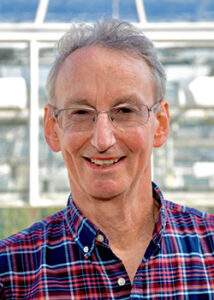
decades, his work has shaped our understanding of plant immunity, from cloning the Cf-9 resistance gene to coauthoring the guard hypothesis and zig-zag model. This year, he shared the Wolf Foundation Prize in Agriculture with long-time collaborators Jeff Dangl and Brian Staskawicz—a recognition of the profound impact plant disease resistance research has had on agriculture.
I spoke with JJ about his reaction to receiving the award, the mentors and moments that shaped his career, his most influential work, and his advice for the next generation.
What was your reaction when you received the news you had won the award?
The call came in over a weekend, but my phone’s usually on silent, so I missed it. Then I got emails from Brian and Jeff. Brian said, “If that’s the Wolf Foundation calling, they’re probably not ringing to tell us we haven’t won.” He was right.
I was elated, especially because I’ve worked with Jeff and Brian for nearly my whole career. The award recognizes not just us, but the importance of plant disease resistance in agriculture. It’s an affirmation that what we’ve been doing matters.
Can you briefly share your journey into science and what first sparked your interest?
My first love was chemistry—I was fascinated by the periodic table as a teenager. In the late 1960s, however, it was clear humans weren’t treating the planet well, so at university I switched to biology to “save the world” from ecological disaster.
Ecology turned out to require patience and statistics, which I wasn’t great at, so I found my home in plant science. Plants are incredible—they turn sunlight and CO2 into the sugars that sustain all life. That led me to a Ph.D. degree at the Plant Breeding Institute, where I saw the intersection of genetics and crop improvement.
A postdoc with Fred Ausubel in the early 1980s got me into symbiotic nitrogen fixation. I was one of the first to move nodulation genes into Agrobacterium to make pseudo-nodules. Later, at a biotech startup in California, I fell in love with designing genetic constructs—it’s like sculpture, shaping something into a functional form.
In 1988, Caroline Dean and I moved to Norwich, where I used transposons to clone Cf-9, one of the first resistance genes. From there, my focus shifted to figuring out how these genes actually work—a much tougher problem.
Were there any key mentors early in your career?
Plenty. Harold Whitehouse taught genetics with rigor. Tom ap Rees brought biochemical precision. My Ph.D. advisors, Dick Flavell and Gabriel Dover, gave me both scientific wisdom and rhetorical skills.
In Fred Ausubel’s lab I was surrounded by brilliance—George Church, Venkatesan Sundaresan, Sharon Long, and Gary Ruvkun. Later, colleagues like Brian Staskawicz, Jeff Dangl, David Baulcombe, and Jane Parker shaped my thinking. Recruiting great people has always been key.
Your research has had a big impact. Which work do you consider most influential?
That’s for others to decide, but the Cf-9 cloning stands out—we had so many different transposon insertions; it was beautiful genetics. The guard hypothesis and zig-zag model have had lasting conceptual impacts.
I’m also proud of the “mutual potentiation” paper, where we figured out how to study ETI without PTI—something nobody had really done before. And, on the applied side, cloning and stacking late blight resistance genes in potato to make field-ready products has been hugely rewarding, even if it’s a long road to deployment.
Looking back, were there any surprising turns in your research?
The Purple TomatoTM company. Cathy Martin and I started it 18 years ago, partly to see if pairing a consumer-friendly trait with agronomic traits could help with public acceptance of GM crops. The original vision was more ambitious, but now there’s a product in the United States with real health benefits—at least if you’re a mouse!
What does this award mean to you personally and professionally?
It says the work my colleagues, collaborators, and I have done over the last 37 years matters and could make a real difference. Recognition is nice, but if you let it drive your research, you risk distorting what you do. Curiosity has to be the real driver.
What responsibilities come with this kind of recognition?
To set a good example—behave generously, not selfishly, and encourage others to see science as an exciting way to make a living—and avoid doing anything I’d regret when I wake up the next morning.
What’s the biggest challenge you’ve faced, and how did you overcome it?
Early on, the challenge was literally getting genes out of genomes before sequencing made it easy. Later, it was working out how resistance genes function—an area where I rely on recruiting great people.
The most painful episode was retracting a paper after discovering data fabrication. The lesson? Always insist on independent replication—three times, minimum—for every figure in a paper.
What advice would you give early-career scientists?
Follow something you’re genuinely curious about. Read enough to know what’s not known. Frame good questions, design experiments to answer them, and, as Barbara McClintock said, “Treasure your exceptions”—unexpected results are often where discoveries hide.
What do you wish more people understood about molecular plant–microbe interactions research?
Genome sequencing shows that plant genomes are full of insertions, deletions, inversions—massive natural variation. Against that backdrop, worrying about adding one or two genes via Agrobacterium or editing 20 nucleotides is absurd. We should all be out there explaining this to anyone who will listen.
Are there emerging areas you think are underexplored?
Lots. Immune receptor design, understanding how calcium signals actually trigger defense, resistance to nonbiotrophic pathogens, plant–invertebrate interactions, understanding how virus resistance NLRs stop viruses, and something I call the “fourth dimension”—studying processes over time, not just endpoints.
How do you hope your legacy will influence the next generation?
I hope they see the opportunity to make agriculture more sustainable by improving crop disease resistance—saving not just grain, but the enormous amounts of water and inputs lost to disease. And, I hope they keep digging in fields where there are still new potatoes to be found.