September
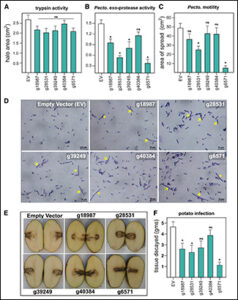
Janak Joshi and colleagues identify protease inhibitors from wild potato that inhibit disease caused by bacterial Pectobacterium pathogens. These protease inhibitors can be used in potato breeding programs and may potentially have a much more immediate effect as purified proteins that can be used to manage Pectobacterium-caused disease.
October
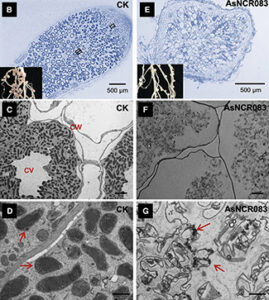
Nodule-specific cysteine-rich (NCR) peptides are targeted to the symbiosomes to regulate bacteroid differentiation. Feng Wei and colleagues identified NCR peptides from Astragalus sinicus and showed that AsNCRs expression depends on a rhizobial peptide transporter encoded by the BacA gene. Further, they established that AsNCR067 promotes rhizobial growth, whereas AsNCR083 expression in rhizobia disrupts late nodule development and bacteroid differentiation. This research highlights that NCR peptides are plant-encoded checkpoints for rhizobial differentiation in nodules and can be used as a tool to modify legume-rhizobia symbiosis.
November
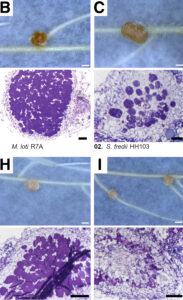
A Promiscuity Locus Confers Lotus burttii Nodulation with Rhizobia from Five Different Genera
Why do some legumes interact only with one or two specialist rhizobia symbionts while others interact with many? Mohammad Zarrabian and colleagues identify a locus in Lotus burtii that determines its ability to interact with many different rhizobia strains. This study provides an opportunity to understand how host range and its restriction is controlled at a molecular level.