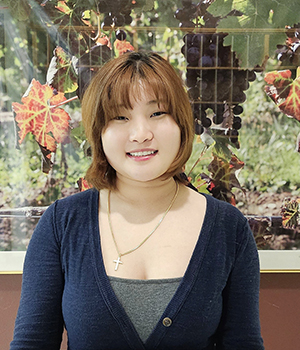
Jiyeong (Jess) Choi is a recent Ph.D. degree graduate from Dr. Marc Fuchs‘ lab at Cornell University, USA. Jess defended her Ph.D. dissertation in August and is currently working as a research assistant in the Fuchs lab.
1. What do you think is the most important or exciting finding from your paper?
This study identified three viral suppressors of RNA silencing (VSRs) encoded by grapevine fanleaf virus (GFLV): proteins 1A and 1B and the fusion protein 1AB, which is an intermediary product of polyprotein proteolytic cleavage processing. One of the most thrilling findings of this study is that the two independent GFLV VSRs (1A and 1B) can function either individually (1A and 1B) or as the fused form (1AB) to reverse systemic RNA silencing and differentially alter host genes associated with antiviral RNA silencing, suggesting that GFLV employs multiple strategies to evade host antiviral defense. This finding assigns a function to protein 1A for the first time and provides the first experimentally validated function for protein 1B. Overall, this study deepened our knowledge of how GFLV counters host antiviral immunity and contributes valuable insights into the molecular biology of this virus.
2. Was there a piece of data that was particularly challenging to obtain or a part of the project that was particularly difficult?
The most challenging aspect of the project was assessing and validating RNA silencing suppression functions of GFLV proteins 1A, 1B, and 1AB. I executed three distinct RNA silencing suppression assays to evaluate their suppression abilities from multiple perspectives and approaches. Designing, developing, optimizing, and conducting these assays were difficult due to the unique RNA silencing suppression characteristics and host gene modulation abilities specific to each protein. By analyzing results both individually and collectively, I validated RNA silencing suppression functions of GFLV proteins 1A, 1B, and 1AB, identifying them as GFLV VSRs.
3. What research project are you most excited about right now?
I’m currently working on elucidating subcellular localization of GFLV VSRs in planta using live-cell imaging techniques via confocal microscopy. Building on the identification of GFLV VSRs (Choi et al., 2023), I have recently identified specific amino acid residues that are critical for systemic RNA silencing suppression functions of GFLV VSRs (Choi et al., 2024). Drawing on these findings, I will explore whether the specific subcellular localization of GFLV VSRs is required for their suppression functions. This study will facilitate identifying potential host interactants of GFLV VSRs at the level of specific organelles, providing further insights into the RNA silencing suppression mechanisms utilized by GFLV VSRs.
4. What drew you to your current lab?
During my undergraduate studies, I completed a 9-week research internship in Dr. Marc Fuchs’ research lab through the Summer Research Scholar Program at Cornell AgriTech. I specifically applied to his plant virology program because I was fascinated by how viruses, primarily composed of proteins and nucleic acids (and sometimes lipids), can overcome the defense mechanisms of complex eukaryotic organisms to cause devastating diseases. I developed a specific interest in studying plant viruses because the impact of plant viral diseases extends beyond the host, affecting both the economy and food security. My summer research focused on elucidating the vein-clearing symptom determinants of GFLV under the mentorship of Dr. Larissa Osterbaan (published in MPMI; Osterbaan et al., 2018). This experience sparked my interest in studying molecular biology of GFLV and deepened my passion for plant molecular virology.
5. What advice would you give to starting graduate students?
When you encounter unexpected data, don’t focus on what you might have done “wrong.” Instead, shift your mindset to what you can do “next” and how you can leverage that unexpected data to build on your research.
6. Who has inspired you scientifically? Why?
I am inspired by Dr. Barbara McClintock for her transformative contributions to genetics, particularly her discovery of transposable elements in maize, which reshaped our understanding of gene regulation. Her innovative thinking inspires me to think outside the box in my research. I admire her resilience and determination in overcoming adversity in a historically male-dominated field, which continues to inspire women in science today. Dr. McClintock’s legacy encourages me to pursue my scientific and career goals with courage and creativity.
7. Have you been involved in other scientific/professional development activities? And how have these contributed to your training?
I served as a secretary for the Bioengineering Applications Committee of The American Phytopathological Society (APS). I co-organized the APS “Exploring Career Paths in Biotechnology” webinar in 2023, which focused on introducing diverse career opportunities in the field of biotechnology to students and postdocs by featuring biotechnologists from academia, government, Extension, and industry. This role allowed me to develop valuable organizational and communication skills, network with diverse experts in the biotechnology and bioengineering fields, and gain insightful perspectives in diverse biotechnology career opportunities.
Additionally, I co-organized a plant pathology workshop, “Somebody Call the Plant Doctor,” for Expanding Your Horizons at Cornell in 2022. This workshop focused on providing hands-on learning experiences for seventh- to nineth-grade students in plant pathology, teaching them how to identify symptoms of plant diseases, use identification sheets and microscopes, and understand how to prevent the spread of pathogens. Through this experience, I was able to practice and improve my public speaking and science communication skills.
8. What is the greatest challenge you have encountered in your career? What did you do to overcome this challenge?
The greatest challenge I faced during my graduate career was a lack of confidence in writing. Initially, I often felt lost, unsure of where to begin, pause, or conclude. Drafting manuscripts made me anxious, but the repetitive process of drafting, editing, and redrafting gradually helped me become more comfortable with my writing. Committing to publish my research and reading a wide range of articles enhanced my understanding of scientific communication and contributed to my growing confidence.
9. How can people find you on social media?
People can find me on X (@jesspatho36), LinkedIn (jess-choi-71b4b5225) ,or ResearchGate (Jiyeong-Choi-3).
10. Is there anything else you would like to share? If so, what is it?
I am very grateful for the opportunity to publish my work in MPMI. I would like to thank Drs. Ved Prakash and Anjali Iyer-Pascuzzi for their invitation to complete this interview and their contributions to MPMI.
11. Bonus question: What’s your favorite pathogen or disease?
Tulip breaking virus! It is the first plant virus I learned about, and it is also my mom’s favorite plant pathogen!