Howard S. Judelson, University of California at Riverside, is a 2018 Fellow of The American Phytopathological Society (APS). This honor recognizes distinguished contributions to plant pathology in one or more of the following areas: original research, teaching, administration, professional and public service, and extension and outreach.
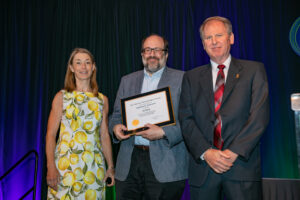
Howard S. Judelson, center, receives the APS Fellow Award at ICPP2018
What area(s) of molecular plant–microbe interactions do you feel your research has impacted most?
When I started my post-doctoral position, molecular research on oomycetes was in a rather primitive state. No one had even cloned or sequenced a single gene! At the time, people were just starting to realize that oomycetes were not true fungi. My work on developing tools for the molecular manipulation of oomycetes helped show that progress could be made on these “difficult” species, which encouraged others to enter the field.
What advice do you have for young scientists aspiring to achieve the level of science that has major impact?
Pick something that you are passionate about, and then stick with it (within reason). While some exciting results come quickly in research, many important findings come through the aggregation of multiple incremental advances in knowledge or methods. Do not be afraid to pick a topic that no one has investigated before. Think and read widely, and attend seminars both inside and outside your discipline, since you might find something that could be applied to your own work.
When you were a post-doc, what had the largest influence on your decision to enter your specific research area in your permanent position? Was this a “hot topic” at the time, or did you choose to go in a different direction?
While my current research deals mostly with Phytophthora infestans, most of my post-doctoral work focused on another oomycete. I was fortunate that my post-doctoral advisor (Richard Michelmore) gave me the freedom to start a side project on P. infestans. This was definitely not a hot topic; barely a handful of laboratories in the entire world were studying any aspect of oomycete molecular biology at the time. As an undergraduate, I was fascinated by the elegant illustrations of oomycete life cycles in the Plant Pathology text written by George Agrios. When I became a post-doc, I saw the opportunity to apply my interest in microbial development to a field with practical impact, such as plant pathology.