Most of us spend the majority of our time in the lab or office, but I know that some members are passionate about moving our newly found technologies into the field to improve crop production and provide food security throughout the world. To this end, I would like to highlight projects associated with IS-MPMI members that demonstrate translations of basic biology into applied products. IS-MPMI member Nicolas Champouret and I are currently serving on the technical advisory board for a USAID project to introduce late blight-resistant potato to Indonesia and Bangladesh using GM technology. Following is a summary of the work that’s being done on this project. I think it’s a great representation of how our science can impact society. If you have projects related to the translation of basic biology to the field and would like to highlight them in Interactions, please let me know.
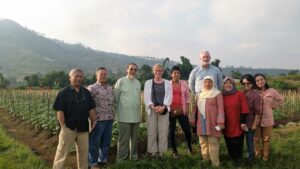
Improving Potato Crops Through Stacked R-Gene Technology
Maybe you like them mashed or baked or perhaps as chips. Whatever your preference, odds are that you are a consumer of potatoes. In fact, more than 1 billion people worldwide eat potatoes. The potato is a fundamental element in food security for millions of people across the globe. Since the early 1960s, the growth in potato production has rapidly overtaken production of all other food crops in developing countries, and potato is now the third most important food crop in the world behind wheat and rice. The potato produces more nutritious food, more quickly, on less land, and in harsher climates than any other major crop. It contains no fat, sodium, or cholesterol. One potato provides nearly half an individual’s daily need of vitamin C and more potassium than a banana.
Threatening the world’s tuber crops is potato’s number-one enemy: late blight disease. Late blight, caused by the water mold Phytophthora infestans, destroys leaves, stems, and tubers. The disease spreads very quickly and can result in total crop loss. The fight against late blight is as old as the potato. Late blight was responsible for the great Irish potato famine of the mid-1800s. In today’s landscape, farmers spray heavy concentrations of fungicides to protect crops against the disease, which increases input and labor costs and poses greater potential risks for the population and environment.
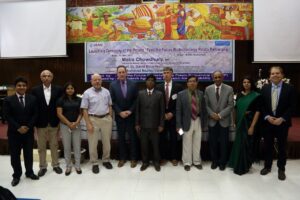
The Feed the Future Biotechnology Potato Partnership is finding effective alternatives for fighting late blight through biotechnology. A 5-year, $5.9-million, multi-institution cooperative agreement involves USAID, Michigan State University (MSU), the University of Minnesota, the University of Idaho, the Bangladesh Agricultural Research Institute, the Indonesian Center for Agricultural Biotechnology Genetic Resources Research and Development, and the J. R. Simplot Company. The mission of this collaboration is to introduce bioengineered potato products in farmer- and consumer-preferred varieties to small-holder farmers in Indonesia and Bangladesh. These biotech potato products will offer broad-spectrum resistance to late blight by using a combination of late blight resistance genes (R genes) found in species of wild potato.
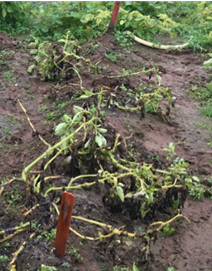
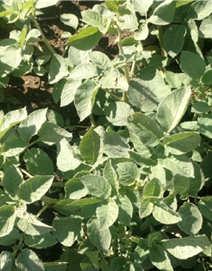
During the first 2 years of the partnership, a proof of concept was completed at MSU through a collaborative research effort with Dr. Marc Ghislain (CIP) in Kenya and his USAID-funded CIP Project. Using the technology developed by Ghislain’s group, MSU developed transgenic potato events containing a stack of three R genes. A confined field trial was conducted at MSU in 2017 with genetically engineered potato events containing three R genes, a single R-gene transgenic event, and nontransgenic control potato plants. The trial was inoculated with Phytophthora infestans using a United States isolate called “US23.” The results showed the superiority of resistance with the stack ed three R-gene transgenic events over the single-gene event and nontransgenic potatoes (Fig. 1).
At the same time, another partner in the project, J. R. Simplot, began testing and evaluating its R-gene technology to select the best combination of R genes. The Simplot stacked three R-gene technology is currently being transferred into the targeted varieties for Bangladesh and Indonesia. The team is purifying the P. infestans isolates found in the project’s target countries and will soon use them for testing. Field trials at MSU and in-country greenhouse testing are expected to begin within 1 year.
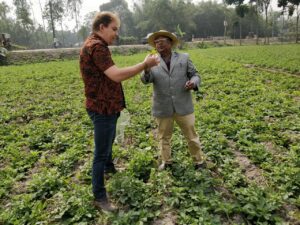
Feed the Future, the U.S. initiative to combat global hunger and poverty, is founded on the belief that global hunger is solvable. By partnering for innovation and creating greater global food security through innovative research in agriculture, Feed the Future is fighting hunger with science and technology. To learn more, visit www.canr.msu.edu/biotechpp or www.feedthefuture.gov.
Figure: Late Blight US23 Confined Field Trial: Michigan State University 2017
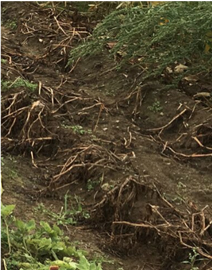
late blight-resistant potato
late blight-resistant potato
Fig. 1. Results of the confined field trial concluded that the three R-gene late blight-resistant potato (C) showed strong resistance to strain US23, whereas the single R-gene events (B) suffered heavy damage and the nontransgenic plants (A) completely succumbed to the disease.