Editor’s note: This is the first article in a new series for IS-MPMI Interactions called InterConnections (because it connects Interactions with the MPMI journal), where we will highlight first authors of “Editor’s Pick” articles from the MPMI journal. The November “Editor’s Pick” is “Mai1 Protein Acts Between Host Recognition of Pathogen Effectors andMitogen-Activated Protein Kinase Signaling”; the first author is Robyn Roberts and the corresponding author is Gregory B. Martin.
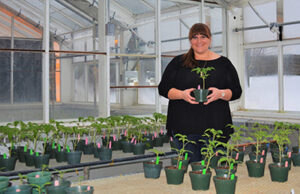
This project is a demonstration of how persistence is key to publication. Like many labs with “historical” projects that get passed down from postgrad to postgrad, this particular project began about a decade ago when Mai1 was discovered in a yeast-two-hybrid screen (by co-author Kerry Pedley). Several postdocs and undergraduates contributed to the project over the decade, but through the years, as people left the lab for other opportunities, this project followed a postdoc chain until it landed on my bench. With good timing between my other projects and the help of experienced undergrads, I was able to contribute some key experiments that supported the role and importance of Mai1 in NLR-triggered immunity (NTI).
I became interested in plant–microbe interactions when I was an undergraduate researcher in Roger Innes’s lab at Indiana University (IU), studying plant immunity in the arabidopsis–powdery mildew system. I was really surprised at how knocking out single genes in plants could have such drastic impacts on immunity. I found a lot of joy in working with plants (and microbes) in research, and after earning my BS degree in biology at IU, my interests in plant pathology led me to the University of Wisconsin–Madison, where I earned my PhD in plant pathology. There, I studied the molecular mechanisms of translation of a wheat virus, Triticum mosaic virus. While I found viruses really fascinating and clever in how they package so much information in their small genomes, I really wanted to move back to the plant side to study plant defense. This led me to a postdoctoral position in Greg Martin’s lab at the Boyce Thompson Institute (BTI) to work on tomato–bacterial interactions with a focus on plant immunity.
I really like postdoc life. Without the pressures of writing a thesis and facing a deadline to graduate, I can be more creative in my research and have more diverse projects. Compared with graduate school, I feel that I have a better handle on time management in the lab and have more experience training undergraduate researchers, so I can accomplish more in less time. I also really enjoy the opportunities to mentor students and work on my own professional development, including my writing and transferrable skills (soft skills). While there is sometimes more pressure to publish as a postdoc than a graduate student, I find that most of this pressure is self-driven and motivated by my desire to share my research with broader scientific audiences.
I participate in a number of extracurricular activities, both professionally and as hobbies. Professionally, I am actively involved in our BTI Postgraduate Society (PGS) and in scientific outreach. My hobbies include volunteering with my dog in Cornell Companions at a local nursing home, hiking around the Finger Lakes and in the Adirondacks, playing saxophone, and crocheting. In graduate school, I was also a part of deBary-tones, an outreach-based, plant pathology-themed band and received funds from the APS Foundation and OPRO to record an album of our music (titled Faster Than the Speed of Blight).