Ashley C. Nelson

Ashley C. Nelson is a second year Ph.D. student in the Plant Pathology Department at North Dakota State University. She is working in Tim Friesen‘s lab, focusing on functional characterization of necrotrophic effectors in the Parastagonospora nodorum–wheat interaction.
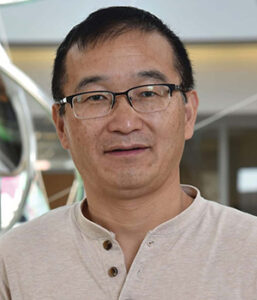
Dr. Bing Yang currently holds a joint position as a principal investigator and member at the Donald Danforth Plant Science Center, as well as being a professor of plant science and technology at the University of Missouri–Columbia. His current research uses bacterial blight of rice as a model to understand the resistant and susceptible interactions between the host and pathogen. Dr. Yang’s group has used the bacterial blight–rice system to master genome-editing technologies for improvement in rice, as well as other crops, including wheat, sorghum, and soybean. Dr. Yang’s work led to the development of the Healthy Crops Project, which creates an opportunity to collaborate with labs worldwide to develop crop resistance in multiple host–pathogen combinations. Dr. Yang’s career work and dedication to science has been rewarded, as he was recently elected as a Fellow of the American Association for the Advancement of Science (AAAS).
Interview
Originally from China, Dr. Yang obtained his bachelor’s and master’s degrees from the Southwest Forestry University, where much of his effort was spent on trees. In 1995, he made his way to the United States as a Ph.D. student in the Department of Plant Pathology at Kansas State University, working with Dr. Frank White. In Dr. White’s lab, his project focused on bacterial blight of rice, and this interest in rice health continued even after obtaining his Ph.D. degree as Dr. Yang remained as a postdoc in the White lab for five more years. Working on rice hit home for Dr. Yang, since rice was a staple food source that is nutritious and essential for the daily diet for not only him and his family, but for much of China. This familiarity and passion continued when Dr. Yang took his first job as an assistant professor at Iowa State University. Wanting to ensure the health and productivity of rice, Dr. Yang continued his work on bacterial blight of rice and subsequently expanded into plant biology using genome editing, first with TALEN and then CRISPR. In 2018, he took a joint position with the Donald Danforth Plant Science Center and University of Missouri–Columbia, where his bacterial blight and genome-editing work continues.
Bacterial blight remains an important disease that is well studied and serves as a model for characterizing interactions to gain fundamental understanding of plant diseases. This understanding aids in the strategy of resistance engineering to make it applicable to other crops by presenting targets to engineer resistance and connect advanced biological techniques to solve real-world problems. Dr. Yang has observed these innovations unfold over his career and has had a direct impact through his Healthy Plants Project, which promotes international collaborations with groups focusing on various host–pathogen systems. Dr. Yang finds motivation in answering scientific questions that lead to new discoveries and technologies resulting in worldwide solutions. He believes that scientific discoveries are not due to individuals, but to collaborative efforts.
Dr. Yang is as excited as he was in the beginning by how science seemingly has no end and has some advice for young scientists navigating their early career. Dr. Yang outlines that identifying the root problem and formulating a scientific question is challenging, but just the beginning of a project. He stresses that answering the scientific question correctly, in a timely manner, and with integrity, while garnering public support are just as important as the question itself. Dr. Yang recommends working toward your passion and finding a way to collaboratively reach goals and find answers to the difficult questions. Dr. Yang also believes finding a mentor is critical, as the support and advocacy will be helpful throughout your career. Last, he encourages preparation, active participation, and networking at conferences to ensure a beneficial experience.