
This InterView with Sophien Kamoun, John Innes Centre, was performed by one of the 2016 IS-MPMI student travel awardees, Jixiang Kong, Gregor Mendel Institute.
John Innes Centre
Gregor Mendel Institute
JIXIANG KONG: What led you to study biology? More specifically plant-pathogen interactions.
SOPHIEN KAMOUN: I grew up with a passion for nature. As a teenager I collected insects and became fascinated by their incredible diversity. Later I took this “hobby” more seriously and I specialized in studying tiger beetles. I even published a few papers on this topic.
After high school in Tunisia, I went to Paris with the firm intention of studying biology and becoming an entomologist. However, I was disappointed by how badly taught zoology was—too much emphasis on taxonomy and little mechanistic thinking. Instead, I became drawn to the more rigorous methods and approaches of molecular biology, and I ended up majoring in genetics. I reconciled this major with my natural history interests by taking multiple modules in evolution and reading a lot on the subject.
Plant pathology came later when I moved from Paris to the University of California-Davis for my Ph.D. The fellowship I received stipulated that I should study plant biology. It wasn’t by choice but rather by accident. But I quickly became engrossed in molecular plant pathology and I really liked that this science involves interactions between multiple organisms. However, for many years I missed a direct connection between the lab work and the field.
JK: If you would not have chosen the topic of plant-pathogen interactions, what would you choose?
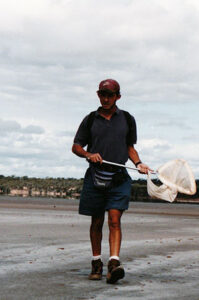
SK: Definitely, entomology. I’m still fascinated by insects, especially beetles. I feel we know so little about their biology, especially from a mechanistic angle. They are so diverse and yet most insect research focuses on a few species, such as Drosophila. There are so many fascinating questions, for example, about the evolution of insect behavior and the underlying genes. Also, insects can be important crop pests and disease vectors. This is a very fertile area of research that I highly recommend to early career scientists.
JK: How do you envision large-scale “omics” approaches in studying plant immunity?
SK: Omics are just another tool. They’re powerful tools but they’re still methods we use to answer questions. I advise everyone to frame their research based on questions and then look for the best methods to answer these questions.
This said, genomics has transformed biology in a fundamental way. It’s a new way of doing business. We now have catalogs of plant and pathogen genes, so the challenge is to link genes to function rather than discovering the genes per se. Another key aspect is that genomics is a great equalizer. Model systems are less important than in earlier days. One can make a lot of progress with a genome and a few functional assays. For example, consider the progress made in discovering effectors in obligate parasites. This would have been almost unthinkable in the pre-genomics age. This is why I wish to see more early career scientists explore the diversity of pathogen systems rather than working on established model systems.
JK: Social media is changing the way of communication rapidly. However, the scientific communication on social media is just emerging. How do you see the direction of social media in the future regarding the impact on science? Will social media replace or minimize some conventional communication such as conferences?
SK: Communication is an essential function of being a scientist. We’re not only in the business of producing new knowledge but it’s also our obligation to communicate knowledge to our peers and the public. These days social media became a major medium for communication in science. It’s an efficient way to filter through the incessant flow of information, stay up to date, and broadly broadcast new knowledge. It also enables us to expand our network way beyond traditional colleagues. I interact on Twitter with teachers, farmers, journalists, etc. I also use it, of course, to communicate with colleagues and share information and insights. I also find Twitter immensely entertaining. Scientists have a lot of humor.
I don’t think social media will replace the need for direct contact and interaction between peers. I think we still would want to break off our daily routine and meet in person with colleagues. However, I wish we could start rethinking the format of scientific conferences. Both the fairly detailed oral presentations and poster sessions could be improved if they were combined with some sort of Internet interaction. Twitter is already transforming how scientists interact at conferences but we could do better.
JK: What advice would you provide to young researchers who are in their early scientific career?
SK: Don’t follow the herd. Take chances. Look beyond the current trends both in terms of experimental systems and questions, and ask provocative questions.