
MPMI proudly presents a special focus issue addressing the #2 top unanswered research question identified by the MPMI scientific community: How do aspects of the abiotic environment affect plant–microbe interactions, and conversely, how do plant–microbe interactions affect host response to abiotic stress? The science presented is crucial to understanding how climate change affects plants on a microbial level and to protecting plant health.
Volume 35, Number 7 / July 2022
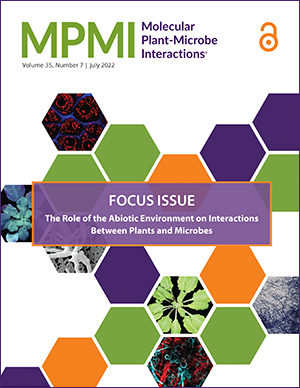
Focus on the Role of the Abiotic Environment on Interactions Between Plants and Microbes
J. M. Harris, J. Bede, and K. Tsuda
Plant–Microbiota Interactions in Abiotic Stress Environments
N. Omae and K. Tsuda
Impact of Future Elevated Carbon Dioxide on C3 Plant Resistance to Biotic Stresses
Q. Bazinet, L. Tang, and J. C. Bede
At the Crossroads of Salinity and Rhizobium–Legume Symbiosis
S. Chakraborty and J. M. Harris
Editor’s Pick: Recognition of Microbe- and Damage-Associated Molecular Patterns by Leucine-Rich Repeat Pattern Recognition Receptor Kinases Confers Salt Tolerance in Plants
E. P.-I. Loo, Y. Tajima, K. Yamada, S. Kido, T. Hirase, H. Ariga, T. Fujiwara, K. Tanaka, T. Taji, I. E. Somssich, J. E. Parker, and Y. Saijo
The Mechanosensitive Ion Channel MSL10 Modulates Susceptibility to Pseudomonas syringae in Arabidopsis thaliana
D. Basu, J. M. Codjoe, K. M. Veley, and E. S. Haswell
Drought Stress Exacerbates Fungal Colonization and Endodermal Invasion and Dampens Defense Responses to Increase Dry Root Rot in Chickpea
V. Irulappan, M. Kandpal, K. Saini, A. Rai, A. Ranjan, S. Sinharoy, and M. Senthil-Kumar
High Salt Levels Reduced Dissimilarities in Root-Associated Microbiomes of Two Barley Genotypes
A. Kherfi-Nacer, Z. Yan, A. Bouherama, L. Schmitz, S. Ouled Amrane, C. Franken, M. Schneijderberg, X. Cheng, S. Amrani, R. Geurts, and T. Bisseling
Salt- and Osmo-Responsive Sensor Histidine Kinases Activate the Bradyrhizobium diazoefficiens General Stress Response to Initiate Functional Symbiosis
J. Wülser, C. Ernst, D. Vetsch, B. Emmenegger, A. Michel, S. Lutz, C. H. Ahrens, J. A. Vorholt, R. Ledermann, and H.-M. Fischer
Temporally Regulated Plant–Nematode Gene Networks Implicate Metabolic Pathways
S. Mishra, O. Salichs, and P. DiGennaro
Special Highlight: Cold Exposure Memory Reduces Pathogen Susceptibility in Arabidopsis Based on a Functional Plastid Peroxidase System
T. Griebel, D. Schütte, A. Ebert, H. H. Nguyen, and M. Baier
As our climate changes, the rapidity of the changes in temperature and carbon dioxide levels and the many planetary processes that they affect, altering weather patterns and soil salinity among others, make it imperative for us to investigate their effect on plant–microbe interactions. In addition to investigating the effects of each of these stresses singly, these changes prompt us to ask questions of increasing complexity. What happens to plant–microbe interactions in the presence of more than one environmental stress? In the natural world, plants associate with more than one microbe at a time—how does abiotic stress affect interactions within the microbial community to affect plant health? And most importantly, how can we translate this increased understanding of the interactions between plants, microbes, and the environment to the field?
— Jeanne Harris, Jacqueline Bede, and Kenichi Tsuda, guest editors
Download and read the articles here.