Borjana Arsova, Root Dynamics group, IBG 2- Plant sciences, Research center Julich, Julich, Germany
Full disclosure: when as plant scientists our group started using microbes as a means to improve plant performance, I thought of them as a “means to an end.” Now I know this is naïve.
The Root Dynamics group in the Plant Sciences Institute in the Research Center in Jülich (IBG-2), Germany, mostly focuses on the plant response to beneficial microbes, and how plants adjust their metabolic pathways under suboptimal (nutrient) conditions, with and without these beneficial organisms. We observe that the nature of the interaction changes depending on the complex environment in which plants and microbes interact. We showed this, for example, in Kuang et al. (2022, Journal of Experimental Botany) and brought it into focus during the work presented here.
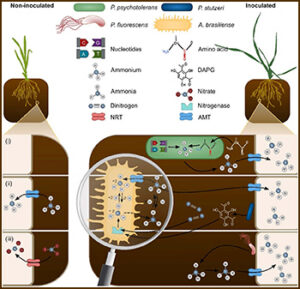
The use of a particular Pseudomonas strain in our lab happened by chance. A colleague sent us a sample, which was supposed to be a Sinorhizobium sp. Their lab had indications of growth promotion, but the project had stopped for various reasons. We also found plant growth-promotion ability, but the phenotype of our plants differed from the preliminary results of our colleagues. The sequencing results showed this to be a Pseudomonas strain. However, the phenotype was interesting, and our Ph.D. student Stefan Sanow was getting promising results in plants grown under low-nitrogen conditions, so he kept working with the new bacterium. This led to the initial question: Are the known molecular mechanisms in plant–bacteria interactions general for all bacteria, or can they be subdivided for specific phylogenetic groups?
Thus, Sanow started compiling evidence about known processes relevant to the Pseudomonadaceae. We found that there are many indications of horizontal gene transfer, which can clearly be linked between different bacterial groups. At the same time there are some differences that seem to be genera specific. The review by Sanow et al. (2023) published in MPMI is the result of this work. We think that this is a novel perspective on this complex genus that could set an example for understanding other genera as well.
The team behind this review comes from three continents—Europe, Australia, and Asia—and, in addition to the research center in Jülich, includes the University of Bonn (Germany), the University of Melbourne (Australia), Australian National University (Australia), and Hunan University of Arts and Science (China).
Learn more about Stefan Sanow in his InterConnections article.