Jawahar Singh, MPMI Assistant Features Editor
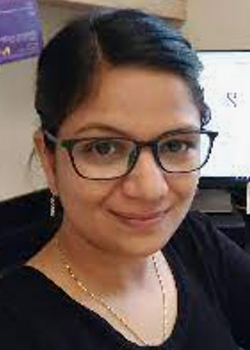
Rikky Rai is an assistant professor in the Department of Botany at the University of Allahabad, India. Her research examines the molecular interactions between plants and phytopathogens to develop sustainable disease management strategies, with a focus on Xanthomonas pathogens. In her recent MPMI paper, “The TALE Effector PthA4 of Xanthomonas citri subsp. citri Indirectly Activates an Expansin Gene CsEXP2 and an Endoglucanase CsEG1 via CsLOB1 to Cause Citrus Canker Symptoms,” written during her postdoctoral research in the laboratory of Prof. Nian Wang, Dr. Rai identified CsLOB1 targets, including CsEXP2 and CsEG1. Using designer TALEs (dTALEs), Drs. Rai and Wang showed that activating these genes alone can induce canker-like symptoms, even without CsLOB1, providing the first evidence that specific downstream genes can independently drive disease symptoms.
1. What do you think is the most important or exciting finding from your paper?
Our most exciting finding is that activation of a specific set of target genes can cause canker-like symptoms without CsLOB1. This opens new directions for understanding symptom development and potentially designing resistance strategies that disrupt these downstream pathways.
2. Was there a piece of data that was particularly challenging to obtain?
Achieving consistent activation of target genes using dTALEs was challenging. Variability in promoter activation, due to factors like suboptimal binding or posttranslational modifications, made functional analyses difficult for some genes. Optimizing this step was critical for success.
3. What research project are you most excited about right now?
I am exploring the diversity of TAL effectors in Xanthomonas pathogens across India’s diverse agroecological zones. This work will help uncover new host-pathogen specificity mechanisms and guide sustainable disease management strategies.
4. What advice would you give to starting graduate students?
Stay curious, think outside the box, and don’t be discouraged by unexpected results—they often lead to the best discoveries. Focus on interpreting your data objectively and never lose hope, even during challenging times.
5. Who has inspired you scientifically? Why?
My Ph.D. supervisor, Dr. Subhadeep Chatterjee, inspired me with his dedication and support during challenging projects. I also was influenced by Prof. Appa Rao Podile‘s engaging teaching style, which first sparked my interest in plant pathology.
6. What is the greatest challenge you have encountered in your career?
Balancing early motherhood with the demands of postdoctoral research, especially during the COVID-19 pandemic, was my biggest challenge. Perseverance, adaptability, and my husband’s support made it possible to continue thriving in science.
7. How can people find you on social media?
People can find me on X and LinkedIn.
8. Is there anything else you would like to share?
I am deeply grateful to my postdoctoral mentors, Drs. Sarah Hind and Nian Wang, for their guidance and flexibility, which allowed me to balance personal and professional responsibilities.
9. Bonus question: What is your favorite pathogen?
Xanthomonas campestris, which is a significant concern in Uttar Pradesh, India.
10. Bonus question: What is your favorite molecular plant pathology paper?
“Repeated Gain and Loss of a Single Gene Modulates the Evolution of Vascular Plant Pathogen Lifestyles” (Science Advances, DOI: 10.1126/sciadv.abc4516). This study elegantly shows how the gain or loss of a single gene can switch Xanthomonas between vascular and nonvascular lifestyles.