September
Pritha Ganguly, Dipan Roy, Troyee Das, Anindya Kundu, Fabienne Cartieaux, Zhumur Ghosh, and Maitrayee DasGupta
The long noncoding RNA ENOD40 is required for cortical cell division during root nodule symbiosis (RNS) of legumes, although it is not essential for actinorhizal RNS. Ganguly et al. set out to understand whether ENOD40 is required for aeschynomenoid nodule formation in Arachis hypogaea. AhENOD40 expresses from chromosomes 5 (AhENOD40-1) and 15 (AhENOD40-2) during symbiosis, and RNA interference by these transcripts drastically affects nodulation, indicating the importance of ENOD40 in A. hypogaea.
Li Guo, Houlin Yu, Bo Wang, Kathryn Vescio, Gregory A. DeIulio, He Yang, Andrew Berg, Lili Zhang, Véronique Edel-Hermann, Christian Steinberg, H. Corby Kistler, and Li-Jun Ma
Two strains of the fungus Fusarium oxysporum (Fo) share a core genome, but one is a beneficial endophyte while the other is a detrimental pathogen causing wilt and death. Guo et al. tried to tease apart why these two strains cause such opposite reactions, and more generally how plants respond differently to useful and harmful microbes, by exploring the interaction of these two strains with the model plant Arabidopsis.
October
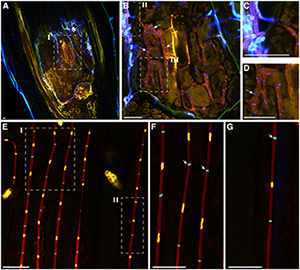
Nazanin Noorifar, Matthew S. Savoian, Arvina Ram, Yonathan Lukito, Berit Hassing, Tobias W. Weikert, Bruno M. Moerschbacher, and Barry Scott
A diverse set of microbes survives and thrives inside plants as endophytes, but we have little mechanistic understanding of these intimate associations. In their study, Noorifar et al. show the way in which an Epichloë endophyte remodels its cell wall, converting chitin to chitosan, to avoid detection by host defenses. Deletion mutants reveal an important role for chitin deacetylases in hyphal growth inside the plant.
November
Kyungyong Seong and Ksenia V. Krasileva
Recent breakthroughs in protein structure modeling demonstrate the ability to predict protein folds without depending on homologous templates. In their study, Seong and Krasileva employed structure prediction methods on the secretome of the destructive fungal pathogen Magnaporthe oryzae. Out of 1,854 secreted proteins, they predicted the folds of 1,295 proteins (70%).