Alicia Camuel
Alicia Camuel is a Ph.D. student at the Plant Health Institute of Montpellier working with Eric Giraud on the Symbiotic Mechanisms in Tropical Legumes team. Her current research is focused
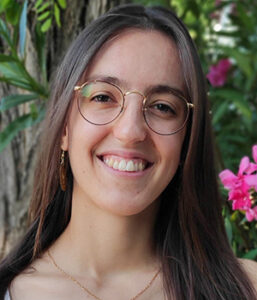
on identifying an alternative symbiotic pathway independent of Nod factors by studying the symbiosis between Aeschynomene spp. and Bradyrhizobium spp. Alicia was the recipient of a Ko Shimamoto Travel Award to attend the 2023 IS-MPMI Congress.
Simona Radutoiu is currently a professor and group leader at the University of Aarhus in Denmark, and her main research area is the identification of the genes involved in nitrogen-fixing symbiosis, with the aim of designing biotechnological tools that will enable us to transfer this ability to nonlegumes.
Conversation with Dr. Radutoiu
Between two sessions at the 2023 IS-MPMI Congress in Providence, RI, and over a lunch break, I had the chance to chat with Simona Radutoiu. Of course, we talked about science—it could not
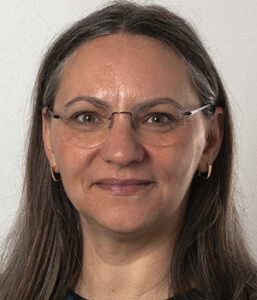
be any other way in such a context. But, we also talked about many other aspects of the life of a woman scientist, career choices, and building a personal life in line with her plans and wishes. In the following article, I recount this informal interview with Simona, which I will remember for a long time. Our conversation began with scientific topics. As I am also working on nitrogen-fixing symbiosis, I wanted Simona’s opinion on questions that were more or less open and that I thought would be useful to discuss later on in my thesis. However, unlike most legumes capable of associating with rhizobia, I am studying an alternative symbiotic model that does not depend on Nod factors but on the bacteria’s type 3 secretion system (T3SS). In a recent paper, Simona and colleagues described the importance of LysM domain receptors that have adapted for nodule organogenesis. I, therefore, asked her about the fact that in my subject of study, the bacteria bypass this signaling mediated by LysM receptors and whether, in her opinion, other key symbiotic players could also be avoided. Our opinion on this question was similar, since it could very well be that other players in the symbiotic pathway are not required. However, it should be noted that “infection by infection threads remains the most efficient…and that CCaMK and CYCLOPS are central players for nodulation.”
Furthermore, the symbiotic model that I use to observe this T3SS-dependent process (Aeschynomene spp./Bradyrhizobium spp.) can only be observed under in vitro conditions. Often genetically associated with the Nod genes, T3SS in nature does not play a role in nodule organogenesis on its own. Nevertheless, a large majority of Bradyrhizobium spp. able to nodulate soybean possess both nod and T3SS genes (1), suggesting that T3SS could play a decisive role in symbiotic efficiency. Indeed, during my Ph.D. study I was able to show that effectors could directly trigger nodulation (2). I asked Simona if there is any real interest in studying this alternative process. According to her, there is: “These two processes [Nod-dependent and T3SS-dependent] should work together” in order to optimize symbiotic efficiency. Indeed, bacteria are known to use T3SS to modulate host specificity, as observed for several legumes (3,4). In this symbiotic model, however, T3SS is not just a host specificity factor, and thus, its role would be broader and complementary with Nod factors in nature. A response like this reinforced my choice of subject for my thesis, which is very fundamental but could ultimately have a broader scope.
I immediately wanted to know what Simona thought about the “dream” of one day transferring the symbiotic capacity of legumes to cereals, which are plants of major agronomic interest. Indeed, as a member of the ENSA (Engineering Nitrogen Symbiosis for Africa) scientific consortium, she is at the heart of this question, which many scientists have been asking themselves for several years. For sure, it represents “a real challenge…coordination between organogenesis and infection is essential but difficult to achieve…and many players have yet to be discovered.” Despite more than 20 years of research, this transfer to cereals remains a real challenge, requiring a great deal of resources and rigor.
Our conversation then moved on to subjects that some might consider ‘lighter,’ but which taught me so much in such a short space of time and which are just as important in a woman’s
scientific career. Having completed her doctorate in Romania, Simona found her calling, so to speak, after her Ph.D. stage at the University of Tennessee in the United States. On her return, she became a mother, but this in no way hindered her career. On the contrary, she says she is “passionate about science,” but still attaches great importance to her family: “I talk a lot with my daughter.” I could see in her eyes how obvious and authentic this was for her, although “managing these two sides of life is a constant learning process.” Being a woman in science has not always been easy, and it still is not, depending on the laboratories and countries in which we work. In France, for example, only around 30% of scientists are women. So, I told Simona about my doubts and misgivings about this aspect, as well as about becoming a mother one day. Although she was happy and fulfilled to be a mother, she advised me “not to let motherhood get in the way, to continue your career and always believe in yourself so that you can keep moving forward.” In a laboratory or elsewhere, it is important to “share your doubts and experiences with other women, with people you trust.” I felt at that moment that this is also what gives us the strength that we do not think we have, but which is always deep within us. Her words touched me deeply, and I invite everyone else to follow her precious advice.
I then asked her about choosing a postdoc position; what would be her career advice in light of her own experience? Should I change my research subject or move to another country? For Simona, it is essential to change subjects and above all to learn new techniques. She invited me to leave my comfort zone and start researching at least one year in advance. Even if changing subjects and leaving your country may seem like a challenge that is not so easy to overcome, you have to “believe in yourself and have confidence in yourself.”
Finally, now living in Denmark, Simona is far from her family and her country of origin. So, I wanted to find out if it had been difficult and how she managed this aspect of her life. For her, it was important for her career to leave Romania, and she was able to find a place where she and her family could blossom and make new friends with the people living there. In the end, she told me that although part of her family is still far away, “having moments to share with them becomes even more precious given the distance.”
Our whole exchange was a real pleasure, both on the scientific side and on the personal side. I hope that my feedback on the time I spent with Simona will also be of interest to young women like me, who are starting out on their scientific careers while trying to make the most of their life choices.
References
1. Teulet, A., Gully, D., Rouy, Z., et al. 2020. Phylogenetic distribution and evolutionary dynamics of nod and T3SS genes in the genus Bradyrhizobium. Microb. Genom. 6(9):mgen000407. DOI: 10.1099/mgen.0.000407
2. Camuel, A., Teulet, A., Carcagno, M., et al. 2023. Widespread Bradyrhizobium distribution of diverse type III effectors that trigger legume nodulation in the absence of Nod factor. ISME J. DOI: 10.1038/s41396-023-01458-1
3. Yang, S., Tang, F., Gao, M., Krishnan, H. B., and Zhu, H. 2010. R gene-controlled host specificity in the legume-rhizobia symbiosis. Proc. Natl. Acad. Sci. U.S.A. 107:18735-18740. DOI: 10.1073/pnas.1011957107
4. Miwa, H., and Okazaki, S. 2017. How effectors promote beneficial interactions. Curr. Opin. Plant Biol. 38:148-154. DOI: 10.1016/j.pbi.2017.05.011