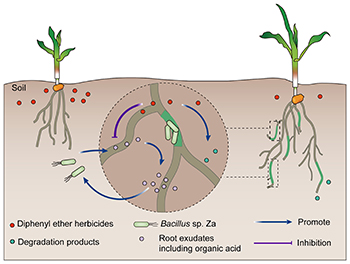
Diphenyl ether herbicides are extensively utilized in agricultural systems, but their residues threaten the health of sensitive rotation crops. Functional microbial strains can degrade diphenyl ether herbicides in the rhizosphere of crops, facilitating the restoration of a healthy agricultural environment. However, the interplay between microorganisms and plants in degradation of diphenyl ether herbicides remains unclear. To explore this, Yanning Tian et al. employed the herbicide-degrading strain Bacillus sp. Za and a sensitive crop (maize)—finding that root exudates enhance Bacillus sp. Za’s degradation of diphenyl ether herbicides through a positive feedback loop with maize. The bacterium increases root exudate secretion, leading to improved rhizosphere colonization, biofilm formation, and herbicide degradation.
Read the commentary by Assistant Feature Editor Siva Sankari.