
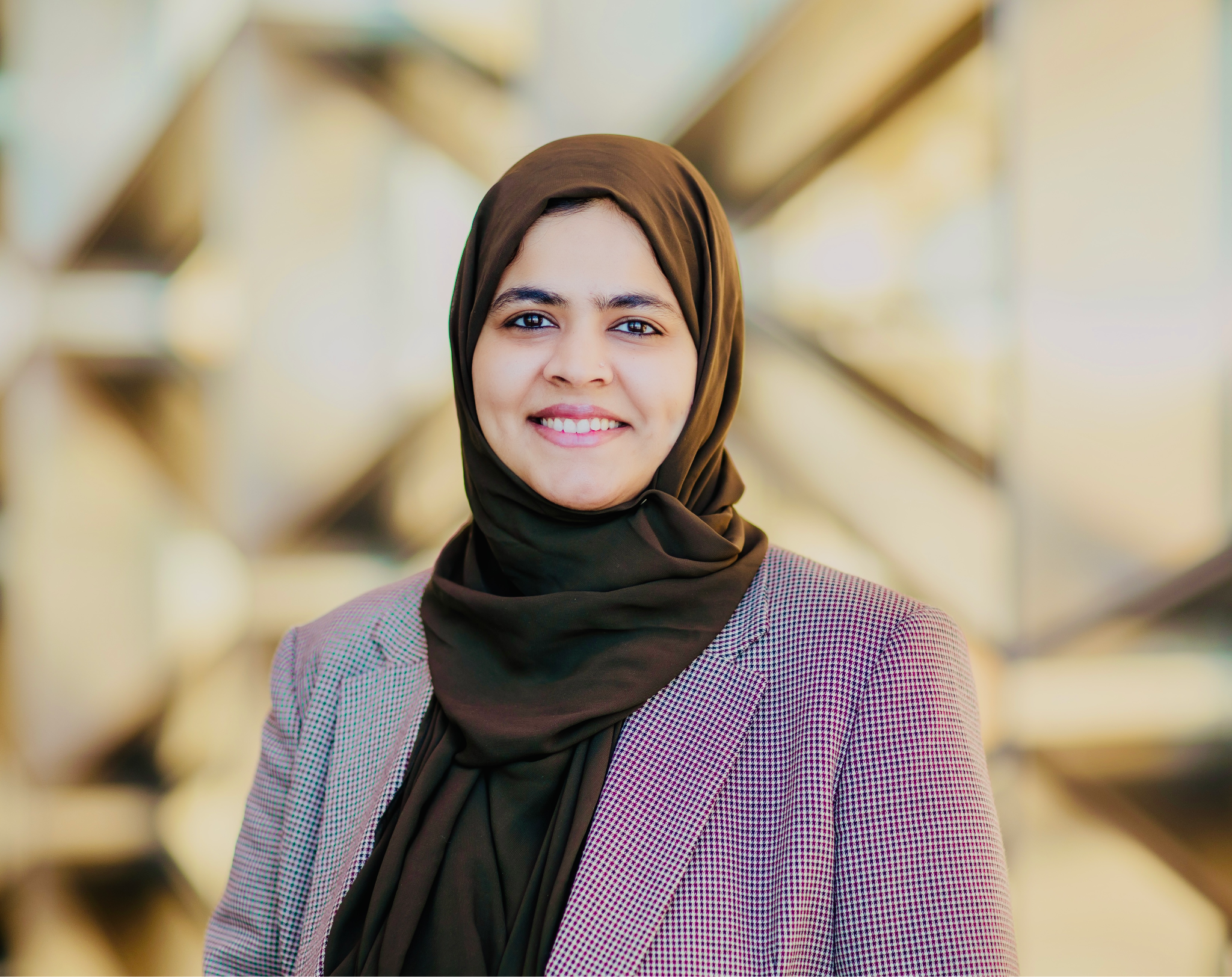
 Urooj Fatima, is a postdoctoral researcher in the Cereal Genetics and Genomics Group at KAUST, Saudi Arabia. Her research focus is to understand the molecular basis of Lectin receptor kinases(LecRKs)-mediated non-host resistance in cereals against rust fungal pathogens. Prior to joining KAUST, she completed her PhD at the National Institute of Plant Genome Research (NIPGR) in India, where she developed a strong foundation in plant molecular biology and plant pathology and protein biochemistry. Her research interests center on plant immunity, particularly the identification of pathogen-derived ligands that are perceived by plant immune receptors to activate plant defense responses. She is especially excited about translating these mechanistic insights into strategies for engineering disease resistance in crop plants.
- What do you think is the most important or exciting finding from your current research?
The most exciting finding from my current research is the discovery of the first molecularly defined ligand–receptor interaction underlying non-host resistance in a cereal crop. We found a conserved clade of fungal glycoside hydrolases (GH5s), enzymes from rust pathogens, that are directly recognised by cell-surface lectin receptor kinases (LecRKs) in barley, triggering immune responses that restrict colonisation by non-adapted rust fungi. Most deployed disease resistance (R) genes in crop breeding are often short-lived due to the rapid evolution of virulent pathogen races. This is particularly exciting because non-host resistance is one of the most durable forms of plant immunity, yet its molecular basis remains poorly understood. What was particularly striking was that LecRKs from different cereal species recognise distinct rust GH5 ligands, and showing this recognition mechanism is conserved and transferable across species. Importantly, we were able to transfer these receptors into wheat and demonstrate enhanced leaf rust resistance under field conditions, opening a promising route towards broad-spectrum, durable rust resistance across cereal crops. - Was there a piece of data that was particularly challenging to obtain or a part of the project that was particularly difficult?
The hardest piece of data to obtain was the quantitative receptor–ligand binding measurement using plant purified proteins for both LecRKs and GH5s. We expressed the LecRKs and, importantly, the fungal GH5 proteins in the plant apoplast so that they retained post-translational modifications. This was important for capturing biologically relevant differences in binding affinity that could be missed with proteins produced in E. coli. Establishing NanoLuc HiBiT–LgBiT binding assay also took considerable optimization. The other challenge was executing the field validation itself, at KAUST’s field site in Saudi Arabia. Rust pathogens require specific environmental conditions to establish and progress through their infection cycle, so we conducted the field experiments during the December-April growing season, when temperatures and humidity are favourable for rust development. Getting both the seasonal timing and sufficiently high and uniform inoculum right was essential for reliably assessing disease severity in the transgenic lines. - What research project are you most excited about right now?
Right now, I’m most excited about engineering pattern recognition receptors (PRRs), including LecRKs, to create broad-spectrum disease resistance in both cereal and non-cereal crops. I’m particularly excited about pushing this beyond proof-of-concept, using our understanding of receptor–ligand recognition to rationally redesign PRRs with minimal sequence changes, within the EU’s emerging regulatory framework for new genomic techniques, and ultimately develop crops with durable disease resistance. - What drew you to your current lab?
I was drawn to my current lab because the project offered a natural continuation of my interest in non-host resistance. During my PhD, I studied non-host resistance against Pseudomonas pathogens in Arabidopsis, including nutrient limitation as a defense strategy, and worked on an independent project investigating non-host resistance in chickpea against Alternaria. The opportunity to investigate the molecular determinants of non-host resistance in cereal crops against rust pathogens therefore felt like a natural next step, while opening a completely new path for my research in understanding how plants recognise and resist a pathogen outside their normal host range.Beyond the scientific fit, I was drawn to KAUST because it provides an exceptional research environment, with the resources and infrastructure to translate fundamental discoveries towards applications in crop improvement. Equally important was the support from my PI, Prof. Simon Krattinger, in pursuing my own ideas, which has given me the freedom to take on ambitious projects and develop as an independent researcher.
- What advice would you give to starting graduate students?
Read, read, and read more. A strong understanding of literature helps you identify important questions and, more importantly, develop your own ideas. Don’t hesitate to share those ideas and discuss them with your colleagues and mentors, even when they are still developing. Finally, choose your lab and PI carefully, the research environment and mentorship you receive early in your career can have a major influence on your scientific trajectory. - Who has inspired you scientifically? Why?
Jonathan Jones has been a major scientific inspiration for me. His 2006 paper with Jeff Dangl on the zig-zag model of plant immunity was one of the first papers I studied when I started my PhD, and it had a strong influence on how I began thinking about plant immunity. What I have always admired is how his work combines fundamental questions about how plants recognise pathogens with a broader vision for improving disease resistance. His ability to bridge fundamental plant biology with translational research has influenced how I think about taking discoveries from the lab towards practical applications. - Are/were you involved in other scientific/professional development activities? And how do/did these contribute to your training?
Yes, alongside my research, I’ve mentored master’s and PhD students, taken part in public engagement activities such as communicating science to children and families during Open Science Day, and stayed active in the BSA Early Career Members network. I’ve also presented my work at international conferences, which has pushed me to communicate my research to audiences ranging from specialists to the general public. Together, these experiences have shaped my training alongside the bench work, strengthening how I communicate, mentor, and build professional networks, while giving me greater confidence in putting my own scientific ideas forward as an independent researcher. - What is the greatest challenge you have encountered in your career? What did you do to overcome this challenge?
One of the greatest challenges in my career was making a complete shift in research system for my postdoc, from studying bacterial non-host resistance and SWEET sugar transporters in Arabidopsis during my PhD to investigating non-host resistance to fungal rust pathogens and LecRKs receptor kinases in an entirely different cereal pathosystem.I approached this by building on the skills I had developed during my PhD while adapting them to a completely different pathogen-host system, learning new approaches to study rust disease, actively seeking advice from colleagues and collaborators, and taking ownership of new research questions. In retrospect, that transition was challenging, but it also pushed me beyond my comfort zone and helped me develop greater scientific independence.
- How can people find you on social media?
You can find me on: LinkedIn: https://www.linkedin.com/in/urooj-fatima-09963475
X (formerly Twitter) @UroojFa57952716 - Is there anything else you would like to share in your Spotlight? If so, what is it?
I would just like to say that I’m very grateful to be part of the MPMI community and to have the opportunity to share my work as an IS-MPMI Rising Star. - What’s your favorite story from an IS-MPMI Society meeting?
One of my favourite memories was at the 2025 IS-MPMI meeting in Cologne, when my PI presented the part of this story. We received really encouraging feedback and some great suggestions that helped us strengthen the story. - What’s your favorite pathogen or disease?
Cereal rusts!! - What’s your favorite molecular plant pathology-related article?
One of my favourite articles is The plant immune system: From discovery to deployment by Jonathan Jones, Brian Staskawicz and Jeff Dangl, published in Cell in 2024. I particularly like it because it brings together three decades of progress in understanding plant immunity.