
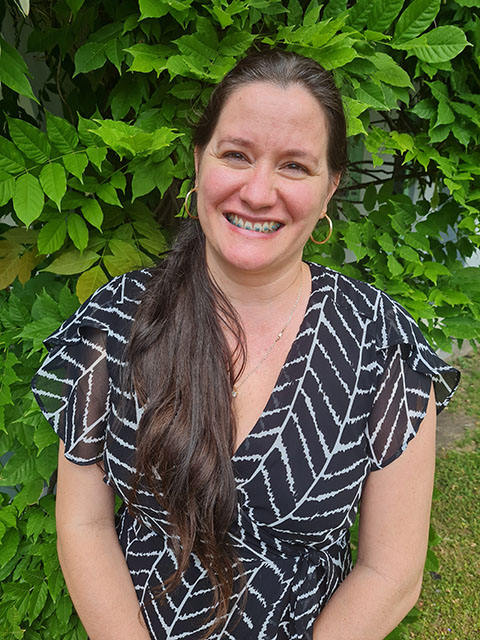
 Dr. Eilyn Mena is a molecular biologist and phytopathologist specializing in agricultural biotechnology and molecular plant-microbe interactions. Her research primarily focuses on the genetic, genomic, and molecular mechanisms involved in fungal pathogenesis and activation of plant defenses. She studies soybean stem canker, a highly destructive disease that limits crop yields globally, at the Department of Molecular Biology of the Instituto de Investigaciones Biológicas Clemente Estable (IIBCE) in Montevideo, Uruguay.
Eilyn Mena obtained her Master’s degree in Biotechnology from the Plant Biotechnology Institute at the Central University of Las Villas (Cuba), where she studied the characterization of antagonistic Bacillus spp. against Mycosphaerella fijiensis, the causal agent of black Sigatoka in plantains and bananas, developing expertise in microbiology applied to biological control and phytopathology. She completed her PhD in Biological Sciences in the Department of Molecular Biology (IIBCE), focusing on soybean stem canker disease and the molecular characterization of the Glycine max–Diaporthe phaseolorum pathosystem. Her research on the soybean stem canker pathosystem combines molecular biology, phytopathology, genomics, transcriptomics, and molecular diagnostics to investigate how Diaporthe species infect soybean and how the plant responds to infection. Her work has contributed to the genomic characterization of D. caulivora, the identification and characterization of Diaporthe species associated with soybean stem canker in Uruguay, the development of multiplex qPCR-based diagnostic approaches, and the study of molecular mechanisms underlying fungal virulence and soybean defense.
Currently, as a postdoctoral researcher at IIBCE, under the mentorship of Dr. Inés Ponce de León, Dr. Mena is investigating shared and species-specific effector genes across several Diaporthe species. By examining their expression during the early stages of infection and developing fungal mutants to investigate their functions, she seeks to understand why closely related pathogens can differ in their ability to manipulate plant immunity and successfully colonize their hosts. During this period, her main contributions included:
- First Nuclear Genome Sequencing of Diaporthe caulivora: She led the first successful nuclear genome resolution of D. caulivora (isolate D57), mapping an estimated genome size of 57.86 Mb and predicting 18,385 protein-coding genes. This work provided a critical reference library for phytopathologists globally.
- Discovery of New Fungal Pathogens in soybean: In 2024, her team successfully identified and documented two entirely new Diaporthe pathogen species affecting soybean crops in Uruguay, establishing a new line of active genomic annotation research.
- Transcriptomic Profiling of Host-Infection: Her work mapped the structural gene expression of D. caulivora during plant invasion, identifying specific pathogenicity determinants such as secreted proteins, oxidoreductases, polyketide synthases, and effectors that breach plant cell walls.
- Advanced Molecular Diagnostics: She co-developed multiplex quantitative PCR (qPCR) diagnostic methods to simultaneously detect and accurately quantify several aggressive species within the complex (D. aspalathi, D. caulivora, D. miriciae, and D. longicolla) directly from plant tissue.
- Mapping Plant Defense Activation: Through comparative studies of contrasting soybean genotypes, her team identified early-stage plant defense triggers, supporting global crop breeding initiatives to build long-term disease resistance.
Studying other Diaporthe species that cause stem canker, along with genome sequencing and comparative genomics, opened new avenues of research into effectors and their functions.
Recently, she identified a bacterium within soybean stems that exhibits antifungal activity against Diaporthe and other pathogenic soybean fungi. This experience enabled her to integrate her prior knowledge, spanning antifungal activity, pathogen virulence mechanisms, and plant defense, with new inquiries into biocontrol-plant-pathogen interactions and the characterization and identification of compounds with antagonistic activity. Throughout her academic career, her work has been recognized with various scientific distinctions, including awards from the Cuban Academy of Sciences and ALAG, as well as fellowships for international CBAB-CABBIO courses and mobility grants to attend international congresses, such as the 2023 travel grant for the IS-MPMI. Her long-term research interests focus on how soybean plants recognize Diaporthe, the role of effectors in their communication, and how these processes determine the host’s degree of susceptibility or resistance and the activation of defense genes.
- What do you currently study? What question(s) are you currently most excited about?
I am currently investigating effectors in Diaporthe species, which are secreted molecules that interfere with host defense responses and facilitate infection. Specifically, I am identifying genes encoding both shared and species-specific effectors across five Diaporthe species that cause soybean stem canker: D. aspalathi, D. caulivora, D. miriciae, D. masirevicii, and D. longicolla. We analyzed the expression of selected effector-encoding genes during the early stages of infection, at 8, 48, and 96 hours post-inoculation (hpi), in soybean plants inoculated with each of these fungal species. We observed that some genes are expressed across all species and at all evaluated time points, whereas others appear to be species-specific. Based on these results, we are currently working to generate Diaporthe mutants for selected effector genes in order to elucidate their functions and gain further insight into the molecular mechanisms underlying pathogenicity.What excites me most is understanding the molecular mechanisms that shape the interaction between fungal pathogenicity and plant defense. I am particularly interested in understanding how closely related pathogens, despite sharing many effector genes, can differ in their ability to manipulate or evade plant immunity and thereby achieve more successful colonization and infection. - Did you always want to be a scientist? What attracted you to plant-microbe interactions?
I have been attracted to science from a very young age. I loved mathematics, physics, and chemistry, and I was always very curious about understanding why things happened around me. Biology became especially fascinating to me once I began to appreciate its complexity, the interactions among different systems and the remarkable way in which cells function as highly coordinated machinery in constant exchange with their environment. During my undergraduate studies, after completing several courses and gaining laboratory experience, I decided that science was the path I wanted to pursue and chose plants as my model system. My passion for plant–pathogen interactions developed during my undergraduate thesis, where I had the opportunity to work within a wonderful and collaborative research team. From that moment, I knew that I wanted to dedicate my career to studying pathosystems and generating knowledge that could ultimately contribute to strengthening plant defense mechanisms and reducing disease incidence. Today, I continue to carry that same curiosity and passion with me, and I also try to transmit it to the students I mentor and teach. - Can you describe your path to graduate school or your current position?
I completed both my undergraduate and Master’s thesis research in the Applied Microbiology and Phytopathology Laboratory at the Plant Biotechnology Institute in Cuba. It was within this research group that I developed as a scientist and became deeply involved in the study of plant–pathogen interactions.Later, after moving to Uruguay, I had the opportunity to join the Department of Molecular Biology under the mentorship of Dr. Inés Ponce de León, where I completed both my PhD and my postdoctoral research. During my doctoral studies, supported by competitive fellowships, my research focused on the Diaporthe–soybean interaction. We investigated and identified: 1) the principal causal agents of soybean stem canker in Uruguay; 2) the virulence mechanisms of D. caulivora, one of the major species associated with the disease; and 3) the molecular mechanisms underlying resistance to D. caulivora in contrasting Glycine max varieties—resistant and susceptible—using transcriptomic approaches.I currently hold a postdoctoral position in the same department, where I continue developing my research line focused on the Diaporthe–soybean interaction. Through this work, we have identified or validated: 4) additional species causing soybean stem canker in Uruguay, including D. miriciae and D. masirevicii; 5) a multiplex qPCR-based diagnostic kit for the detection of Diaporthe species; and 6) shared and species-specific effector genes associated with pathogenicity. We have published several scientific articles based on this work and continue investigating genes encoding effectors and their potential roles in pathogenicity. - What are the best things but also the most challenging things scientifically for you now?
One of the most rewarding aspects of my scientific career is being able to look back and appreciate how far I have come. I value everything I have learned, the people I have worked with, and the colleagues and scientists I have met through courses, collaborations, and conferences. I also greatly value the many experiences I have had in the laboratory, both positive and challenging, because there is always something to learn from each of them. Some of the most meaningful moments in my career include attending scientific conferences, participating in thesis defenses, seeing research articles accepted for publication, obtaining project funding, teaching, and training students in the laboratory. All of these experiences are deeply fulfilling and continue to strengthen my passion for science.My greatest current challenge is reinvigorating my academic career after becoming a mother and caring for a young child. At the same time, this stage has reinforced my determination to establish an independent research line focused on the communication that occurs between plants and pathogens during recognition, colonization, and infection. - What advice would you give to starting graduate students?
My first advice would be not to give up and not to lose the passion that motivated you to begin your graduate studies or choose your research topic. A scientific career requires commitment, resilience, cooperation, and technical ability. Science can be stressful, and the financial rewards are not always high, but finding scientific explanations and solutions to real-world problems can be extremely rewarding. There will be periods when everything progresses smoothly and others when it may feel as though the work will never be completed. Every difficulty encountered along the way represents an opportunity to learn. In many cases, we learn more quickly from our mistakes, and these experiences help us grow both personally and professionally as scientists. It is also very important to listen to researchers with more experience and to exchange ideas openly with mentors and supervisors. In addition, I believe that establishing a roadmap with short-term objectives or achievable goals is extremely helpful. It allows you to organize your work, recognize the progress you are making, and avoid feeling overwhelmed by the entire workload at once.
- Are you involved in other scientific/professional development activities? And how do these contribute to your training?
Yes. I taught Biotechnology at ORT University, and I continue to maintain a connection with the institution through the training of students in laboratory internships and thesis projects. In addition, I participate in science outreach activities in schools aimed at encouraging vocational interest in scientific careers. Sharing my passion for science and for plant–pathogen interactions through these activities is one of my greatest motivations. These experiences have allowed me to develop new skills, learn from different audiences, improve my ability to listen, and adapt the way I communicate and teach scientific concepts.
- Where do you see yourself in 5 and 10 years in terms of your career?
In the future, I see myself leading my own independent research line focused on plant–pathogen interactions. I would also like to continue training students, advising agricultural producers, teaching courses, participating in scientific conferences, and contributing to both fundamental and applied research in plant pathology. My goal is to combine research, education, mentorship, and knowledge transfer in a way that allows my work to contribute both to the scientific community and to agricultural production.
- How can people find you on social media?
I use several social media platforms to connect and exchange ideas with other researchers, primarily LinkedIn (Eilyn Mena) and Twitter/X (@eilyn_mena).These platforms allow me to remain connected with the scientific community, follow developments in my field, share research-related information, and interact with colleagues working in plant pathology, molecular biology, biotechnology, and related areas. - Is there anything else you would like to share in your Spotlight? If so, what is it?
I believe that these scientific studies extend beyond basic science because they also establish an essential foundation for applied research. Molecular studies of plant–pathogen interactions can ultimately have a direct impact on the food we consume, agricultural production, and the national economy. Understanding the mechanisms that determine whether a plant becomes susceptible or resistant to a pathogen can contribute to the development of more effective and sustainable strategies for disease management. For this reason, I believe it is essential for scientists to communicate their knowledge in formats that are more accessible to society and to emphasize the importance of scientific research beyond the laboratory.I would particularly like to inspire future scientists and show them that science is fundamentally collaborative. Scientific progress is rarely the result of one individual; it emerges from teams of people who contribute different experiences, perspectives, and expertise toward a common goal. - Bonus question: What’s your favorite pathogen or disease? Or biological system to work with?
I am especially passionate about fungus–plant interactions and the molecular strategies that each organism uses either to infect or to defend itself. I find it fascinating to study the dynamic relationship between fungal pathogenicity and plant immunity, including the mechanisms pathogens use to colonize their hosts and the defense responses plants activate to recognize and restrict infection. Understanding more about the molecular mechanisms underlying pathogenicity and plant defense is what I intend to dedicate my research to over the coming years.