
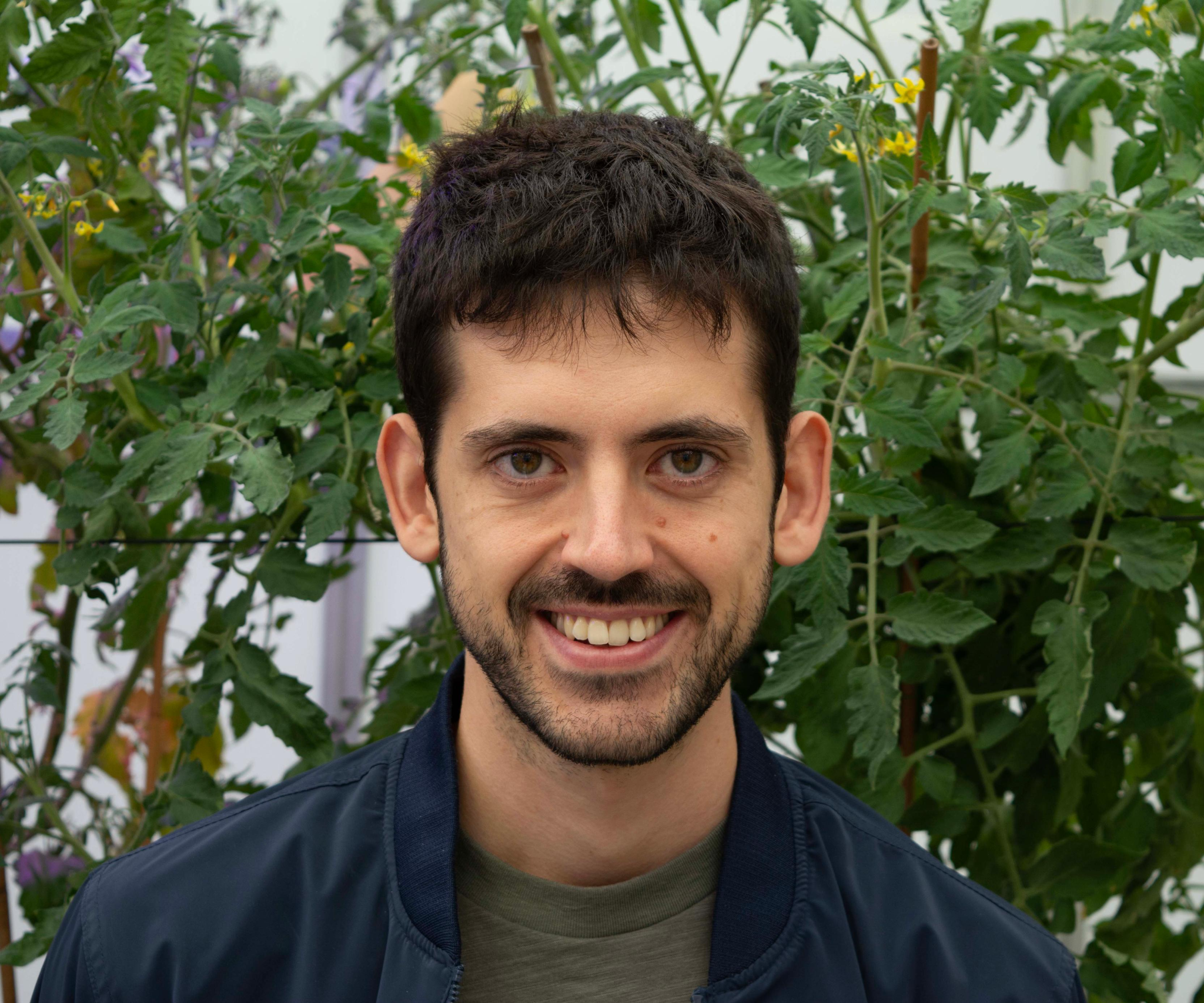
 Adrián González is a Postdoctoral Research Fellow at the University of Nottingham (UK), where he works in Gabriel Castrillo’s lab. His research explores plant-microbiome interactions, with a particular interest in how root-associated microbial communities influence plant development, stress resilience, and health. He completed his PhD at the Centre for Plant Biotechnology and Genomics (CBGP) in Madrid, where he studied beneficial plant-fungus interactions, focusing on how the endophytic fungus Serendipita indica influences plant hormone signalling and development. His current research builds on this background to explore plant interactions with more complex microbial communities.
- What do you think is the most important or exciting finding from your current research?
One of the findings that I found particularly exciting during my PhD was discovering how a beneficial endophytic fungus such as Serendipita indica can profoundly influence plant hormone signalling and, consequently, plant development and responses to environmental stress. What I found particularly interesting was that the interaction was much more dynamic than simply the fungus providing a benefit to the plant. The plant’s physiology and hormonal balance were actively being reshaped through the interaction.I think this is particularly relevant from an agricultural perspective, because understanding how beneficial microbes naturally reshape plant hormone signalling could help us develop more sustainable ways of improving crop growth and resilience to environmental stresses, potentially reducing our reliance on chemical inputs. I have only recently joined the University of Nottingham as a Postdoctoral Researcher, so it is probably too early to point to a major finding from my current work. However, I am working on a question that I think could change the way we understand plant‑microbe interactions, and I am very excited to see where it takes us.
- Was there a piece of data that was particularly challenging to obtain or a part of the project that was particularly difficult?
One of the most challenging parts of my PhD was dealing with a result that initially seemed to contradict our hypothesis. We were interested in understanding why Serendipita indica promotes root growth, and we thought that a straightforward explanation would be an increase in the expression of genes involved in auxin biosynthesis. So, we designed an RNA-seq experiment to test this hypothesis.When we got the data, however, we found almost no evidence for the response we were expecting. Instead, the strongest transcriptional response was related to defense. This was intellectually challenging because the data did not fit the model we had in mind, and we had to reconsider how the fungus might be influencing auxin biology.That result forced us to look at the problem from a different angle. We realised that the fungus was not simply increasing auxin biosynthesis but was affecting local auxin homeostasis through changes in auxin transport and conjugation. That turned what initially seemed like a disappointing result into one of the most interesting parts of the project. It taught me that unexpected data can sometimes be much more valuable than the result you were hoping to find.
- What research project are you most excited about right now?
I am particularly excited about the research I have recently started in Nottingham in Gabriel Castrillo’s lab. After mainly focusing on beneficial plant-fungus interactions during my PhD, I am now interested in understanding plant interactions with more complex microbial communities and how these communities can influence plant growth and responses to the environment. I find this particularly exciting because it allows us to move beyond looking at individual plant-microbe interactions and start thinking about how microbial communities collectively influence the plant. I cannot say too much about the project yet, but I think this broader perspective could open up new ways of understanding how plants interact with their microbiome, and I am very excited about the questions we are starting to address. - What drew you to your current lab?
There were several reasons. Nottingham is a really exciting place for Plant Sciences, with a strong research community and excellent infrastructure, including the Nottingham Arabidopsis Stock Centre (NASC) and the facilities within the School of Biosciences. I was particularly attracted by the breadth of expertise and the interdisciplinary environment, which brings together areas such as genetics, physiology, microbiology and root biology. I also wanted to broaden my perspective on plant-microbe interactions. During my PhD, I mainly focused on beneficial plant-fungus interactions, and I wanted to move towards a broader plant-microbiome perspective. Gabriel’s research was a particularly good fit for that transition. His work approaches plant-microbe interactions from a different perspective, and I saw joining his lab as a great opportunity to broaden my scientific view, gain international research experience, and take the next step in my career. So, for me, it was really the combination of the research environment at Nottingham and the scientific direction of Gabriel’s lab that made it particularly attractive.
- What advice would you give to starting graduate students?
I think having a supportive and inspiring research environment can make a big difference during a PhD. Having a mentor who encourages you to develop your own ideas, challenges you scientifically, and keeps you motivated can be incredibly valuable throughout such a long journey. At the same time, I think you need a good dose of discipline. Motivation comes and goes, but discipline is what keeps you moving forward when things are not working. For me, having good scientific guidance while also developing the discipline to keep going are probably two of the most important things for getting the most out of a PhD.
- Who has inspired you scientifically? Why?
There are several people who have inspired me scientifically at different stages of my career. Stephan Pollmann, my PhD supervisor, has obviously had a very special influence on me. Beyond the scientific training, he gave me the confidence and freedom to develop my own ideas and become more independent as a scientist. I am very grateful for that, and for the way he has supported me throughout my PhD.In plant science, I have also been very inspired by the work of José Alonso and Ana Stepanova at North Carolina State University. Their research on auxin biology and plant development has had a strong influence on the way I think about plant hormone signalling and how I approach scientific questions. - Are/were you involved in other scientific/professional development activities? And how do/did these contribute to your training?
Yes. I have been involved in several activities outside my day-to-day research, particularly through the Plantae Fellows programme (ASPB). As part of the programme, I have helped organise webinars and contributed blog posts aimed at communicating plant science to a broader audience. These activities have helped me develop my communication skills and become more comfortable discussing science with people from different backgrounds. They have also given me the opportunity to interact with researchers at different career stages and become more involved in the wider plant science community. I think this has been a really valuable complement to the technical training I have received through my research.
- What is the greatest challenge you have encountered in your career? What did you do to overcome this challenge?
I think one of the greatest challenges in my career has been learning to become an independent scientist. During my PhD, I gradually moved from working within a defined project to developing my own questions, making decisions when experiments did not work, and learning to trust my own scientific judgement.What helped me overcome this was having a supervisor who gave me the freedom to develop my own ideas, but also learning to take responsibility for my decisions and to be persistent and disciplined when things did not go as planned. I also learned to become more comfortable with uncertainty and with not always knowing the answer. Moving to Nottingham has been another important step in that process, because I am now approaching research from a different perspective and continuing to build on what I learned during my PhD. - How can people find you on social media?
You can find me on X (@adrigov98), Bluesky (@adrigov.bsky.social), and ResearchGate. I mainly use them to share research updates, interesting papers, and connect with people in the plant-microbe community.
- Is there anything else you would like to share in your Spotlight? If so, what is it?
Perhaps I would just say that I am very excited about this new stage of my career. One of the things I enjoy most about research is that the more you learn, the more questions you have. Moving to Nottingham has given me the opportunity to step outside my comfort zone, learn new things, work in an international environment, and look at plant-microbe interactions from a different perspective. I am really enjoying that process, and I am very excited to see where this new direction takes me.