
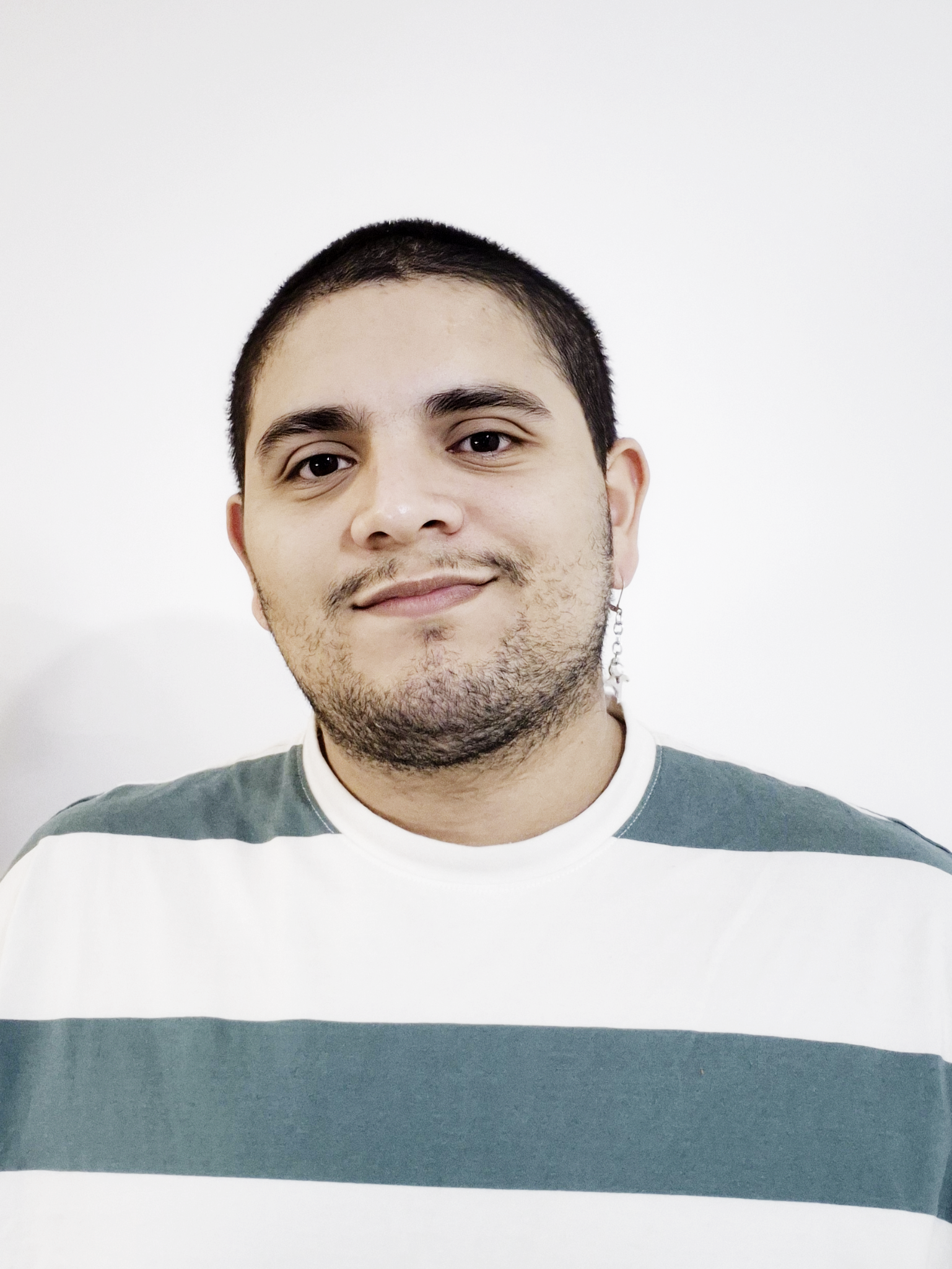
 Federico Emanuel Aballay, MSc is a PhD student/CONICET fellow at Instituto de Fisiología, Biología Molecular y Neurociencias (IFIBYNE), Universidad de Buenos Aires, Argentina where he leads a research line in Dr. Ezequiel Petrillo’s lab. He studied the Molecular Biology program in Universidad Nacional de San Luis (Argentina) and now he’s carrying the line on the physiological role of ppGpp (alarmone), a chloroplast-based hyperphosphorylated nucleotide that might work as retrograde signal, on the regulation of nuclear transcriptome responses during plant-pathogen interaction.
During his PhD, he did an internship training with Dr. Nicolás Cecchini where he started to delve deeper into the plant-pathogen interaction studies. In such collaboration along with Dr. Ben Field from Marseille, France, they all found that high ppGpp levels promote hypersusceptibility to Pseudomonas and the low levels of this molecule promote the resistance against this pathogen. Moreover, they also found that this nucleotide is required for the resistance against Botrytis cinerea.
His scientific career started during his undergrad/master thesis where he reported the antimicrobial activity of three novel bismuth-based compounds. Then, during his PhD he started to work on plant molecular biology. His work has received distinctions from Argentinian Society of Plant Physiology (SAFV) and Society of Biology of Cuyo (SBCuyo). In addition, he was one of the speakers of the Rising Stars of IS-MPMI webinar series. Moreover, he has been granted an UBAINT fellowship sponsored by Universidad de Buenos Aires to work abroad. His research interests focus on chloroplast signaling during plant-pathogen interaction and how this or other organelles can shape the nuclear transcriptome at different regulatory layers.
- What do you think is the most important or exciting finding from your current research?
The most exciting finding from my research was the regulation of photosynthetic efficiency not only by ppGpp during Pseudomonas syringae pv. tomato DC3000 infection but also by pathogen’s T3SS activity. At that moment, I was doing a three-month research stay in Dr. Ben Field’s laboratory in Marseille, thanks to an UBAINT2026 fellowship. He and my supervisor, Dr. Ezequiel Petrillo, suggested me to study the photosynthetic efficiency of ppGpp-altered plants with the Pst ∆hrcC mutant strain. When I analyzed the data, I could not believe it at all. Then, when I repeated the experiments with extra stuff, I found the same data. It was there: the photosystem II activity was being strictly regulated during pathogen infection by ppGpp and such effect was dependent on T3SS activity! - Was there a piece of data that was particularly challenging to obtain or a part of the project that was particularly difficult?
Many things were difficult since Argentina’s government decided to defund science programs and our lab research grants were cut out. Since then, we have received zero pesos (ARS). Working in science has been a huge challenge for us. Aside from that, measuring ppGpp was hard to perform. Since the extraction and sample storage and shipping would be a problem for us because of the required equipment and reagents, it was needed to do in an expert’s lab. That’s where the fellowship application race started! I applied for five fellowships until I finally got one to travel to Dr. Ben Field’s lab. - What research project are you most excited about right now?
Working on the ppGpp biology during plant-pathogen interactions has given me tons of questions. I would love to keep delving deeper into this field as there are many unanswered questions. First one and the one I hopefully answer soon: how is mechanistically ppGpp regulating nuclear gene expression? Is it done by the molecule itself? Is there any intermediate signal? - What drew you to your current lab?
When I was an undergrad student at Universidad Nacional de San Luis (UNSL) and taking the Cell Biology class, I learned about splicing and alternative splicing. That idea kept in my head for years and when I was about to get graduated, I decided to contact my current supervisor. I knew that I wanted to work and do research on splicing in plants. At that moment, we had the hypothesis that ppGpp was acting as a retrograde signal to affect the splicing pattern of some genes. However, it wasn’t regulating the splicing of our genes of interest, so I decided to go further with an RNAseq to check what was happening at the transcriptome-wide level. I found extraordinary things: ppGpp was affecting more than the expected the immunity-related nuclear genes. That’s when I decided to shift the direction of my PhD: ppGpp is clearly affecting immunity, so I have tostart working in plant-pathogen interactions, I said to myself. My supervisor fully supported me in this decision and, then, I visited Dr. Nicolas Cecchini’s lab to learn to work and collaborate with him in the ppGpp-immunity project.
- What advice would you give to starting graduate students?
I do not have one but many advices for starting graduate students is: 1) do not be afraid of switching the topic of your PhD thesis if you feel you are in a dead end; 2) Ask as many questions as you have to your supervisor whenever you feel you don’t know something about a topic, i.e: when someone is presenting a seminar and they say something that quite surprises you; 3) do not be afraid of introducing yourself to someone in a conference and discuss about your research topic. You never know when someone might be doing something related to your topic.
- Who has inspired you scientifically? Why?
There isn’t an individual person who has inspired me, but if I had to choose, I would say my supervisor. I can’t separate the person from the scientist, so I can say he’s got a brilliant mind and he’s an incredible person. Also, he creates a very good and fun working atmosphere. I wish I could know at least 10% about what he knows about alternative splicing! - Are/were you involved in other scientific/professional development activities? And how do/did these contribute to your training?
My institute is part of the organization of the “Biology week” which takes place once a year. There, I get to be part of an awesome group of PhD students in the plant biology area where we present part of our work and the importance of research in plant biology to secondary school and university undergraduate students. Personally, I think this annual milestone gives me the confidence to re-affirm what I’m doing as an early career scientist. - What is the greatest challenge you have encountered in your career? What did you do to overcome this challenge?
As I mentioned before, science funding is one of the major challenges in Argentina. This is why we have to precisely think before doing an expensive experiment, i.e: we decide to specifically find a phenotype, and be sure about the results, before performing RNA extraction and RT-qPCR at certain time points/stages. However, I think this is why we can keep doing good quality science with low resources. In order to overcome such funding challenges, we try to collaborate among different people and think “Ok, we have these reagents that people can borrow and we can also offer people some specific techniques and protocols in order to save money”. - How can people find you on social media?
Twitter/X: @fedeaballay
Bluesky: @fedeballay.bsky.social - What’s your favorite pathogen or disease?
I think I can say Pseudomonas syringae is my favorite pathogen because it’s the first one I met. In a couple of years, I might change my mind!
- What’s your favorite molecular plant pathology-related article?
I have been going through a lot of plant-pathology papers since I got into MPMI field. Right now, I am in love with the preprint from Secco et al. (2026) where they report that the RNA from Turnip mosaic virus can be methylated using the plant cell m6A writer which leads to an enhanced viral infection. Turnip mosaic virus co-opts host RNA methylation machinery to orchestrate plant infection